



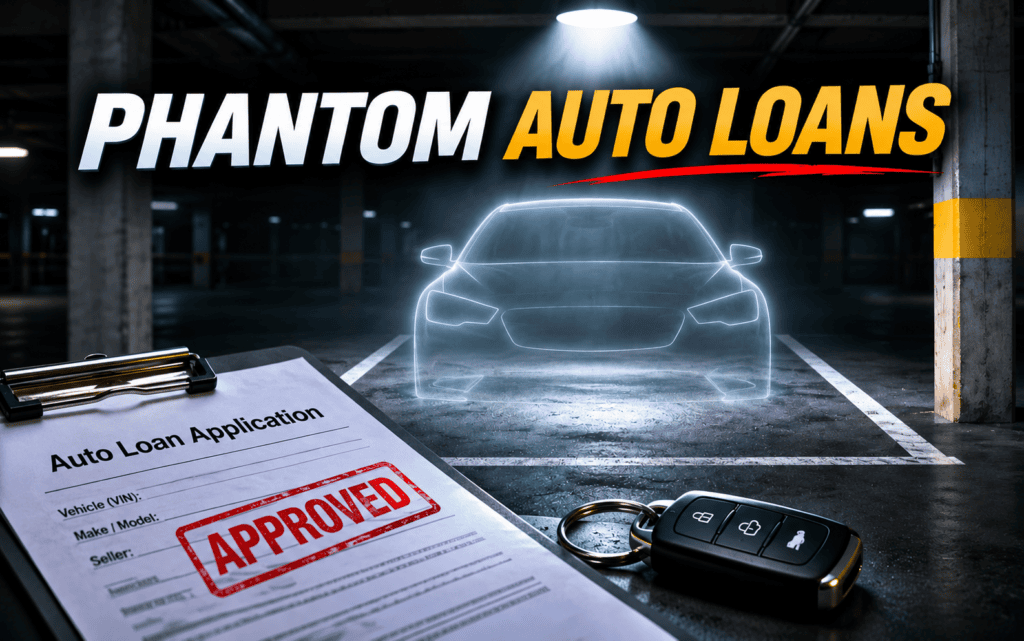
Federal prosecutors say a Georgia man used fictitious vehicle information, false income claims and fraudulent documents to obtain nearly $450,000 in loans from banks and credit unions.
–
November 6, 2026 — What happens when a lender finances a vehicle that doesn’t exist?
For banks and credit unions victimized by a Georgia man’s elaborate lending fraud, that question became a costly reality after he obtained nearly $450,000 in fraudulent loans using fictitious vehicle information and falsified financial documents.
According to a November 5 announcement from the U.S. Department of Justice, Hugh A. Brown Jr., 35, of Fayetteville, Georgia, was sentenced to 33 months in federal prison for a series of fraud schemes involving financial institutions and federal pandemic-relief programs.

The case highlights a particularly troubling form of auto finance fraud: phantom collateral, in which a lender extends credit against a vehicle that does not exist as represented in the loan documents.
–
Nearly $450,000 in Fraudulent Vehicle Loans
Federal prosecutors said that between February 2022 and February 2025, Brown obtained nearly $450,000 in fraudulent loans from banks and credit unions.
His methods included submitting fraudulent documents, misrepresenting his employment and income, and providing fictitious vehicle information as collateral.
The Justice Department did not identify the financial institutions involved, disclose how many individual loans were obtained or explain precisely how the fictitious vehicle information escaped detection.
It also did not establish whether every vehicle was entirely nonexistent or whether some of the collateral information involved fabricated or misrepresented vehicle identities.
Regardless, the loans exposed financial institutions to collateral that could not be relied upon as represented.
–
A Much Larger Fraud Operation
The vehicle loan scheme was only one component of Brown’s activities.
According to prosecutors, he also obtained a $162,500 Paycheck Protection Program loan in 2020 using false payroll information and fraudulent IRS documents.
In 2022, he submitted fraudulent Employee Retention Credit claims on behalf of his company, resulting in seven U.S. Treasury checks totaling $644,452.98 in credits and related payments.
Altogether, federal authorities attributed approximately $1.25 million in fraudulent loans and pandemic-related funds to Brown’s activities.
Brown pleaded guilty on June 3, 2026, to conspiracy to commit bank fraud and bank fraud.
On November 5, U.S. District Judge Victoria M. Calvert sentenced him to two years and nine months in federal prison, followed by five years of supervised release.
He was also ordered to pay $1,244,243.81 in restitution to the Small Business Administration, Internal Revenue Service and affected financial institutions.
That restitution amount covers the broader fraud case, not solely the vehicle loans.
–
When Phantom Loans Reach Collections
For credit union collections departments, phantom auto loans present a particularly difficult problem.
When an ordinary auto loan defaults, the lender generally has an identifiable vehicle that may be located, repossessed and liquidated to reduce the outstanding debt.
But when the collateral information is fictitious, that recovery process can break down before it begins.
A repossession assignment involving nonexistent or falsely identified collateral can send recovery agents searching for vehicles that cannot be located because the information supplied at origination was fraudulent.
The result can be wasted investigative time, unnecessary recovery expenses and a loan balance with little or no recoverable collateral.
There is no indication in the Justice Department’s announcement that Brown’s loans resulted in repossession assignments or that recovery agencies were involved. Nevertheless, the case illustrates why collateral verification must begin before a loan is funded rather than after it becomes delinquent.
–
The Warning for Lenders
Vehicle identification numbers, title records, ownership information and supporting documentation are essential safeguards against this type of fraud.
But documentation alone is not enough when the information being submitted is fabricated.
Lenders must also consider whether vehicle descriptions, ownership records, valuations and other collateral information can be independently verified.
The Justice Department has not disclosed which verification procedures failed in Brown’s case.
For credit unions, the lesson is that even a loan appearing to be secured by a vehicle can become effectively unsecured when the collateral information proves fraudulent.
And once the money has been disbursed, discovering that the vehicle never existed as represented may leave collections departments with little more than a debt, a fraud investigation and an impossible recovery assignment.
A phantom auto loan can look perfectly legitimate on paper. The problem begins when someone tries to find the car.
Phantom Auto Loans: Georgia Man Sentenced for $450,000 Fraud Scheme – Phantom Auto Loans: Georgia Man Sentenced for $450,000 Fraud Scheme – Phantom Auto Loans: Georgia Man Sentenced for $450,000 Fraud Scheme
Phantom Auto Loans: Georgia Man Sentenced for $450,000 Fraud Scheme – Police – Police – Arrest – Arrest – Credit Union Collections – Credit Union Collectors – Lending – Fraud – Fraud – Auto Loan – Department of Justice





More Stories
Credit Union Auto Loan Growth Masks Stubborn Delinquencies
Credit Union Hardship Modifications Surge 23% as Navy Federal Accounts for Much of the Increase
STUPID STUFF FRAUDSTERS BUY: The $18 Million Shopping Addiction
NCUA Plans $4.3 Million AI Push to Detect Fraud
Credit Repair’s Strange Business: Disparaging Lenders, Monetizing Borrowers
Fake Loans and Dead Members’ Accounts: NCUA Bans Two Former Credit Union Employees