



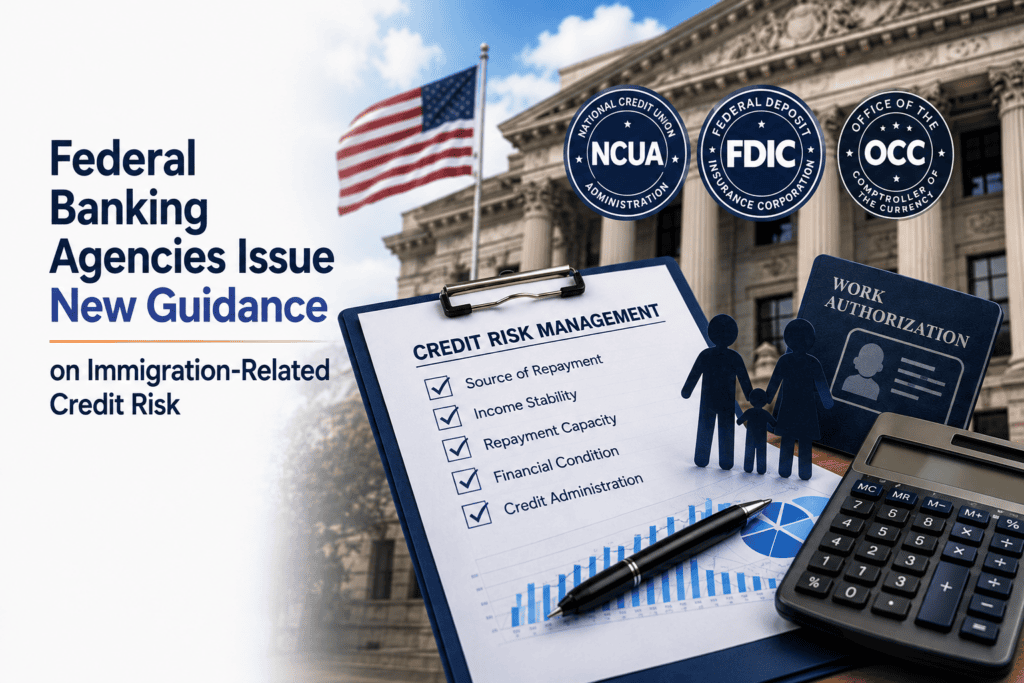
NCUA, FDIC and OCC remind financial institutions to incorporate employment uncertainty into credit risk management
–
Federal financial regulators have issued new interagency guidance reminding banks and credit unions that existing safety and soundness principles already require institutions to consider how employment authorization uncertainty may affect a borrower’s ability to repay.
The guidance, jointly released by the National Credit Union Administration (NCUA), Federal Deposit Insurance Corporation (FDIC) and Office of the Comptroller of the Currency (OCC), does not establish new lending requirements. Instead, it reinforces that financial institutions should continue evaluating repayment capacity, income stability and overall credit risk throughout the life of a loan using existing supervisory standards.
The agencies also directed institutions to consider the Consumer Financial Protection Bureau’s June 2026 Statement on Ability To Repay and Immigration Status, which discusses creditor obligations under the Truth in Lending Act (Regulation Z) and the Equal Credit Opportunity Act (Regulation B).

The complete interagency guidance is available from the OCC:
https://www.occ.gov/news-issuances/bulletins/2026/bulletin-2026-31.html
The joint agency announcement can be found on the NCUA website:
https://ncua.gov/newsroom/press-release/2026/agencies-issue-guidance-lending-individuals-not-legally-authorized-work-united-states
–
Existing Expectations, Not New Rules
The agencies emphasize that this guidance serves as a supervisory reminder rather than a change in federal lending policy.
Financial institutions are expected to continue applying prudent underwriting and portfolio management practices by evaluating:
- Source of repayment
- Stability and sustainability of income
- Repayment capacity
- Overall financial condition
- Credit administration throughout the life of the loan
The regulators note that uncertainties surrounding employment authorization may affect repayment capacity and should therefore be incorporated into existing credit risk management processes.
–
More Than an Underwriting Issue
Importantly, the agencies make clear that these considerations extend well beyond loan origination.
The guidance states that institutions should incorporate these risks into their:
- Underwriting practices
- Account management
- Credit classification
- CECL allowance analysis
- Compliance programs
For collections departments, that means monitoring may become increasingly important after a loan is booked.
Unexpected employment disruptions can quickly affect a borrower’s repayment ability, making early borrower outreach and loss mitigation efforts more valuable.
–
CECL Considerations
The inclusion of allowance analysis is particularly noteworthy for credit unions operating under the Current Expected Credit Loss (CECL) accounting standard.
Rather than focusing on immigration status itself, institutions may need to consider whether localized employment disruptions or changing repayment trends should influence expected credit loss assumptions for certain portfolio segments.
As with other qualitative CECL factors, institutions will need to document any methodology adjustments consistent with their existing risk management framework.
–
Consumer Protection Requirements Remain
The agencies also emphasized that lenders must continue complying with applicable consumer protection laws.
Credit decisions should continue to reflect safe and sound lending practices while remaining consistent with the requirements of the Equal Credit Opportunity Act and Truth in Lending Act.
–
Looking Ahead
While the guidance creates no new legal obligations, it offers insight into where federal examiners may focus during future examinations.
For credit unions, the message is straightforward: repayment capacity should continue to be evaluated as borrower circumstances evolve, not just when the loan is originated.
As economic conditions remain uncertain, collections departments may find themselves playing an increasingly important role in identifying emerging repayment risks before accounts progress to default.
Federal Banking Agencies Issue New Guidance on Immigration-Related Credit Risk – Federal Banking Agencies Issue New Guidance on Immigration-Related Credit Risk – Federal Banking Agencies Issue New Guidance on Immigration-Related Credit Risk
Federal Banking Agencies Issue New Guidance on Immigration-Related Credit Risk – Credit Union Collections – Credit Union Collectors – Lending – Fraud – Auto Loan – Skip – Skip – Auto Loan – Repossession – Repossess – Repossession






More Stories
The $694 Million Paradox: When Does a Risky Loan Become Too Risky to Make?
He Bought Their Identities. Then He Bought the Cars
Catch Me If You Can: Inside the Gingerbread Man Auto-Fraud Enterprise
Case Study: Out of the Inbox, Into the System
Same FICO, Different Risk: Geography Emerges in Auto Loan Delinquencies
All Loan and No Cattle