

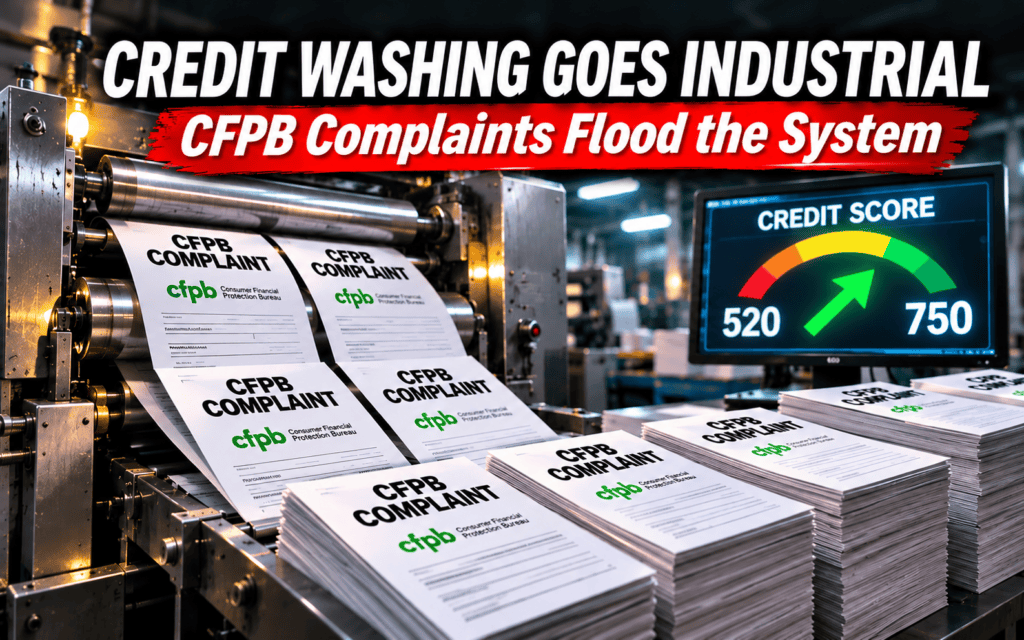
New analysis finds 1.7 million duplicate consumer complaints as credit repair operators exploit a system designed to protect borrowers from inaccurate credit reporting.
–
November 12, 2026 — What happens when a consumer protection system designed to correct inaccurate credit reports becomes a tool for making legitimate debts disappear? According to new fraud research, that question is no longer hypothetical.
Millions of complaints submitted to the Consumer Financial Protection Bureau (CFPB) contain identical or nearly identical language, raising concerns that credit repair operators are increasingly exploiting the federal complaint process to manipulate credit histories and improve borrowers’ apparent creditworthiness.
An analysis by fraud researcher Frank McKenna, co-founder of Point Predictive, examined more than 17.1 million CFPB complaints submitted between March 2015 and July 2026. Of approximately 3.8 million complaints containing published consumer narratives, 1.7 million were exact duplicates of at least one other complaint.

The findings suggest that credit washing, once largely associated with individual consumers disputing unfavorable credit information, has evolved into a high-volume operation fueled by social media, inexpensive dispute templates, and increasingly sophisticated automation.
For credit unions and other lenders, the consequences can extend well beyond the complaint process. When legitimate derogatory information is improperly removed from a credit report, lenders may approve borrowers or offer interest rates based on credit histories that no longer accurately reflect their repayment risk.
–
Nearly 60% of Complaints Used Identical Language
McKenna’s analysis revealed a dramatic increase in duplicate complaint narratives over the past decade. In 2015, just 3.2% of published CFPB complaint narratives matched another complaint word for word. By 2025, that figure had climbed to 59.3%.
The number of duplicate complaints increased from approximately 1,732 in 2015 to more than 724,000 in 2025.
Even more revealing was the concentration of complaints around a relatively small collection of standardized narratives.
Just 204 templates appeared at least 1,000 times each, collectively accounting for approximately 887,000 complaints, or nearly one-quarter of all published complaint narratives examined.
One particularly popular template, referencing federal credit reporting law, appeared more than 93,000 times. More than 30,000 copies even contained the same grammatical error.
The templates were reportedly promoted through social media platforms, including TikTok, and sold through online marketplaces for as little as $5 to $15.
While using standardized language does not necessarily make a complaint fraudulent, the extraordinary volume of identical submissions raises questions about whether some consumers are filing legitimate disputes or simply following instructions intended to remove unfavorable information regardless of its accuracy.
–
The Most Troubling Finding: It Appears to Work
Perhaps the most consequential finding involves how frequently complaints resulted in reported relief. According to McKenna’s analysis, 45.8% of complaints using duplicate templates were closed with non-monetary relief, compared with 20.6% of complaints overall.
That is more than twice the overall rate.
Non-monetary relief can include corrections to credit information, account updates, or other actions taken in response to a complaint. It does not necessarily mean a legitimate debt was deleted.
Nevertheless, the disparity raises an uncomfortable question: Are standardized complaints more successful because they identify legitimate reporting errors, or because their wording and volume are exploiting weaknesses in the dispute resolution process?
The research establishes a correlation, not proof that the templates caused the favorable outcomes. It also does not establish how many complaints were fraudulent.
For lenders, however, the possibility that accurate derogatory information could be removed through repeated or misleading disputes is a significant underwriting concern.
–
Credit Washing Can Make Risky Borrowers Look Prime
Credit washing generally involves disputing legitimate negative credit information in an effort to have it removed, suppressed, or blocked from a consumer’s credit report.
Unlike identity theft, the borrower is real. Unlike synthetic identity fraud, the credit history belongs to the person applying for the loan. The manipulation involves the accuracy or completeness of the information lenders receive.
A borrower with a history of late payments, charge-offs, or collections may suddenly appear substantially more creditworthy after unfavorable tradelines disappear.
That can translate into loan approvals, larger credit limits, or more favorable interest rates that would not otherwise have been offered.
Point Predictive’s 2026 Auto Lending Fraud Trends Report identified a five-fold increase in its credit washing alert rate between 2019 and 2024.
The company’s alert rate reached 1.7% of auto loan applications in 2024 before declining slightly to 1.54% in 2025, remaining nearly five times higher than pre-2022 levels.
These are indicators of potentially suspicious credit changes, not confirmed instances of fraud.
Point Predictive’s Q3 2026 Fraud Risk Intelligence report further examines the expanding role of automation and artificial intelligence in financial fraud.
The concern is that increasingly sophisticated tools may allow credit repair operators to generate large numbers of disputes with relatively little effort.
–
The CFPB Acknowledges the Problem
The CFPB itself has acknowledged that its complaint system has been vulnerable to abuse.
In a June 24 announcement, the Bureau reported that credit and consumer reporting complaints had increased from more than 150,000 in 2019 to over five million in 2025.
The agency identified several contributing factors, including credit repair organizations misusing the complaint process, social media influencers encouraging questionable disputes, and new technologies capable of generating complaints automatically.
The CFPB also reported that the three nationwide credit reporting agencies closed approximately 2.1 million complaints with non-monetary relief in 2025, up from 1.3 million in 2024.
However, the Bureau acknowledged inconsistencies in how companies classified those outcomes, making it difficult to determine precisely what relief consumers received.
In August, the CFPB took another significant step.
The agency announced it would stop publishing unverified consumer complaint narratives and associated visualizations, arguing that the material could mislead consumers and unfairly damage companies’ reputations.
The Bureau continues to collect and process consumer complaints, but the decision marked a substantial change in how complaint information is made publicly available.
–
Legitimate Consumer Protection or Manufactured Creditworthiness?
There is an important distinction between legitimate credit repair and credit washing.
Consumers have the right under the Fair Credit Reporting Act to challenge inaccurate, incomplete, or unverifiable information appearing on their credit reports.
Those protections are essential, particularly for victims of identity theft and consumers harmed by reporting errors.
Using a standard complaint template is not inherently improper, and legitimate disputes can result in the removal of inaccurate information.
The problem arises when consumers or credit repair businesses knowingly challenge accurate debts, falsely claim identity theft, or submit misleading information to obtain credit reporting changes they are not entitled to receive.
For lenders, the distinction can be difficult to identify during underwriting.
A credit report may appear clean without revealing that significant derogatory information was recently disputed or removed.
That creates an opportunity for borrowers to obtain financing based on a credit profile that may not accurately represent their financial history.
It also raises a question about whether lenders are relying too heavily on credit scores without examining sudden changes in the underlying credit file.
–
Who Ultimately Pays for Credit Washing?
When credit washing results in loans being approved for borrowers whose actual repayment histories would have raised concerns, the financial consequences may not become apparent until months later.
For credit unions, those consequences can include unexpected delinquencies, increased collection expenses, higher charge-offs, and potentially greater loan-loss provisions.
For borrowers, fraudulent credit repair can create its own problems. Removing unfavorable information from a credit report does not eliminate a legally enforceable debt, and obtaining additional financing without addressing underlying financial difficulties can make an already precarious situation worse.
Meanwhile, legitimate borrowers with inaccurate credit reports may face additional scrutiny as lenders and regulators attempt to distinguish genuine disputes from manufactured ones.
The CFPB’s challenge is therefore twofold: preserving meaningful protections for consumers while preventing those protections from becoming a mechanism for manipulating creditworthiness.
–
Has Credit Repair Become a Business of Hiding Risk?
The findings present a troubling contradiction.
The federal complaint system was created to help consumers challenge unfair or inaccurate financial reporting. Yet the same protections may now be exploited by businesses whose customers want unfavorable but accurate information removed.
The scale of duplicate complaints does not prove that millions of consumers committed fraud. It does, however, demonstrate how standardized and automated the dispute process has become.
For credit unions and lenders, the more important question may be what happens after the complaints are resolved.
If borrowers can substantially improve their apparent creditworthiness without improving their actual financial condition, traditional underwriting models may be evaluating something very different from the risk lenders believe they are measuring.
And when those loans eventually become delinquent, the costs are borne not by the credit repair operators who promoted the disputes, but by the lenders, their members, and ultimately the financial system those consumer protections were intended to safeguard.
Credit Washing Goes Industrial as Identical CFPB Complaints Flood the System – Credit Washing Goes Industrial as Identical CFPB Complaints Flood the System – Credit Washing Goes Industrial as Identical CFPB Complaints Flood the System
Credit Washing Goes Industrial as Identical CFPB Complaints Flood the System – Credit Union Collections – Credit Union Collectors – Lending – Fraud – Fraud – Auto Loan – Straw Buyer – Paystubs – Point Predictive – Consumer Financial Protection Bureau – CFPB





More Stories
Phantom Auto Loans: Georgia Man Sentenced for $450,000 Fraud Scheme
Credit Union Auto Loan Growth Masks Stubborn Delinquencies
Credit Union Hardship Modifications Surge 23% as Navy Federal Accounts for Much of the Increase
Gunman Kills One in Rampage over $2,556 Citibank Credit Card Debt
STUPID STUFF FRAUDSTERS BUY: The $18 Million Shopping Addiction
NCUA Plans $4.3 Million AI Push to Detect Fraud