

Behind a Missouri Church Fraud Scheme Were Betrayed Parishioners, Credit Repair Businesses and Hundreds of Thousands in Bogus Car Loans
–
A visiting pastor who told parishioners he could help fix their credit has been convicted in a sprawling federal fraud case involving stolen identities, pandemic relief money, luxury purchases and hundreds of thousands of dollars in fraudulent auto loans.
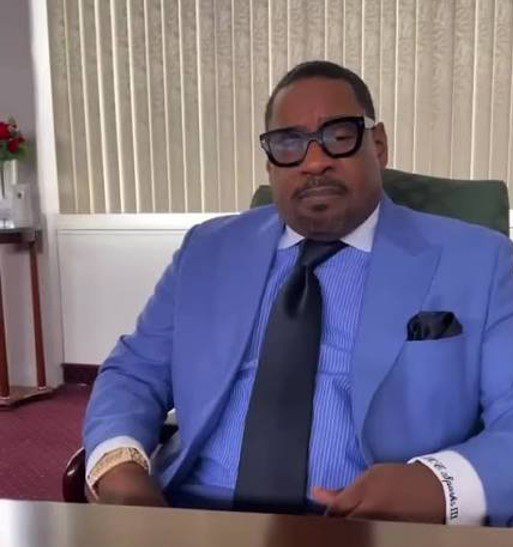
But the deeper you look into the people surrounding Kenneth C. Sparks III, known to members of Faith Walk Ministry as “Apostle K.C. Sparks”, the more interesting the credit connection becomes.
One of Sparks’ co-conspirators operated a credit-repair company and, according to federal prosecutors, taught Sparks how to submit fraudulent loan applications.
Another publicly promoted credit-repair services and later joined Sparks in an approximately $460,000 fraudulent auto-loan scheme.
Meanwhile, Sparks was obtaining parishioners personal financial information by telling some of them that he and others could fix their credit scores.
It makes for an almost irresistible description:
–
The Credit Repair Ministry
Faith Walk Ministry was not a megachurch.
It was a small, tightly knit congregation in Paris, Missouri, a rural community of roughly 1,100 people. Members described an environment in which religious authority and personal trust ran deep.
According to the U.S. Attorney’s Office for the Eastern District of Missouri, Sparks originally arrived at Faith Walk as a visiting minister invited to preach for three days.
He stayed for three years.
During that time, prosecutors say Sparks portrayed himself as a prophet and an “Apostle” of God whose decisions and decrees could not be questioned.
What developed inside the church was described much differently by Assistant U.S. Attorney Derek Wiseman during closing arguments.
A “full-time fraud operation.”
On August 26, a federal jury convicted Sparks on all 20 counts he faced: conspiracy to commit wire fraud, six counts of wire fraud, three counts of aggravated identity theft and ten counts of money laundering.
The jury deliberated for about an hour.
According to the government, approximately $1.2 million in fraudulent pandemic loans were obtained in the names of parishioners and church employees.
More than $1 million ultimately went to Sparks.
And pandemic relief was only part of it.
–
“We Can Fix Your Credit”
The way Sparks obtained access to parishioners’ financial information is especially significant for lenders.
According to the Justice Department’s original indictment announcement, Sparks told some church members that he needed their personal and financial information so that he and others could fix their credit scores.
Others were told their information would be used to obtain funding for the church.
Faith Walk’s lead minister and CEO, Harold G. Long, allegedly assured members that Sparks could be trusted.
Sparks also directed parishioners to open new accounts at a credit union.
When suspicious credit-union officials froze some accounts, prosecutors say church members were supplied with scripts containing false explanations to give financial institution employees in an effort to have the money released.
The scheme eventually generated roughly 40 fraudulent EIDL and PPP loans, according to DOJ.
The trust being exploited was not merely financial.
Trial reporting by St. Louis Magazine describes church members who felt that questioning Sparks could have spiritual consequences.
Members who challenged the operation reportedly faced warnings about questioning a “man of God” and even threats of “curses from God.”
Some of the parishioners eventually became criminal defendants themselves.
Yet their sentences and court filings reveal an unusual aspect of the case: several appear to have occupied the uncomfortable position of being both participants and victims.
Mya McClain and Harold Long received probation. Augustine Hardine, a 55-year-old grandmother with no prior criminal record, acknowledged participating but told the court through her attorney that her trust in those in authority had been misplaced.
Other defendants accepted responsibility through pretrial diversion rather than guilty pleas.
Then there was longtime parishioner John Fonville.
Fonville testified that he provided Sparks financial information because Sparks told him he could improve his credit.
Instead, according to trial reporting, a car loan appeared in Fonville’s name without his knowledge.
His credit subsequently plummeted.
–
The First Credit Repairman
The credit-repair connection did not begin with Sparks.
Federal prosecutors say the fraud actually began with Jeffrey C. Oboite, a Maryland businessman.
DOJ identifies Oboite as the operator of several businesses, including Emerald Score LLC.
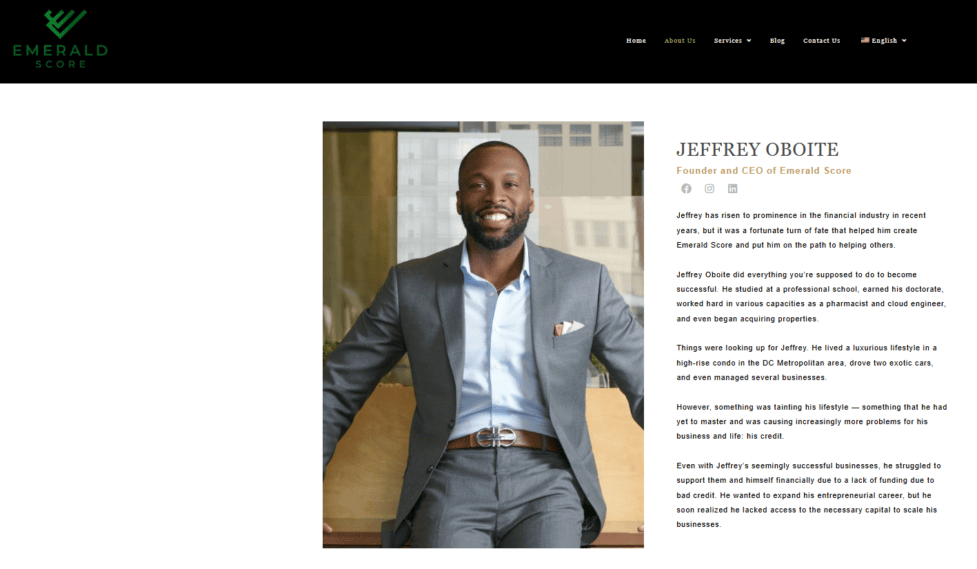
More importantly, prosecutors say Oboite taught Sparks and McClain how to submit fraudulent PPP loan applications.
Oboite and Sparks then submitted or caused fraudulent applications to be submitted in their own names and received at least $200,000, according to the indictment.
When suspicious credit-union personnel later froze parishioners’ accounts, prosecutors say Sparks and Oboite coached church members on what to tell the financial institution to get the money released.
And Emerald Score was no incidental corporate name.
The Better Business Bureau profile for Emerald Score identifies Jeffrey Oboite as its owner and categorizes the company under both Financial Services and Credit Repair Services.
Oboite’s historical LinkedIn activity is even more explicit.
Posts associated with Emerald Score promoted credit repair, credit-repair services, improving credit scores and obtaining business capital. One promoted Emerald Score as a way to obtain credit repair and capital for a business; another specifically marketed the company’s credit-repair service.
But Emerald Score’s own website takes the connection another step.
–
Tradelines, Score Boosts and “Leverage” With the Bank
An Emerald Score credit-repair page describes services for challenging negative credit information and rebuilding credit.
It also explicitly markets authorized-user tradelines as a way to increase a customer’s credit score.

The company explains that it can add consumers as authorized users to seasoned accounts with established payment histories and low utilization, allowing the consumer to “piggyback” on the positive account history.
Emerald Score’s premium package goes further.
It advertises a seasoned tradeline intended to produce an additional score increase, potentially as much as 40 points, and describes providing customers with a strategy for how to leverage the improved credit position with a bank.
The site also advertises a platform through which consumers can buy and sell tradelines.
None of that establishes that Emerald Score was engaged in fraud.
Authorized-user tradelines exist legally, consumers have the right to challenge inaccurate credit reporting, and CUCollector has found no evidence establishing that Oboite improperly disputed accurate information or fraudulently manipulated a particular Faith Walk parishioner’s credit file.
But Oboite’s expertise becomes highly relevant in context.
This was a man operating a business that marketed credit repair, score improvement, tradelines and access to funding.
And federal prosecutors say he was the person who taught Sparks how to submit fraudulent loan applications.
–
Then Came a Second Credit Repairman
The auto-loan side of the operation introduces another figure.
Terrance A. Kwade.
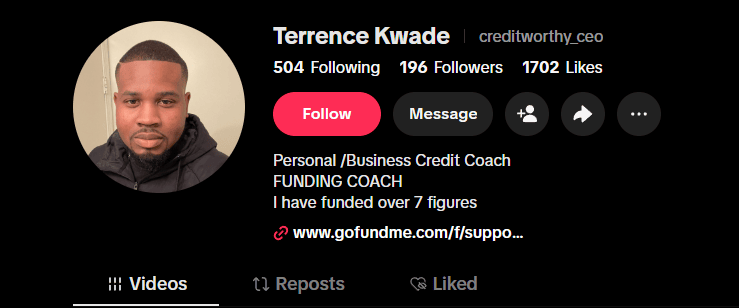
According to court records reviewed by St. Louis Magazine, Sparks and Kwade devised another way to extract money from the Faith Walk parishioners.
Automobile loans.
Approximately $460,000 in bogus auto loans were obtained through parishioners for vehicles they did not genuinely intend to purchase, according to the reporting.
Kwade reportedly received a 10% cut.
Kwade also had a credit-repair background.
Florida corporate records identify Terrence Kwade as CEO of Kwade Legacy Enterprises LLC, established in late 2020 and effective January 2021.
Social-media accounts associated with Kwade and the business during this period publicly promoted credit repair and client results, including disputes involving credit bureaus and customers obtaining new credit.
A TikTok account using the handle @creditworthy_ceo continued promoting credit-related material as recently as 2023.
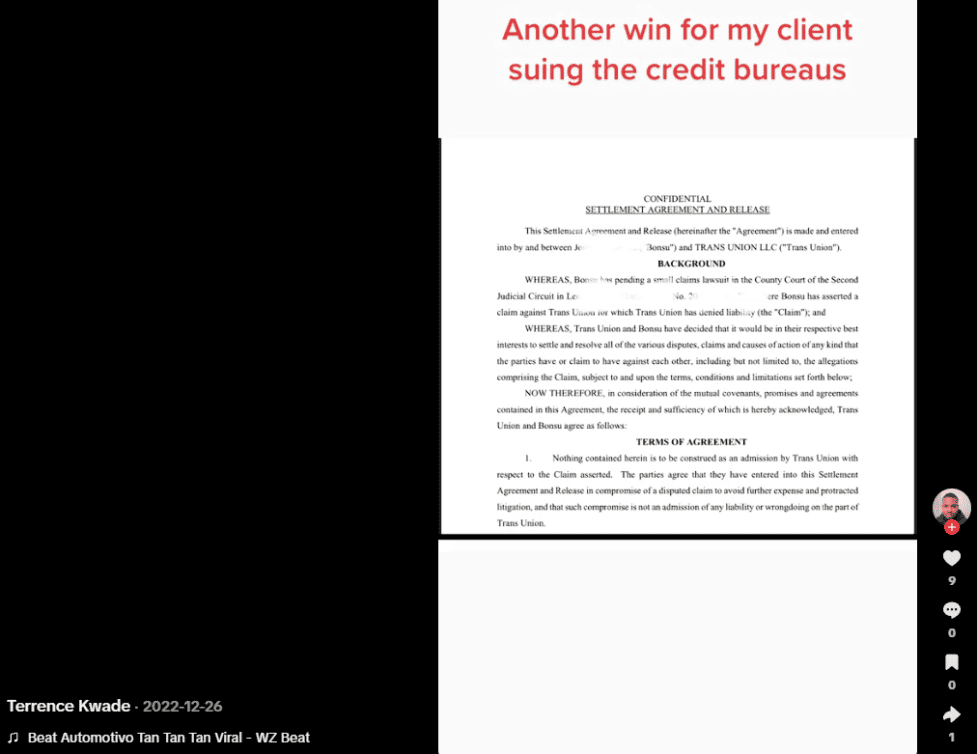
Again, advertising credit repair is not evidence of criminal conduct.
But its presence on both sides of Sparks is difficult to overlook.
One credit-repair entrepreneur allegedly taught Sparks how to submit fraudulent loan applications.
Another credit-repair entrepreneur subsequently joined Sparks in the fraudulent automobile-loan operation.
And between them stood a preacher collecting parishioners’ personal information under the representation that he and others could fix their credit.
–
Credit Repair or Credit Preparation?
That creates a question the publicly available court record has not yet answered.
Were the victims’ credit profiles actually being worked on before loans were submitted?
Did anyone dispute derogatory accounts?
Were authorized-user tradelines added?
Were scores increased before applications were sent to lenders?
Or was “credit repair” simply a convincing pretext Sparks used to obtain Social Security numbers, financial records and other information needed to commit identity and loan fraud?
There is presently no evidence establishing that the Faith Walk borrowers’ credit files were manipulated before the fraudulent auto loans were originated.
That difference matters.
CUCollector therefore would not characterize what happened as “credit washing” without additional evidence showing that accurate negative information was knowingly or improperly disputed or suppressed.
But for lenders, the unanswered question is significant. A credit report shows what is being reported about an applicant at the moment the report is pulled.
It doesn’t necessarily tell an underwriter what disappeared from that file recently, why it disappeared, or whether an applicant was recently added as an authorized user to seasoned accounts for the purpose of increasing a score.
If a temporarily strengthened credit profile is quickly followed by aggressive borrowing, lenders may be underwriting a borrower who looks materially different from the same person only weeks earlier.
Whether that happened here remains unknown.
But the people surrounding the Faith Walk fraud certainly appear to have understood how credit could be improved, and how access to credit could be monetized.
–
$460,000 in Bogus Auto Loans
The automobile portion of the case deserves particular attention because DOJ’s latest announcement somewhat obscures its scale.
The government says Sparks used many of the same methods to obtain $685,000 in personal and auto loans in his own name and the names of others.
Court reporting provides a more useful breakdown for auto lenders.
Approximately $460,000 was attributed specifically to bogus automobile loans involving parishioners and vehicles they did not actually intend to purchase.
The Fonville loan provides an especially troubling example.
Here was a church member who says he surrendered his financial information because his minister was supposedly going to help his credit. Instead, he discovered that someone had obtained automobile financing in his name.
That is not merely application fraud. It is a complete inversion of the trust upon which consumer lending depends.
–
The Apostle Had a Past
There was another part of Sparks’ history that jurors largely did not hear.
The Missouri State Highway Patrol Sex Offender Registry identifies Kenneth Carl Sparks, born January 24, 1970, and records an offense of Indecency With a Child – Exposes, involving a 14-year-old female victim.
The registry gives an offense date of March 25, 2013, in Dallas, Texas.
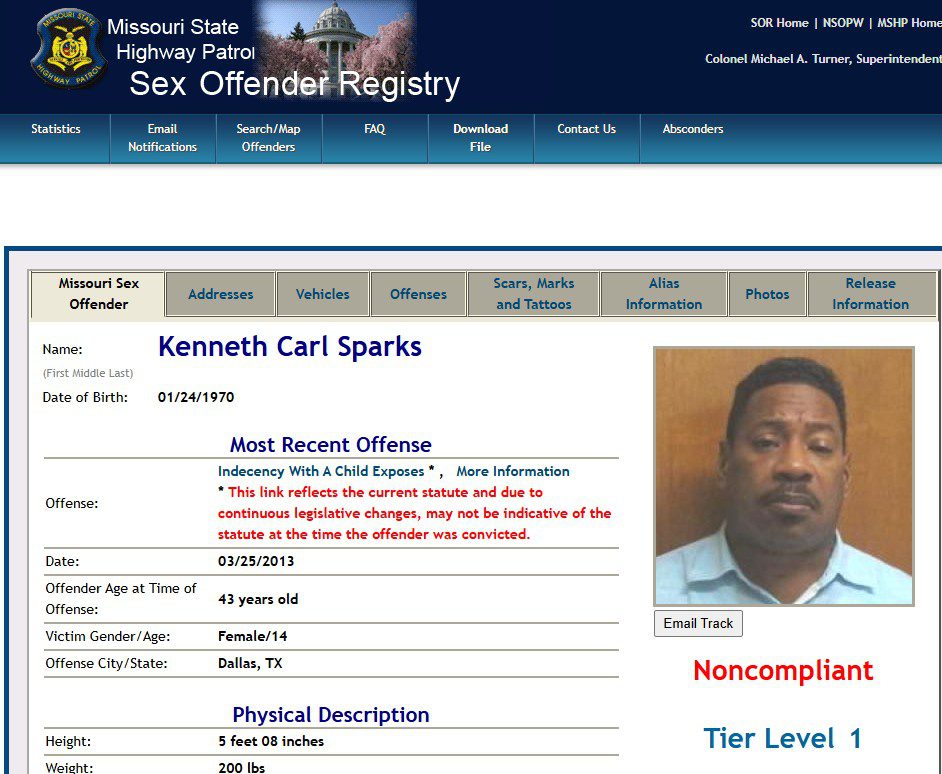
Importantly, that is the offense date, not necessarily the conviction date.
CUCollector has not independently obtained the underlying Dallas County judgment and therefore is not assigning a specific conviction date based solely upon secondary reporting.
Evidence concerning Sparks’ felony history nevertheless became relevant during the federal fraud prosecution because of representations he allegedly made on pandemic-loan applications.
Reporting surrounding the trial says prosecutors established that Sparks had been placed on felony supervision or parole by 2017 and subsequently faced a Missouri felony indictment in 2019 reportedly involving failure to register as a sex offender.
CUCollector has found no reliable evidence establishing that the 2017 supervision represents an additional unidentified felony rather than a disposition connected to the Texas matter.
There is no reason to speculate. The documented history is extraordinary enough.
–
Mercedes, Rolexes and Designer Shoes
While parishioners dealt with fraudulent loans, damaged credit and eventually criminal charges of their own, prosecutors traced enormous amounts of money to Sparks.
IRS Criminal Investigation testimony showed approximately $313,000 in checks written to Sparks himself, another $172,000 obtained through cash withdrawals or advances, $168,000 spent at luxury retailers, $127,000 on real estate and $47,000 on jewelry.
The jewelry included a diamond-covered Rolex.
Court filings reviewed by St. Louis Magazine indicate Sparks also bought two Mercedes, reportedly costing approximately $133,000 and $108,000, and made payments to a Bentley dealership in Chicago.
Jurors were shown video of Sparks purchasing a Mercedes.
The contrast is difficult to escape.
A man who arrived at a small Missouri church to preach for three days eventually claimed spiritual authority over its members. People gave him their personal financial information believing he could improve their credit or help their church.
Some ended up with fraudulent loans. Some ended up criminal defendants. At least one says he ended up with an automobile loan he never authorized.
And Sparks ended up with Mercedes, Rolexes and designer merchandise.
–
The Auto Lenders Are Still Missing from the Story
One important piece remains hidden.
Publicly available records reviewed by CUCollector still do not identify all of the auto lenders, credit unions, dealerships, vehicles, VINs or individual balances associated with the approximately $460,000 auto-loan scheme.
Nor do they tell us what happened after those loans defaulted.
Were the vehicles repossessed?
Were they surrendered?
Were they ever where lenders believed they were?
What did the collateral bring at auction?
How much remained as deficiencies?
And ultimately, who absorbed the losses?
Those answers may begin emerging soon.
Federal court records currently schedule both men with particularly interesting roles in this story for sentencing on September 9 before Senior U.S. District Judge John A. Ross.
Terrance A. Kwade is scheduled for 1:30 p.m.
Jeffrey Oboite follows at 2:00 p.m.
Their sentencing memoranda, restitution calculations and related filings could provide information that the government’s conviction announcement does not.
Sparks is scheduled for sentencing December 1.
–
Trust Was the Collateral
There are obvious lessons here about identity theft, application fraud, credit-report disputes, authorized-user tradelines and loan verification.
But another form of collateral runs through the entire Faith Walk story.
Trust.
Parishioners trusted their church.
They trusted their pastor. They trusted the visiting “Apostle” their pastor vouched for.
They entrusted him with the information that defined their financial identities because they were told it could be used to improve their credit or help their church.
Financial institutions subsequently trusted applications and credit files that appeared to represent legitimate borrowers entering legitimate transactions.
Federal prosecutors say Sparks exploited both systems.
One was built on faith.
The other was built on credit.
Both depended upon trust.
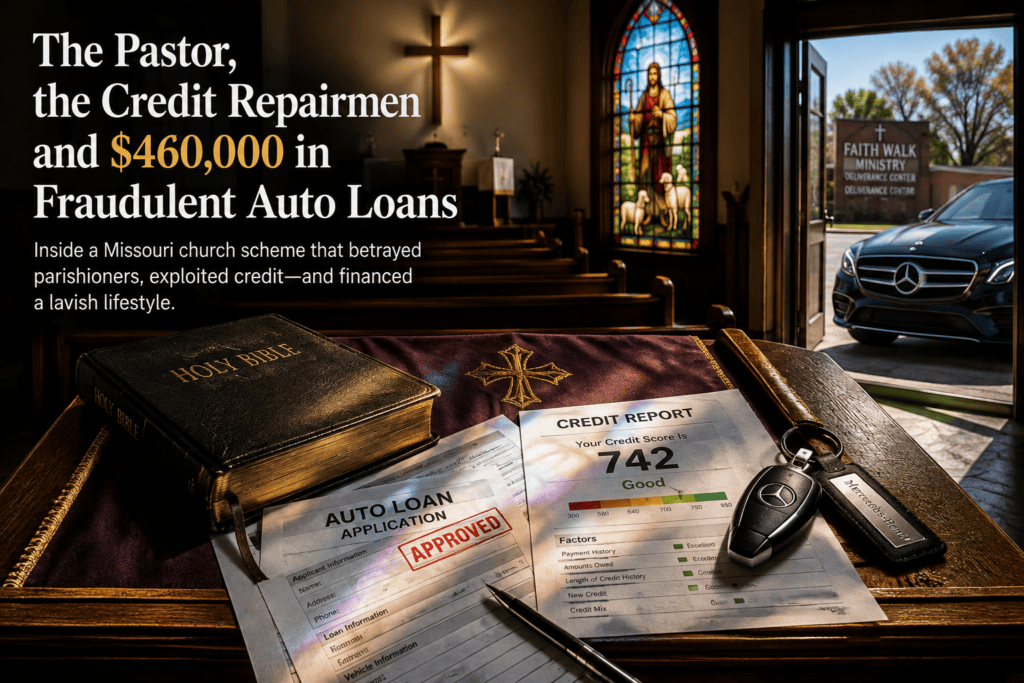
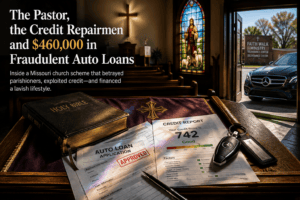
The Pastor, the Credit Repairmen and $460,000 in Fraudulent Auto Loans – The Pastor, the Credit Repairmen and $460,000 in Fraudulent Auto Loans – The Pastor, the Credit Repairmen and $460,000 in Fraudulent Auto Loans
The Pastor, the Credit Repairmen and $460,000 in Fraudulent Auto Loans – Police – Police – Arrest – Arrest – Credit Union Collections – Credit Union Collectors – Lending – Fraud – Fraud – Auto Loan – Straw Buyer



More Stories
One Employer, Hundreds of Auto Loans: The Fed Warns About Concentrated Credit Risk
The 30-Day Blind Spot: How Straw Buyers Financed Nearly 100 Cars Before Lenders Could See Them Coming
They Called a Collector; They Got a Credit Repair Company Instead
Lien Stripping: Mechanic’s Lien Loopholes and the Ticking Time Bomb
The Father, the Son and a $2.26 Million Synthetic Identity Scheme
When the Borrower Is the Fraudster