



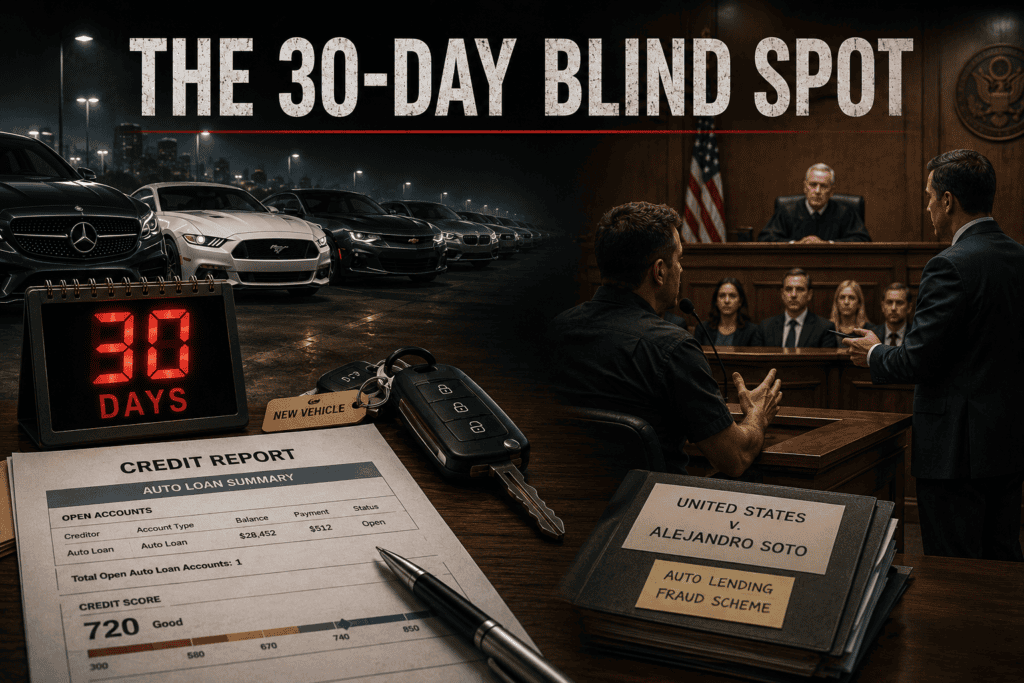
Credit Unions Were Among the Victims as Fraudsters Exploited a 30-Day Credit Reporting Window to Stack Auto Loans Across Multiple Lenders
–
Miami, FL – August 25, 2026 – How many cars can one borrower finance before the next lender realizes what is happening? Four? Ten? Fifteen?
In a sprawling South Florida auto lending fraud case involving 90 vehicles and approximately $3.6 million in financing, federal trial testimony provides an unsettling answer: potentially a lot of them, if the purchases happen fast enough.
And credit unions were among the lenders caught in the middle.

According to the Florida Office of Financial Regulation, Alejandro Soto and his co-conspirators recruited approximately 16 straw buyers with good credit to purchase 90 vehicles using $3.6 million in financing. The vehicles were then rented through Turo under Soto’s Venom Luxury Rentals Corp. (Flofr)
But Soto’s 2026 federal trial revealed something much more important for lenders:
How they got the loans through in the first place.
The strategy described under oath exploited a simple weakness in auto lending, acquire vehicles through different dealerships and different lenders quickly enough that recently originated loans had not yet appeared on the straw buyer’s credit report.
One participant put the strategy plainly.
The cars, he testified, needed to be purchased “in a period less than a month,” so the previous purchases would not yet appear on the borrower’s credit report.
It was, in effect, a race against the credit bureaus.
–
Four Cars. Four Dealerships. Keep Moving.
Cesar Cespedes, who pleaded guilty to participating in the conspiracy and testified against Soto, described buying and financing vehicle after vehicle on Soto’s behalf.
At one point, Cespedes testified that he had purchased four Mercedes-Benz through four different dealerships.
Why not simply buy all four at the same dealership?
According to Cespedes, Soto explained that the purchases needed to move through different dealerships and financing sources. After one lender financed a vehicle, they would move on and avoid sending the next inquiry to that same institution.
The objective, Cespedes testified, was “so that way the banks wouldn’t find out that we were purchasing different cars.”
Eventually, Soto allegedly needed more dealership connections.
Cespedes testified that they met broker Lazaro Osorio and that Soto explained the strategy: obtain the vehicles in less than a month and send the inquiries individually to different lenders. Osorio was allegedly offered $200 per vehicle.
The pace accelerated.
Cespedes testified that he subsequently financed four vehicles at one Rick Case dealership over just two days.
–
“The Banks Do Not Communicate Amongst Themselves”
Dealer Javier Calunga provided perhaps the most troubling explanation for lenders.
Asked how multiple loans could be obtained by the same borrower, Calunga testified that lenders weren’t necessarily seeing what other institutions were simultaneously financing.
What was sent to Westlake, he explained, had nothing to do with what was sent to Miami Postal Service because they were separate institutions.
Prosecutors then asked specifically about the time limit associated with the purchases.
Calunga testified about a roughly 30-day period before the accumulation of cars would show on the credit report.
Earlier in his testimony, he put the vulnerability even more starkly. Because lenders did not communicate among themselves, he said, a person with sufficient credit could potentially obtain “10 or 15 cars.”
For lenders accustomed to viewing a credit report as a snapshot of a borrower’s existing obligations, the case demonstrates a dangerous distinction:
A credit report can be accurate , and still already be obsolete.
–
Credit Unions Were in the Rotation
The scheme did not target only large banks and national auto finance companies.
Credit unions were part of the financing mix.
Calunga testified about loan applications being submitted to credit unions from his dealership. In one example involving straw buyer Elcis Carvajal, an application listed employment at Total Cabling and monthly income of $5,500.
Frank McKenna’s review of the financed vehicles identified numerous credit-union loans among the vehicles, including financing associated with Space Coast Credit Union, Miami Postal Service Credit Union, Tropical Financial Credit Union, Dade County Federal Credit Union and others.
But one Space Coast loan received particular attention during Cespedes’s testimony.
Cespedes testified that he went to a dealership in Medley where a Ford Mustang had already been selected and financing was arranged through Space Coast Credit Union.
The prosecutor asked whether he had gone to the credit union to open an account or fill out paperwork.
“No. No,” Cespedes answered.
Then came the electronic loan documents.
“How did you sign the documents with the credit union?” the prosecutor asked.
“It’s not my signature,” Cespedes testified.
The loan was for $35,925, with payments of $514 over seven years. The documents were dated September 1, 2020.
Shown the electronic signature again, Cespedes testified that it did not look like his.
–
Good Credit Was the Commodity
This wasn’t necessarily a synthetic identity scheme built around people who didn’t exist.
The people existed.
Their creditworthiness was what had value.
OFR says the operation specifically recruited straw buyers with good credit to obtain the vehicles. (Flofr)
Calunga testified that Soto told him his own credit and his girlfriend’s credit were poor. With bad credit, he explained, they couldn’t obtain enough vehicles themselves.
So other people’s credit was used instead.
That distinction matters.
A lender looking for a fabricated identity could instead encounter a real consumer with a legitimate credit history and apparently manageable obligations.
The problem was what that lender couldn’t yet see:
the loans the same borrower may have obtained days earlier somewhere else.
–
False Income, False Employment, and Someone to Answer the Phone
Credit velocity wasn’t the scheme’s only weapon.
Cespedes testified that a false credit application containing inaccurate employment and income information was reused as the group moved among dealerships.
After meeting Osorio, Cespedes said he provided the same application previously used elsewhere. He acknowledged under oath that it contained false employment and income information.
At Rick Case, the loan paperwork was already prepared when Cespedes arrived.
Asked whether the finance manager questioned him about his employment or income, Cespedes answered:
“No.”
An August 30, 2020 credit application subsequently shown to the jury contained the same false employment and income information.
Even employment verification allegedly had a workaround.
Calunga testified that finance manager Gustavo Navarette generated false employment documents and had a contact at Total Cable who could verify the fake employment information when lenders called.
The broader allegation is confirmed by OFR, which says Soto and his co-conspirators submitted fraudulent loan applications to multiple financial institutions to obtain financing for the straw buyers. (Flofr)
–
Then Came the Down Payments That Never Happened
Some deals contained another familiar piece of auto-finance fiction: money supposedly put down by the borrower that was never actually paid.
In one transaction presented at trial, a contract showed a $4,500 down payment.
Calunga testified that it was never made.
Asked why it appeared on the contract anyway, his answer was two words:
“For the approval.”
During cross-examination, testimony also addressed applications containing inflated income, nonexistent down payments and false employment information entered to obtain loan approvals.
Put all the pieces together and the vulnerability becomes much larger than a delayed tradeline.
A real borrower with good credit. Multiple dealerships. Multiple lenders. False income. False employment. Someone allegedly prepared to verify that employment. Down payments that existed only on paper.
And a clock ticking before the borrower’s rapidly multiplying auto debt appeared on the next lender’s screen.
–
South Florida Has Seen This Playbook Before
For regular CUCollector readers, there is something disturbingly familiar about all of this.
CUCollector has followed a string of Miami-Dade auto-loan bust-out investigations over the past year. We have found no documented personnel connection between those cases and the Soto prosecution.
The method, however, is strikingly familiar.
In September 2025, we reported on 21 Arrested in Miami-Dade Auto Loan Fraud Ring, involving Operation Credit Bust Out, more than $5 million in alleged fraud and more than 100 vehicles.
Miami-Dade investigators said some suspects were obtaining as many as 20 vehicles in a single week.
But one statement from Miami-Dade Sheriff’s Office Auto Theft Task Force Sgt. Luis Paz now looks especially significant.
Explaining how the scheme worked, Paz told Local 10 News that a consumer tradeline can take roughly 30 days to fully reflect on a credit report. (wplg)
That was in 2025.
Five years earlier, according to testimony at Soto’s federal trial, participants were allegedly exploiting essentially that same window.
And the Miami cases kept coming.
In February, CUCollector reported From Dealership Desks to Racketeering: Another Miami Fraud Ring Busted, involving more than $1.5 million in loan approvals and allegations involving straw buyers, brokers and dealership finance personnel.
According to independent reporting on that investigation, one 85-year-old straw buyer allegedly financed six vehicles between December 22 and December 28, 2024, with nearly $435,800 in approvals from different lenders. Another borrower allegedly obtained nearly $539,000 in financing between January 8 and January 16, 2025. (wplg)
Then came another case we covered: Ten Cars, Eight Days, One Waitress – Another Miami Bust Out Fraud Arrest.
Different defendants. Different investigations. Different vehicles.
But an increasingly familiar formula:
Good or apparently finance-able credit. False income or employment. Multiple dealerships. Multiple lenders. And speed.
What makes the Soto case different is that this time federal prosecutors put people involved in the operation on the witness stand.
And they explained how the clock worked.
–
The Fraud Is Old. The Lesson Isn’t.
The vehicle purchases at the heart of the Soto case date primarily to 2020 and 2021. This isn’t a newly discovered fraud ring.
What is new is the view inside it.
On March 4, a federal jury convicted Soto of one count of conspiracy to commit wire fraud and three counts of wire fraud. (Flofr)
Three months later, Soto was sentenced to 99 months in federal prison followed by three years of supervised release. OFR reported that approximately 16 straw buyers purchased 90 vehicles for around $3.6 million. The vehicles generated approximately $600,000 in Turo rental revenue before payments on some loans stopped, leaving lenders pursuing the straw borrowers. Some of those borrowers eventually filed for bankruptcy. (Flofr)
Florida OFR , Soto sentencing and case summary
But Soto’s federal trial produced something potentially more valuable to today’s lenders: sworn testimony describing how participants believed they could exploit the lag between one auto loan closing and another lender being able to see that new obligation.
And five years later, Miami-Dade investigators were publicly describing the same roughly 30-day vulnerability while dismantling another major auto-loan bust-out operation.
That makes this less a story about a Turo fleet assembled years ago than a warning about what lenders can see today.
Credit reports remain indispensable underwriting tools. But these cases demonstrate the danger of treating a credit report as a real-time accounting of a borrower’s obligations when multiple vehicle transactions are occurring in rapid succession.
For credit unions and other auto lenders, perhaps the most important question raised by the case isn’t how 90 cars got financed.
It’s much smaller than that.
How many cars could one borrower finance this week before your credit report shows you what they did last week?
–
Related:
21 Arrested in Miami-Dade Auto Loan Fraud Ring
The Never-Ending Auto Loan Fraud Parade in Miami Marches On!
Miami Woman Busted in Miami’s Multi-Million Dollar Auto Fraud Epidemic
Another Arrested in Miami’s Multi-Million Dollar Auto Loan Bust Out Fraud
Miami Man Busted in $500,000 Auto Fraud Scheme Tied to South Beach Syndicate
Another Man Busted in South Beach Syndicate Auto Fraud Scheme
The 30-Day Blind Spot: How Straw Buyers Financed Nearly 100 Cars Before Lenders Could See Them Coming – The 30-Day Blind Spot: How Straw Buyers Financed Nearly 100 Cars Before Lenders Could See Them Coming – The 30-Day Blind Spot: How Straw Buyers Financed Nearly 100 Cars Before Lenders Could See Them Coming
The 30-Day Blind Spot: How Straw Buyers Financed Nearly 100 Cars Before Lenders Could See Them Coming – Police – Police – Arrest – Arrest – Credit Union Collections – Credit Union Collectors – Lending – Fraud – Fraud – Auto Loan – Dealer– Dealer – Straw Buyer






More Stories
Capital One Is Lending More to Subprime Borrowers. The Real Test Comes in 2027
STUPID STUFF FRAUDSTERS BUY: Et Tu, Fraudster?
Ally Keeps Growing as Auto Loan Delinquencies and Losses Edge Higher
When a Car Is Obtained Through Fraud, Is It Counted as Stolen?
Credit Union Employee Accused of Stealing from the Dead
Credit Union Promoted Employee Despite Fraud Warnings — Then Collapsed Under $3.5 Million in Losses