



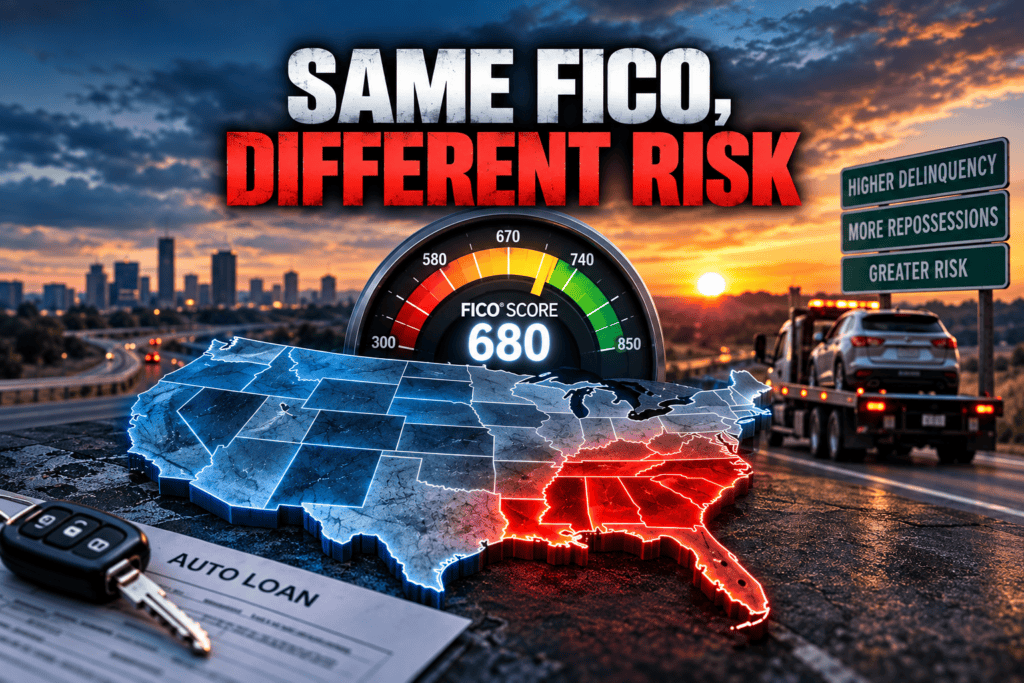
KBRA Finds Southeast Auto Delinquencies Remain Elevated Even After Adjusting for Credit Quality
–
The South has long carried many of the nation’s lowest credit scores, lower household incomes and higher repossession volumes. None of that is particularly surprising. But a new state-by-state analysis of auto-loan securitizations from Kroll Bond Rating Agency (KBRA) provides a striking reminder that where a borrower lives may be telling lenders something that the credit score doesn’t.
KBRA’s analysis of auto-loan ABS pools found that four of the five highest 60-plus-day delinquency rates during the first half of 2026 were concentrated in the Southeast.
Mississippi led the nation at 4.57%, followed closely by South Carolina at 4.54% and Georgia at 4.46%. New Mexico ranked fourth at 4.40%, while Louisiana came in fifth at 4.17%.
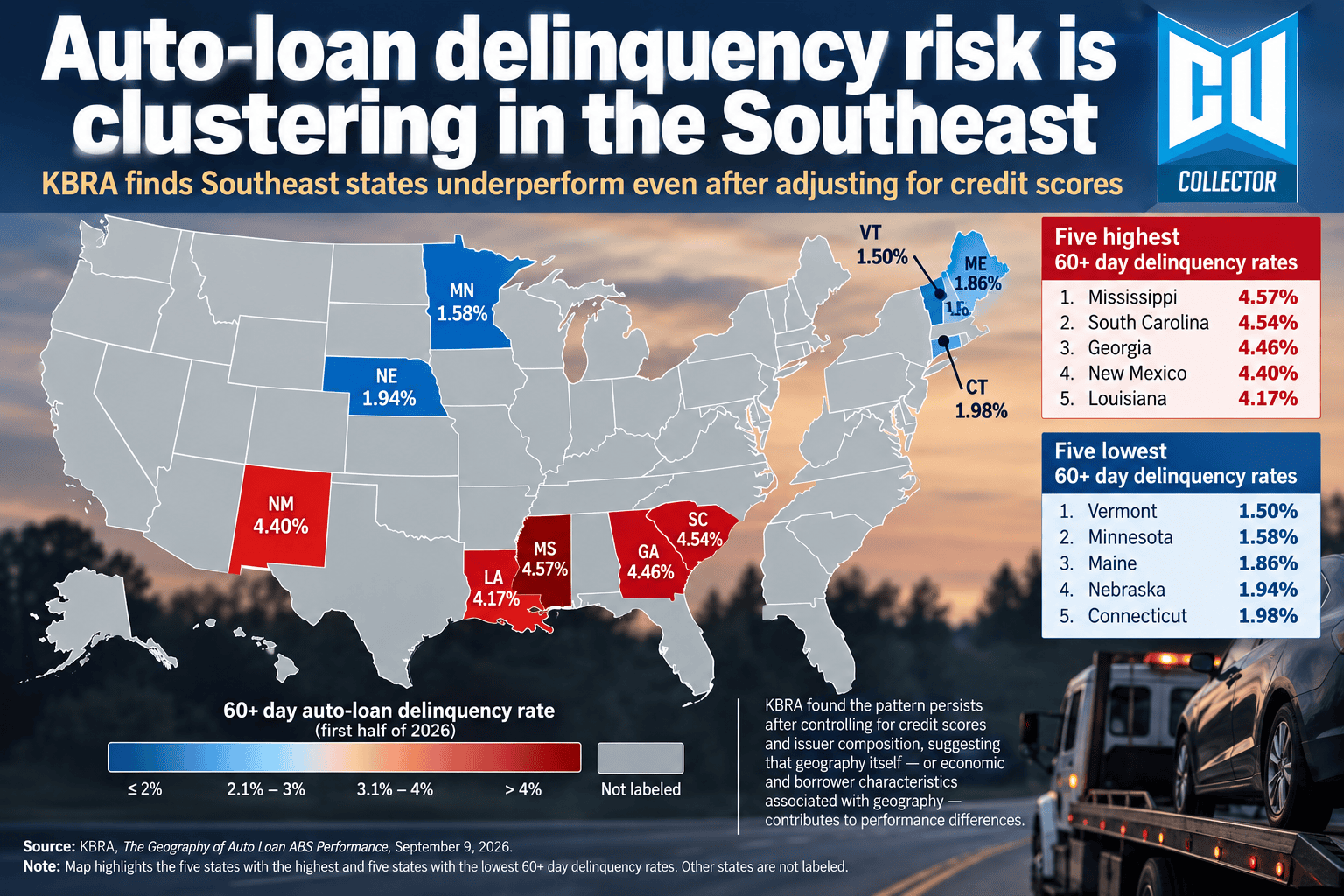
At the other end of the spectrum, Vermont recorded a delinquency rate of just 1.50%, followed by Minnesota at 1.58%, Maine at 1.86%, Nebraska at 1.94% and Connecticut at 1.98%.
The difference is substantial. Mississippi’s 60-plus-day delinquency rate was more than three times Vermont’s.
But that isn’t the most interesting part of KBRA’s findings.
–
FICO Doesn’t Explain It All
It would be easy to attribute the Southeast’s performance to borrower credit quality. States with lower average credit scores would naturally be expected to produce higher delinquency rates.
KBRA attempted to remove much of that explanation.
After controlling for credit score and securitization shelf composition, several Southern states continued to perform materially worse than expected.
Louisiana was 77 basis points worse than expected, Georgia 60 basis points worse, Mississippi 51 basis points worse, South Carolina 37 basis points worse and Alabama 32 basis points worse.
That suggests something beyond the credit score is influencing loan performance.
The contrast with New Mexico is particularly revealing.
Despite having the fourth-highest raw delinquency rate at 4.40%, New Mexico performed 42 basis points better than expected after KBRA adjusted for credit quality and issuer composition. Louisiana went the other direction. Its actual delinquency rate was lower than New Mexico’s, but its borrowers performed substantially worse than their underlying credit characteristics would have predicted.
In other words, the delinquency rate tells one story. The difference between expected and actual performance tells another.
–
Geography May Be a Credit Variable
A FICO score measures a borrower’s credit history. It cannot fully capture the economic environment surrounding that borrower.
Regional wages, employment stability, insurance costs, transportation dependency, household expenses and other local economic pressures can affect a borrower’s ability to continue making a $600, $700 or $800 monthly vehicle payment.
KBRA’s findings don’t establish that any one of those factors is responsible for the Southeast’s performance. But the analysis does show that borrower credit quality and issuer composition do not fully explain the geographic differences in delinquency performance.
And the pattern isn’t new.
KBRA found Mississippi, Louisiana, Georgia and South Carolina have repeatedly appeared toward the weaker end of state auto-loan performance, while states including Vermont, Minnesota, Maine and Nebraska have consistently performed better.
That persistence makes the geographic concentration considerably harder to dismiss as a temporary economic anomaly.
–
From Delinquency to Collections
For collectors and recovery managers, there is another implication.
A 60-day delinquent loan is not a repossession, and many of these accounts will cure. But serious delinquency is upstream from collections activity, charge-offs and collateral recovery.
Where serious delinquency becomes geographically concentrated, collection workloads and eventually repossession demand are likely to become geographically concentrated as well.
That matters particularly when lenders expand beyond their traditional markets.
Large national auto securitizations generally contain enough geographic diversification that weakness in one or two states may have limited portfolio-level impact. KBRA makes that point directly, but also says geography may become more important for whole-loan buyers and securitizations with outsized concentrations in states performing materially above or below expectations, particularly when the geographic mix differs from an issuer’s historical footprint.
A credit union or regional lender can be a very different animal.
Indirect expansion, loan participations, purchased portfolios and third-party origination can expose a lender to markets well outside the geography it historically understood. A portfolio may appear diversified across dealers, credit tiers and loan terms while quietly accumulating another form of concentration:
ZIP codes.
–
A Map Worth Looking At
There is nothing revolutionary about seeing Mississippi, Louisiana, Georgia and South Carolina near the difficult end of a consumer-credit map. Lenders and collectors have seen similar regional patterns for years.
But that’s precisely why the visualization matters.
It provides another reminder that two borrowers with similar FICO scores, similar vehicles and similar loan structures don’t necessarily represent identical risks.
For lenders expanding geographically or purchasing auto loans originated by somebody else, KBRA’s September 2026 analysis raises a simple question worth adding to the portfolio review:
We know the borrower’s credit score. But do we know what is happening where the borrower lives?
Same FICO, Different Risk: Geography Emerges in Auto Loan Delinquencies – Same FICO, Different Risk: Geography Emerges in Auto Loan Delinquencies – Same FICO, Different Risk: Geography Emerges in Auto Loan Delinquencies
Same FICO, Different Risk: Geography Emerges in Auto Loan Delinquencies – Credit Union Collections – Credit Union Collectors – Lending – Auto Loan – Delinquency – Equifax – Experian – Experian – TransUnion – TransUnion – Subprime Auto Loans – Subprime Auto Loans – Repossession – Repossession






More Stories
All Loan and No Cattle
Auto Lending 2026: State of the Union, the Repo Squeeze, and What Comes Next
Your Newer Collateral May Be Losing Value Faster
Stop Waiting for the Credit Report: Put the Fraud Alert in the LOS
Regulators Clarify What Credit Unions Can Tell Members About Suspicious Activity
The Payment Moved, The Depreciation Didn’t