



Longer Loan Terms, Aging Vehicles and the Growing Risk of Collateral That May No Longer Be Worth Recovering
–
October 13, 2026 – The American auto finance industry may be approaching a problem that cannot be solved by extending loan terms, refinancing balances or lowering monthly payments. Increasingly, the vehicles securing those loans are growing old before the borrowers finish paying for them.
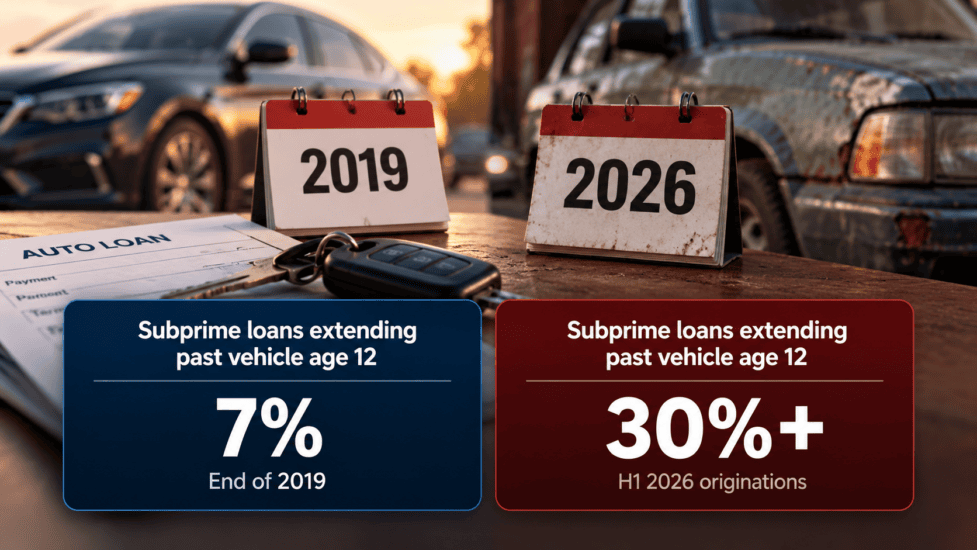
According to an October 13 Reuters Breakingviews analysis by Stephen Gandel, more than 30% of subprime auto loans originated during the first half of 2026 will not be paid off until the financed vehicles are more than 12 years old. At the end of 2019, that figure was just 7%.
The implications extend well beyond the dealership showroom and the monthly payment. For lenders, collectors and repossession professionals, this raises a fundamental question about the future value of the collateral securing America’s $1.7 trillion in outstanding auto loans.

What happens when the borrower still owes thousands of dollars on a vehicle that is no longer economically practical to repair, operate or recover?
–
The Automobile Is Getting Older, but the Debt Is Not Going Away
The numbers illustrate how dramatically automobile financing has changed.
According to the Reuters analysis, citing Edmunds data, the average vehicle purchased in the $15,000 to $20,000 price range during the second quarter of 2026 was approximately six years old. In 2019, a vehicle in that same price range averaged just over three years old.
Consumers are effectively paying comparable prices for vehicles that are considerably older. Meanwhile, the average used-vehicle loan term has grown from 64.7 months in 2019 to 67.9 months in 2026, according to Experian data cited by Reuters.
That means a consumer purchasing a six-year-old vehicle today with a typical used-car loan could still be making payments when the vehicle is approaching its twelfth birthday.
And that is only the average.
Subprime borrowers, who frequently face higher interest rates and more limited vehicle choices, can find themselves financing older vehicles for even longer periods.
The automobile may be depreciating, accumulating mileage and approaching expensive mechanical repairs, but the loan balance continues according to its original amortization schedule.
–
The $3,000 Repair That Changes Everything
Consider a hypothetical borrower who purchases a six-year-old vehicle for $18,000 and finances it over 72 months at a 12% annual interest rate. The monthly principal-and-interest payment would be approximately $352, excluding taxes, fees and any additional financed products.
Four years later, the borrower still owes approximately $7,500, even though the vehicle is now ten years old.
Then the transmission fails. The repair estimate is $3,500.
The borrower now faces a choice that is becoming increasingly common in the used-vehicle market: spend thousands of dollars repairing an aging vehicle while continuing to make payments, or stop paying for transportation that no longer works.
For a financially stable household, that may be an unpleasant but manageable expense. For a subprime borrower already struggling with housing, insurance, groceries and other necessities, it may be financially impossible.
The result can be a vehicle sitting in a driveway, a loan falling further into delinquency and a lender holding a security interest in collateral that is deteriorating while the debt continues to accrue.
This is where the problem moves from traditional credit risk into something more complicated.
The borrower may not have stopped paying because the monthly payment was unaffordable. The borrower may have stopped paying because keeping the vehicle operational became unaffordable.
–
Negative Equity Makes the Problem Worse
The Reuters analysis also highlights another significant development: the growing amount of negative equity carried by consumers.
According to Edmunds figures cited in the report, used-car buyers who financed negative equity in 2026 borrowed an average of $5,114 more than their vehicles were worth, compared with $3,774 in early 2020. For new-car buyers financing negative equity, the average amount reached $7,023.
These figures describe negative equity carried into vehicle purchases, rather than the average deficiency on all outstanding auto loans. Nevertheless, they illustrate how consumers can begin a new financing agreement already burdened by debt from a previous vehicle.
When that debt is combined with longer repayment periods, higher interest rates and older collateral, the potential consequences become more severe. A borrower may owe considerably more than the vehicle’s market value long before experiencing a mechanical failure or financial hardship.
And when the vehicle eventually becomes inoperable, the outstanding loan does not disappear with its usefulness.
–
When Repossession No Longer Makes Economic Sense
For repossession professionals, this developing problem introduces a familiar calculation under increasingly unfavorable circumstances.
Not every delinquent vehicle is worth recovering.
Lenders have always considered collateral value, repossession expenses, transportation, storage, condition and anticipated auction proceeds when determining whether recovery is economically justified.
But aging collateral can make that calculation considerably more difficult. Consider another hypothetical example involving a ten-year-old vehicle with a $9,000 outstanding loan balance.
The vehicle has significant mechanical problems and an estimated as-is wholesale value of $2,500.
Recovery and disposition might involve:
- Repossession and associated recovery expenses.
- Transportation to auction or another disposition facility.
- Storage, administrative and title-related costs.
- Condition-related deductions or necessary reconditioning.
If these expenses total $1,200, the lender could net approximately $1,300 from the sale, assuming the vehicle actually brings $2,500.
That leaves a deficiency of approximately $7,700 before accounting for other permissible charges, adjustments or recoveries.
And if the vehicle is inoperable, has excessive mileage or requires major repairs, even the $2,500 valuation may prove optimistic.
The lender may still choose to recover the vehicle, depending on its policies, legal obligations and recovery expectations. But the economics become increasingly difficult to justify.
The vehicle remains collateral in the legal sense, yet its practical value as security for the loan may be severely diminished.
–
The Collector’s Dilemma: Cure the Loan or Repair the Car?
This is where the situation becomes particularly important for credit union collection departments and other lenders. Traditional delinquency management generally focuses on restoring the borrower’s ability and willingness to make payments.
Extensions, payment arrangements, hardship assistance and other loss-mitigation tools may help borrowers recover from temporary financial difficulties. But those solutions depend, at least in part, on the underlying reason for delinquency.
If the borrower has lost income but still has reliable transportation, a temporary payment arrangement may provide enough relief to restore the account. If the vehicle has suffered a catastrophic mechanical failure, however, extending the loan may do little to solve the actual problem.
The borrower still needs transportation and the repair bill remains unpaid. And the lender may be extending the repayment period on a vehicle that is already approaching the end of its economically useful life.
In some cases, a repair assistance program or another restructuring option may make financial sense. In others, the cost of restoring the vehicle to service could exceed its realistic value.
The challenge for collectors is recognizing when delinquency is fundamentally a cash-flow problem and when it has become a collateral problem. Treating both situations identically may produce very different outcomes.
–
Voluntary Surrenders and the Problem of Worthless Collateral
There is another possible consequence for the recovery industry.
Borrowers who can no longer afford to repair their vehicles may become more willing to surrender them voluntarily. But a voluntary surrender does not necessarily produce a better financial outcome for the lender.
A vehicle that has been sitting for months with a failed engine, damaged transmission or other serious mechanical problems may have little remaining wholesale value. It may require towing rather than ordinary transportation, additional handling at the storage facility and special consideration at auction.
Some vehicles may ultimately have little more than salvage value.
This could create a growing segment of delinquent auto loans in which the lender’s principal concern is no longer whether the collateral can be located and recovered, but whether recovering it will produce enough proceeds to justify the expense.
For repossession agencies, this also raises operational questions about recovery assignments involving older, inoperable vehicles and the costs associated with handling them.
–
A Warning From the Subprime Market
The deterioration in collateral economics is occurring alongside growing signs of financial stress among weaker borrowers.
Reuters reports that Fitch Ratings’ measure of subprime auto loans in asset-backed securities that are at least 60 days delinquent is hovering around 6%, near historically elevated levels.
That measure applies to loans backing particular securitizations, not the entire U.S. auto lending market. Nevertheless, it provides an important indication of stress in a segment of the industry already exposed to elevated credit risk.
The connection between aging collateral and delinquency deserves closer attention.
A vehicle’s mechanical condition is not ordinarily captured by the borrower’s credit score. Nor does a conventional payment-to-income calculation fully account for the possibility of major repairs several years into a loan.
A borrower may qualify for a payment today without having the financial reserves necessary to maintain the vehicle throughout the financing period.
And when the vehicle breaks down, the lender may discover that the borrower cannot afford either the repair or the remaining debt.
–
The Risk May Have Been Created Years Before the Default
For lenders, perhaps the most uncomfortable implication is that some of these problems originate at underwriting rather than collection.
A longer loan term can make a vehicle appear affordable by reducing the monthly payment. But extending the term does not make the automobile newer, more reliable or less expensive to maintain.
Nor does it guarantee that the collateral will retain sufficient value throughout the loan.
The borrower receives a manageable payment at origination, the dealer completes the sale and the lender books the loan. Years later, the collection department may inherit a delinquent account secured by a vehicle that is worth a fraction of the outstanding balance.
The repossession agency may then be asked to recover an aging, inoperable automobile whose eventual sale proceeds will cover only a small portion of the debt.
The original financing decision may have been profitable under the assumptions used at origination. But those assumptions become increasingly vulnerable when the expected repayment period approaches or exceeds the vehicle’s economically useful life.
–
The Loan Can Last Longer Than the Transportation
None of this means that a twelve-year-old vehicle is necessarily unreliable or worthless. Many automobiles remain serviceable well beyond that age, and proper maintenance can extend their useful lives considerably.
Nor does it mean that longer-term auto loans are inherently unsound.
The concern is the growing combination of older vehicles, extended financing terms, limited household financial reserves and negative equity. Together, these conditions can create loans in which the borrower’s obligation survives long after the vehicle has ceased providing reliable transportation.
For collectors, that may mean more delinquent borrowers facing repair bills they cannot pay.
For repossession agencies, it may mean more assignments involving inoperable vehicles with questionable recovery economics.
For lenders, it raises the possibility that collateral values and expected recoveries may deteriorate faster than existing credit models anticipate.
The auto finance industry has spent years finding ways to make increasingly expensive vehicles fit into consumers’ monthly budgets. But affordability at origination is only one part of the equation.
A lender can extend a repayment schedule for another year or two. It cannot extend the mechanical life of the vehicle simply by changing the terms of the loan.
And when the automobile finally reaches the end of the road, the borrower may still have years of payments left to make.
Source: Stephen Gandel, Reuters Breakingviews, October 13, 2026, The $1.7 Trillion Auto Loan Market Heads for a Crash. Additional figures attributed to Experian, Edmunds and Fitch Ratings as reported by Reuters. Financial examples are hypothetical and provided solely to illustrate loan amortization and collateral recovery economics.
When the Auto Loan Outlives the Car – When the Auto Loan Outlives the Car – When the Auto Loan Outlives the Car
When the Auto Loan Outlives the Car – Subprime Auto Loans – Subprime Auto Loans – Repossession – Repossession – Credit Union Collections – Credit Union Collectors – Lending – Modifications – Remarketing – Auto Loan







More Stories
Nearly One in Five American Families Fell Behind on Debt Payments
STUPID STUFF FRAUDSTERS BUY: Gotta Fraud ’Em All!
The Weak Links: One Loan, Many Points of Attack
Join Us at UCC 2027 – Credit Union Attendees Receive $200 Off
CEO Pleads Guilty to Embezzling Millions from Credit Union
Two Men. Two Stolen Identities. One Greenwich Dealership.