




Federal Reserve data show rising incomes and relatively stable debt levels, but more households are struggling to keep up with their monthly obligations.
–
Washington, DC – October 10, 2026 – American families are earning more money, carrying relatively stable levels of debt, and increasingly falling behind on their payments. That is the troubling contradiction emerging from the Federal Reserve’s latest Survey of Consumer Finances, released October 9.
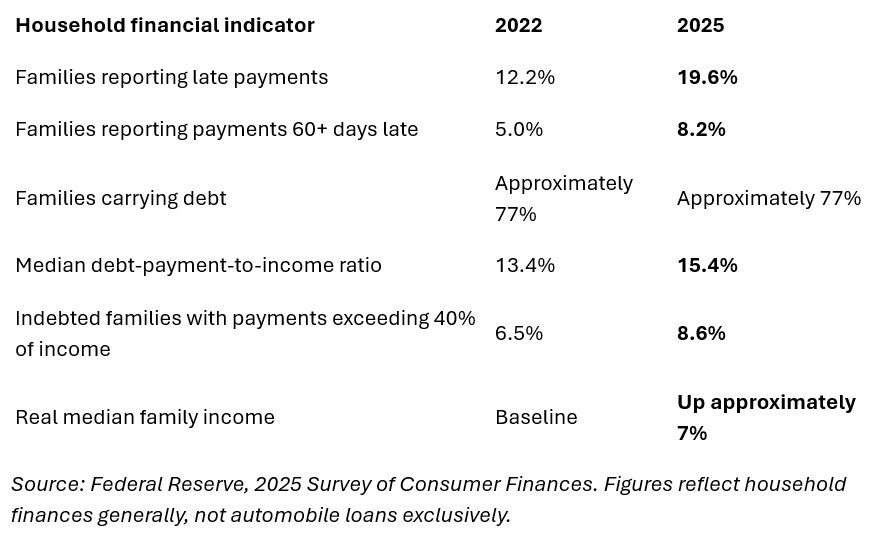
According to the report, 19.6% of American families reported making a late payment in 2025, compared with 12.2% in 2022. That represents an increase of more than 60% in the share of families reporting late payments and the highest level recorded since 2010, when households were still struggling with the aftermath of the Great Recession.
More serious payment problems are also increasing. The percentage of families reporting payments at least two months late climbed from 5% in 2022 to 8.2% in 2025.

For lenders and collection professionals, the figures raise an important question: If household incomes are increasing and debt levels are relatively stable, why are so many more borrowers having difficulty making their payments?
–
–
More Income, More Payment Problems
The Federal Reserve found that real median family income increased approximately 7% between 2022 and 2025, meaning incomes rose even after adjusting for inflation.
Meanwhile, the percentage of families carrying debt remained nearly unchanged at approximately 77%. Median outstanding debt also remained relatively stable in inflation-adjusted dollars.
Yet the financial burden of servicing that debt increased.
The median ratio of required debt payments to family income rose from 13.4% in 2022 to 15.4% in 2025. The percentage of indebted families devoting more than 40% of their income to debt payments increased from 6.5% to 8.6%.
In other words, families were generally not taking on substantially more debt, but many were spending a larger share of their incomes making payments on the debt they already carried.
–
The Cost of Carrying Debt
One possible explanation is the higher cost of borrowing.
Interest rates increased sharply following the pandemic, raising financing costs for consumers purchasing vehicles, refinancing obligations, or carrying variable-rate debt.
At the same time, households continued absorbing the cumulative effects of inflation on housing, groceries, insurance, utilities, transportation, and other everyday expenses.
Although inflation has slowed considerably from its pandemic-era peaks, slower inflation does not mean prices have returned to their previous levels. For many households, those higher costs remain part of the monthly budget.
The Federal Reserve’s findings do not establish how much of the increase in late payments can be attributed to interest rates, inflation, or other factors. However, the combination offers a plausible explanation for why rising incomes have not necessarily translated into stronger payment performance.
A borrower can earn more money than three years ago and still have less money remaining after meeting essential expenses.
–
A Familiar Problem Returns Under Different Circumstances
The last time the percentage of families reporting late payments reached comparable levels was 2010, during the aftermath of the Great Recession.
The economic circumstances were substantially different.
In 2010, widespread unemployment, falling home values, and the lingering effects of the financial crisis contributed to household payment difficulties. The Federal Reserve had reduced short-term interest rates to nearly zero in an effort to stimulate the economy.
Today’s borrowers face a different combination of pressures, including higher borrowing costs and living expenses.
The similarity lies in the outcome rather than the underlying economic conditions: a growing share of American households is having difficulty meeting its financial obligations.
–
What This Means for Collections
For credit union collectors, auto lenders, and loss-mitigation departments, the findings suggest that traditional indicators of borrower financial stability may not tell the whole story.
Employment and rising income do not necessarily guarantee that a borrower has sufficient cash flow to remain current.
A borrower who has maintained steady employment and received wage increases may still be struggling with higher housing expenses, insurance premiums, transportation costs, and required debt payments.
That creates challenges when evaluating payment arrangements, extensions, and other loss-mitigation options.
A temporary financial setback may be resolved through a short-term accommodation. A borrower whose recurring expenses consistently exceed available income presents a more difficult problem.
For automobile lenders, the consequences can extend beyond delinquency. Repeated extensions may postpone default without resolving the underlying affordability problem, while the vehicle securing the loan continues to depreciate.
The Federal Reserve’s survey does not provide a direct measure of automobile repossessions or establish that auto-loan defaults are increasing at the same rate as overall household late payments. Nevertheless, the findings provide important context for the financial pressures that eventually reach collection departments.
–
The Numbers Behind the Delinquency
Perhaps the most revealing finding is not simply that nearly one in five families reported a late payment.
It is that this deterioration occurred during a period when real median household income increased and inflation-adjusted debt balances remained relatively stable.
For collection professionals, that suggests the problem may be less about how much borrowers owe than how much of their income remains available to pay it.
The Federal Reserve’s latest survey offers a reminder that a borrower’s ability to repay is determined not only by income and debt balances, but also by the cost of carrying that debt and the competing demands on the household budget.
And increasingly, those demands appear to be leaving more American families behind on their payments.
Source: Federal Reserve – 2025 Survey of Consumer Finances, released October 9, 2026.
Nearly One in Five American Families Fell Behind on Debt Payments – Nearly One in Five American Families Fell Behind on Debt Payments – Nearly One in Five American Families Fell Behind on Debt Payments
Nearly One in Five American Families Fell Behind on Debt Payments – Credit Union Collections – Credit Union Collectors – Lending – Auto Loan – Delinquency – Lending –






More Stories
STUPID STUFF FRAUDSTERS BUY: Gotta Fraud ’Em All!
The Weak Links: One Loan, Many Points of Attack
Join Us at UCC 2027 – Credit Union Attendees Receive $200 Off
Two Men. Two Stolen Identities. One Greenwich Dealership.
The Risk Didn’t Leave Auto Finance, It Changed Hands
Financed Monday. Exported Friday.