



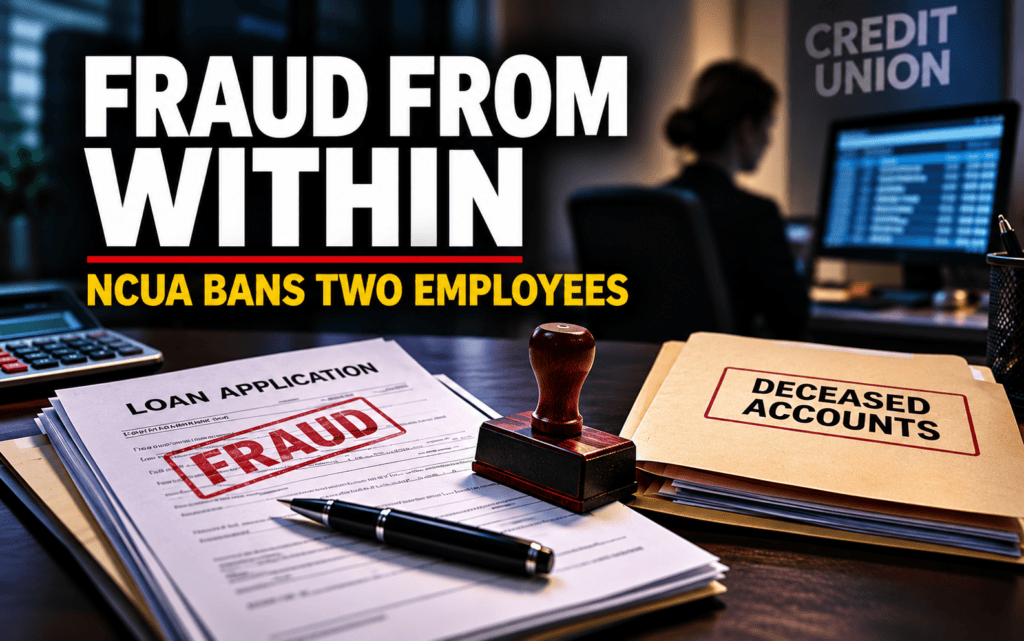
Two former credit union employees are permanently barred from federally insured financial institutions following separate fraud convictions involving more than $358,000 in stolen funds.
–
Alexandria, VA – October 31, 2026 – The National Credit Union Administration (NCUA) announced Friday that it has issued two conviction-based prohibitions against former credit union employees whose crimes involved fictitious loans, unauthorized account transactions and the theft of money belonging to deceased credit union members.
The October 30 announcement names Haley Maxine Snodgrass, a former branch manager at Doches Credit Union in Texas, and Ian Edward Moore, a former member service officer at Heartland Credit Union in Illinois.
Both individuals were previously convicted and sentenced in federal court. The latest NCUA action formally prohibits them from participating in the affairs of federally insured depository institutions without prior written regulatory consent.

Together, their cases involved more than $358,000 in stolen funds and exposed two very different vulnerabilities in credit union internal controls.
–
Texas Branch Manager Used Fake Loans to Steal $281,000
Haley Maxine Snodgrass began working for Doches Credit Union in Nacogdoches, Texas, in 2016, initially as a teller before eventually becoming manager of the credit union’s Hemphill branch.
According to the U.S. Department of Justice, her activities came under scrutiny in April 2023 when an auditor requested a sample of loans from the branch.
The review uncovered missing documentation and unusual transactions involving loans Snodgrass had approved.
A subsequent independent investigation revealed that Snodgrass had been using several methods to divert credit union funds for her personal benefit.
Investigators determined that the schemes included:
- Creating fictitious loans using credit union members’ information.
- Refinancing legitimate loans without the members’ knowledge or consent.
- Misappropriating loan payments.
- Conducting unauthorized transactions involving member accounts.
According to federal court records reported by Credit Union Times, the losses included approximately $176,500 in fictitious loans, $70,993 in unauthorized refinances, $27,419 in unauthorized account transactions and $6,185 in misappropriated payments.
Snodgrass pleaded guilty to credit union theft and admitted embezzling approximately $281,098.
On July 1, 2025, U.S. District Judge Marcia A. Crone sentenced her to 33 months in federal prison and ordered her to pay $330,351.39 in restitution.
The restitution included the stolen funds, accrued interest losses and the cost of the credit union’s forensic investigation.
The case was investigated by the FBI’s Lufkin Field Office and the Texas Department of Public Safety.
–
Illinois Employee Stole From Deceased Members’ Accounts
The second case involved Ian Edward Moore, a former member service officer at Heartland Credit Union in Springfield, Illinois.
According to a June 2025 federal indictment, Moore exploited his responsibilities for handling the accounts of deceased credit union members between 2022 and 2024.
Rather than properly distributing funds to estates, surviving joint account holders or beneficiaries, Moore issued checks payable to himself and made cash withdrawals.
The transactions were presented as legitimate distributions associated with deceased members’ accounts.
Moore subsequently pleaded guilty to six felony counts of bank fraud and one count of credit union theft.
In February 2026, U.S. District Judge Colleen R. Lawless sentenced Moore to time served and three years of supervised release, including six months of home confinement.
He was also ordered to pay $77,099 in restitution and a $700 assessment.
According to court records reviewed by Credit Union Times, several sentencing documents were sealed, including the judge’s explanation for the sentence.
The available records do not establish how many deceased members’ accounts were affected, how the transactions escaped detection for approximately two years or what ultimately exposed the misconduct.
–
Two Different Schemes, Similar Internal-Control Questions
Although the methods differed, both cases illustrate the financial exposure that can arise when employees are able to initiate or process sensitive transactions without sufficient independent verification.
In the Doches Credit Union case, the manipulation of loan records and unauthorized refinancing activity went undetected until a routine audit identified irregularities.
The Heartland Credit Union case raises a different concern involving deceased-member accounts, where account holders cannot identify unauthorized transactions and surviving family members may not have immediate access to account histories.
The cases underscore the importance of independent loan verification, transaction monitoring, separation of duties and additional oversight of estate-related account distributions.
Neither NCUA’s announcement nor the available court records establishes that these particular institutions lacked all such controls. However, the misconduct demonstrates how employees can exploit weaknesses in financial transaction oversight.
–
NCUA Issues Permanent Prohibitions
In its October 30 enforcement announcement, NCUA confirmed that both former employees are prohibited from participating in the affairs of any federally insured depository institution.
The individual notices were dated August 12, 2026, for Snodgrass and October 19, 2026, for Moore.
Under federal law, the prohibitions prevent the individuals from working for, participating in the management of or controlling a federally insured financial institution without prior written regulatory consent.
Violations can result in additional criminal penalties.
While the convictions and sentencing occurred before this week’s announcement, the NCUA action brings renewed attention to two cases involving employees entrusted with protecting credit union members’ money.
And in both cases, the institutions’ greatest fraud exposure came not from an outside criminal attempting to gain access, but from employees who already had it.
Sources: NCUA October 30 Enforcement Announcement | U.S. Department of Justice – Snodgrass Sentencing | NCUA – Haley Snodgrass Prohibition | NCUA – Ian Moore Prohibition | Credit Union Times – October 30, 2026
Fake Loans and Dead Members’ Accounts: NCUA Bans Two Former Credit Union Employees – Fake Loans and Dead Members’ Accounts: NCUA Bans Two Former Credit Union Employees – Fake Loans and Dead Members’ Accounts: NCUA Bans Two Former Credit Union Employees
Fake Loans and Dead Members’ Accounts: NCUA Bans Two Former Credit Union Employees – Police – Police – Arrest – Arrest – Credit Union Collections – Credit Union Collectors – Lending – Fraud – Fraud – NCUA – NCUA





More Stories
CCUCC Honors Industry Leaders at Record-Setting Anaheim Conference
Stupid Stuff Fraudsters Buy: The $250 Million Pool Shark
Argos Risk Announces Partnership with Credit Union Loan Source
The New Face of Auto Theft: Financing Fraud
STUPID STUFF FRAUDSTERS BUY: Et Tu, Fraudster?
Ally Keeps Growing as Auto Loan Delinquencies and Losses Edge Higher