




New York Fed data shows auto loan balances 90 days past due climbing 18% in one year, even as the pace of new serious delinquencies begins to stabilize.
–
November 12, 2026 — American consumers are falling further behind on their auto loans, with the amount of seriously delinquent auto debt increasing by approximately $15 billion over the past year, according to newly released Federal Reserve Bank of New York data.
The New York Fed’s Q3 2026 Household Debt and Credit Report reveals that approximately $98.1 billion in outstanding auto loan balances were at least 90 days delinquent at the end of September, compared with approximately $83.1 billion a year earlier.
That represents an increase of approximately 18% in seriously delinquent auto loan balances, even as the rate at which additional borrowers are falling seriously behind has begun to stabilize.

For auto lenders, credit unions and the repossession industry, the findings present a troubling contradiction. While the deterioration in new serious delinquencies appears to be slowing, the volume of existing troubled auto debt continues to grow.
Serious Auto Loan Delinquencies Continue Climbing
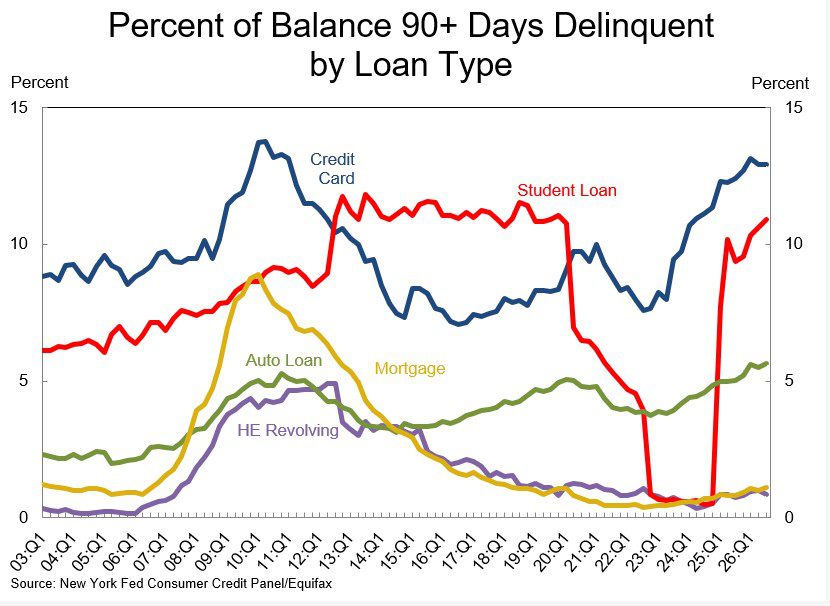
According to the New York Fed’s underlying data, the percentage of outstanding auto loan balances at least 90 days delinquent reached 5.66% in Q3 2026, compared with 5.49% in the previous quarter and 5.02% one year earlier.
That represents a 0.64-percentage-point increase over the past year, or approximately 12.7% relative growth in the delinquency rate.
The increase comes as total outstanding auto loan debt continues expanding, reaching $1.734 trillion at the end of September, up from $1.655 trillion a year earlier.
Together, these developments have pushed the dollar value of seriously delinquent auto debt substantially higher.
| Auto Loan Indicator | Q3 2025 | Q3 2026 |
| Outstanding auto loan balances | $1.655 trillion | $1.734 trillion |
| Share of balances 90+ days delinquent | 5.02% | 5.66% |
| Estimated balances 90+ days delinquent | $83.1 billion | $98.1 billion |
| Transition into 30+ day delinquency | 7.79% | 7.96% |
| Transition into 90+ day delinquency | 2.99% | 3.02% |
The dollar estimates are calculated from the New York Fed’s reported balances and delinquency percentages.
Delinquencies Remain Above Great Recession Levels
The historical data provides additional perspective on the severity of current auto loan performance.
The share of auto loan balances at least 90 days delinquent has risen substantially since the unusually low levels recorded during the pandemic.
At 5.66%, the current rate is also above the approximately 5% level reached during the aftermath of the 2008 financial crisis.
Although the lending environment, vehicle prices, loan sizes and borrower composition have changed considerably since that period, the comparison illustrates how elevated serious auto loan delinquency has become.
Unlike the Great Recession, however, today’s auto credit problems are occurring while lenders continue originating substantial volumes of new loans.
The New York Fed reports that $208 billion in new auto loans appeared on consumer credit reports during the third quarter of 2026. The credit quality of newly originated loans remained largely steady.
That combination suggests the auto lending market continues expanding despite persistent repayment problems among existing borrowers.
Early Delinquencies Rise, but New Serious Defaults Stabilize
Perhaps the most important distinction in the latest report involves the difference between borrowers entering delinquency and those progressing into serious delinquency.
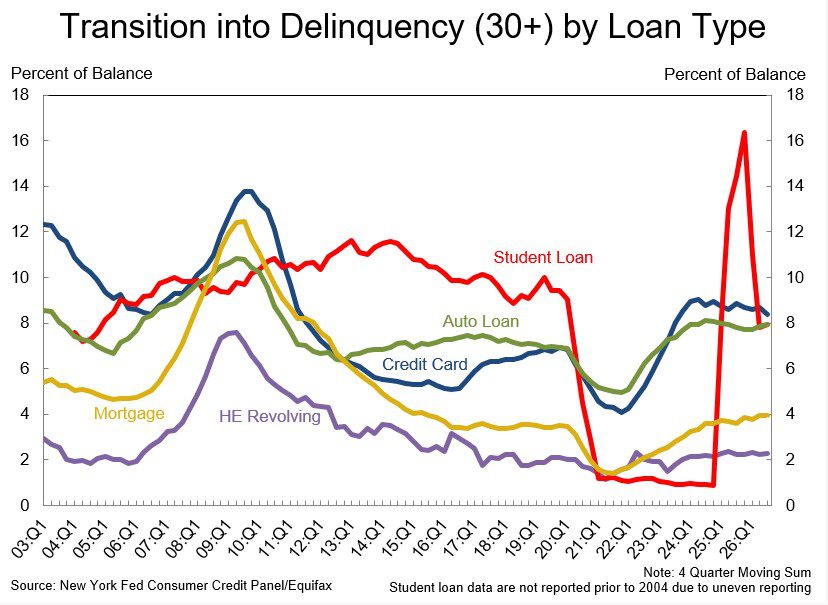
The New York Fed reports that the rate at which auto loan balances transitioned into delinquency of at least 30 days increased from 7.79% in Q3 2025 to 7.96% in Q3 2026.
This indicates that additional previously current auto loan balances continue falling behind.
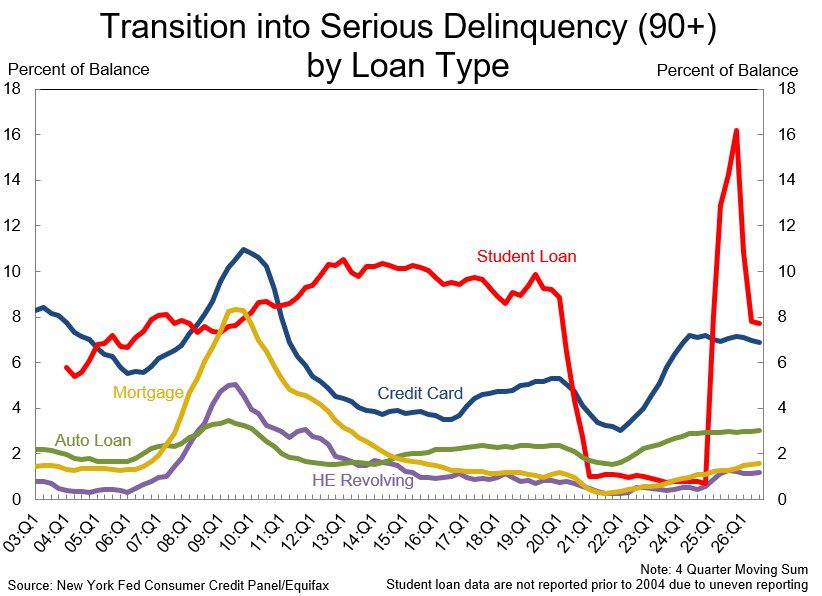
However, the rate at which auto loan balances transitioned into serious delinquency of at least 90 days changed very little.
That measure increased from 2.99% a year earlier to 3.02% in the latest quarter.
Both transition measures represent four-quarter moving sums rather than the percentage of all outstanding loans currently delinquent.
–
The distinction is significant.
While more auto loan balances continue entering the early stages of delinquency, the rate at which balances deteriorate into serious delinquency is no longer increasing substantially.
Several factors could contribute to this development, including collection efforts, payment arrangements, loan extensions, modifications and borrowers bringing accounts current.
However, the New York Fed report does not identify which of these factors, if any, are responsible for the stabilization.
Nor does the leveling off in new serious delinquencies mean the existing volume of troubled loans has declined.
On the contrary, the dollar value of seriously delinquent auto debt continues increasing.
Younger Borrowers Continue Struggling
The report also reveals substantial differences in auto loan repayment performance across borrower age groups.
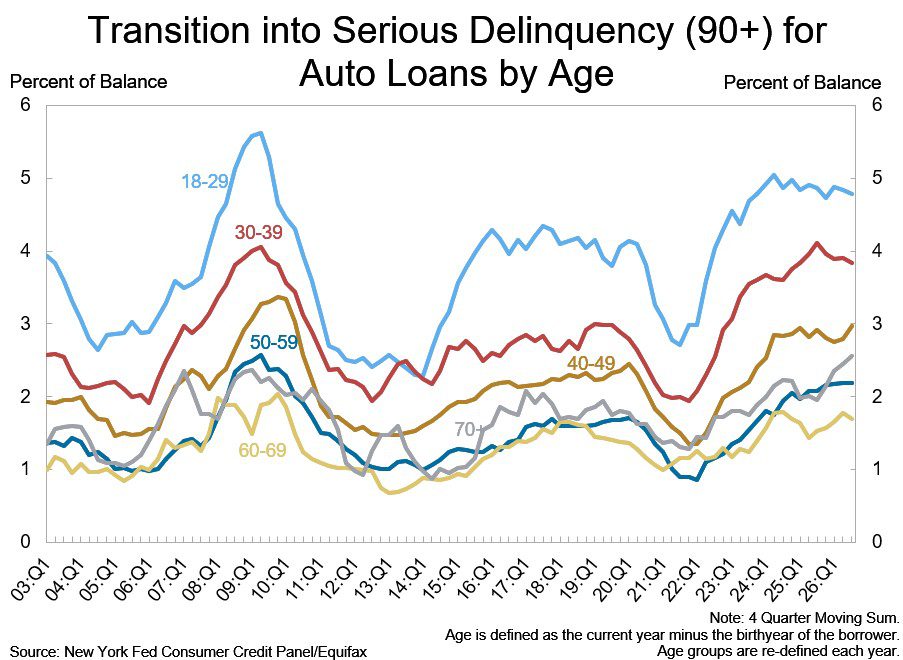
Consumers under 40 continue experiencing significantly higher rates of serious auto loan delinquency than older borrowers.
For the four quarters ending in Q3 2026, the transition rate into serious auto loan delinquency was approximately 4.79% among borrowers ages 18–29 and 3.84% among those ages 30–39.
By comparison, the rate was approximately 2.19% among borrowers ages 50–59 and 1.69% among borrowers ages 60–69.
| Borrower Age | Transition into 90+ Day Delinquency |
| 18–29 | 4.79% |
| 30–39 | 3.84% |
| 40–49 | 2.97% |
| 50–59 | 2.19% |
| 60–69 | 1.69% |
| 70+ | 2.56% |
The figures show that the youngest borrowers are experiencing serious delinquency transitions at nearly three times the rate of consumers ages 60–69.
While the rate among borrowers under 30 has declined slightly from a year earlier, it remains elevated by historical standards.
The age differences suggest that lenders with greater exposure to younger borrowers could face more persistent collection challenges than institutions serving older borrower populations.
What Does This Mean for Repossessions?
For the repossession industry, the continued increase in seriously delinquent auto debt raises an obvious question: Why aren’t elevated delinquency levels necessarily producing a corresponding acceleration in repossession activity?
The answer is that delinquency and repossession are not interchangeable measurements.
A loan becoming 90 days delinquent does not automatically result in a repossession assignment. Lenders may pursue additional collection efforts, extend payment terms, modify loans, establish repayment arrangements or delay recovery decisions.
Likewise, the dollar value of delinquent auto debt does not establish how many vehicles are available for repossession.
Higher vehicle prices, larger original loan amounts and longer financing terms can increase delinquent balances without producing a proportional increase in the number of delinquent accounts.
The New York Fed report measures outstanding balances and delinquency transitions. It does not report repossession assignments, completed recoveries or the number of auto loans at least 60 days past due.
Nevertheless, the increase in seriously delinquent balances indicates that financial pressure within existing auto loan portfolios remains substantial.
For recovery agencies, this could mean continued demand for collateral recovery services, although the timing and volume of assignments will depend heavily on individual lender policies and collection strategies.
The stabilization in serious delinquency transitions also suggests that recovery agencies should not assume that elevated delinquency balances will automatically produce continued growth in assignments.
More Loans, More Delinquent Dollars
Another important development is the continued expansion of the overall auto loan market.
Outstanding auto loan balances increased by $21 billion during the third quarter alone, reaching $1.734 trillion.
Over the past year, balances increased by approximately $79 billion.
The combination of expanding loan balances and rising serious delinquency percentages means the total amount of delinquent auto debt is increasing faster than the overall loan
Seriously Delinquent Auto Loan Debt Jumps $15 Billion as Borrower Distress Persists – Seriously Delinquent Auto Loan Debt Jumps $15 Billion as Borrower Distress Persists – Seriously Delinquent Auto Loan Debt Jumps $15 Billion as Borrower Distress Persists
Seriously Delinquent Auto Loan Debt Jumps $15 Billion as Borrower Distress Persists – Repossession – Repossession – Credit Union Collections – Credit Union Collectors – Lending – Auto Loan – Delinquency







More Stories
Credit Washing Goes Industrial as Identical CFPB Complaints Flood the System
Phantom Auto Loans: Georgia Man Sentenced for $450,000 Fraud Scheme
Credit Union Auto Loan Growth Masks Stubborn Delinquencies
Credit Union Hardship Modifications Surge 23% as Navy Federal Accounts for Much of the Increase
NCUA Plans $4.3 Million AI Push to Detect Fraud
Fake Loans and Dead Members’ Accounts: NCUA Bans Two Former Credit Union Employees