



Earn $300–$500 per vehicle. No money required. Just bring your driver’s license.
–
November 24, 2026 – Mississauga, Ontario, Canada – Looking for a little extra Christmas money? How about earning $300 to $500 for buying a new car with someone else’s money? No investment required, no credit impact and no experience necessary. All you need is a driver’s license and a willingness to purchase a vehicle in your own name for someone else. Sound familiar? Welcome to the surprisingly public world of professional automotive straw buying.
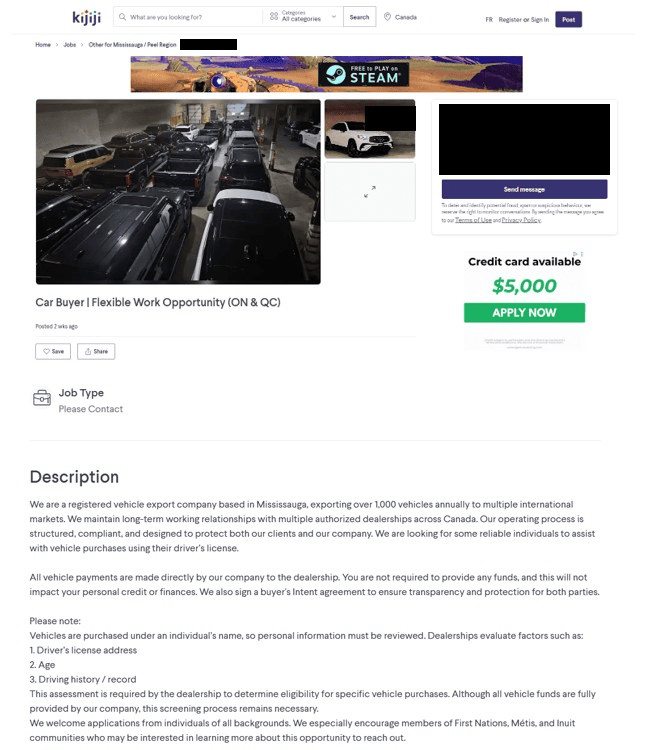
Recently highlighted by fraud expert Frank McKenna of Frank on Fraud, an advertisement appearing on the popular Canadian online classified advertising platform Kijiji is openly recruiting individuals to purchase vehicles on behalf of an international vehicle exporter.
Titled “Car Buyer | Flexible Work Opportunity (ON & QC),” the advertisement claims to represent a registered vehicle export company based in Mississauga, Ontario, that exports more than 1,000 vehicles annually to international markets and maintains relationships with authorized dealerships across Canada.

From the advertisement:
“We are looking for some reliable individuals to assist with vehicle purchases using their driver’s license. All vehicle payments are made directly by our company to the dealership. You are not required to provide any funds, and this will not impact your personal credit or finances.”
The advertisement goes on to explain that vehicles are purchased in the individual’s name and that dealerships may evaluate prospective purchasers based on their age, driver’s license address and driving history.
Interested applicants are asked to submit photographs of both sides of their driver’s license and their availability. Compensation ranges from $300 to $500 per vehicle.
Curiously, the advertisement also specifically encourages members of First Nations, Métis and Inuit communities to apply.
The advertiser repeatedly characterizes the arrangement as legal, transparent and compliant. Whether the operation meets all applicable regulatory requirements has not been independently established.
–
Why Would an Exporter Need You to Buy Their Cars?
If an international vehicle exporter has the financial resources to purchase more than 1,000 vehicles annually, why would it need to recruit strangers off the internet to purchase them?
The answer may lie in the lucrative international gray market for new automobiles.
Automobile manufacturers have a vested interest in protecting their international distribution networks, regional pricing structures and authorized dealership territories. Significant differences in vehicle prices and availability between countries can make purchasing vehicles in North America and exporting them overseas an exceptionally profitable business.
To protect those markets, some manufacturers and dealerships restrict sales to known or suspected exporters. The use of individual buyers provides a means of circumventing those restrictions when the intended export is not disclosed.
The individual receives a relatively modest commission while the exporter stands to profit from the difference between the vehicle’s domestic purchase price and its overseas market value.
And this is hardly a new business.
–
Confessions of a Straw Buyer
In a previous CUCollector article, Confessions of a Straw Buyer, we highlighted a fascinating July 2018 Car and Driver feature written by Travis Simpkins, a self-described professional straw buyer.
In 2013, Simpkins was an unemployed former convict living in Georgia. Within months, he was purchasing high-end luxury vehicles on behalf of a California-based exporter.
By late November of that year, he had purchased more than a dozen luxury vehicles worth nearly $1 million.
According to Simpkins, individual straw buyers could earn commissions ranging from $500 to $7,000 per vehicle. But it was not a business that offered much in the way of career longevity. As manufacturers identified and blacklisted suspected exporters and their buyers, individuals became increasingly unable to purchase additional vehicles.
Eventually, even his mother was refused a vehicle purchase after a dealership recognized the family name.
Eight years after the publication of that article, the recruitment of individual vehicle purchasers for international export appears to remain alive and well. And apparently, there is little need to conceal the recruitment process.
–
Is It Legal?
Purchasing a vehicle for export is not inherently illegal. Nor is purchasing a vehicle on behalf of another party necessarily fraudulent.
However, deliberately misrepresenting the identity of the actual purchaser, the intended use of the vehicle or its ultimate destination can raise substantial legal and contractual issues.
In 2013, the U.S. Attorney’s Office for the Southern District of New York announced a civil forfeiture action targeting four bank accounts and 47 luxury vehicles associated with an alleged international vehicle export scheme.
Federal authorities alleged that the exporter had recruited straw buyers, misrepresented the intended use of vehicles to dealerships and insurance companies, and subsequently exported the vehicles, primarily to China.
Approximately $3.7 million had been seized from the associated bank accounts.
Interestingly, the alleged scheme involved vehicles purchased outright using funds supplied by the exporter, not conventional auto loan fraud. The forfeiture complaint nevertheless alleged that fraudulent representations had been made during the transactions.
In Canada, the Ontario Motor Vehicle Industry Council (OMVIC) maintains specific registration and compliance requirements for commercial vehicle exporters under the province’s Motor Vehicle Dealers Act.
The existence of a legitimate vehicle export industry does not, in itself, establish the legitimacy of every purchasing arrangement used within it.
–
What Happens When Financing Enters the Equation?
For credit unions and other auto lenders, the most significant concern is not necessarily the existence of the international automotive gray market. It is what happens when the same purchasing model incorporates financing.
While the Canadian advertisement specifically states that vehicles are purchased with company funds, Simpkins acknowledged in his 2018 account that financed purchases also occurred within the export-oriented straw-buying business.
Consider the potential consequences of an individual with an acceptable credit profile obtaining an auto loan for a vehicle that is actually destined for an overseas commercial buyer.
The application may contain a legitimate driver’s license, verifiable employment, an established residence and a satisfactory credit history. Unlike synthetic identity fraud or conventional identity theft, the person applying for the loan may be exactly who they claim to be.
What they may not be is the actual intended user or beneficiary of the vehicle.
Should that loan go into default after the vehicle has been exported, the lender could find itself holding a valid loan agreement secured by collateral that is thousands of miles away, potentially beyond any practical or economically viable means of recovery.
For the collections department, the warning signs may not become apparent until the first payment is missed, the borrower is contacted and the whereabouts of the vehicle cannot be established.
For the repossession agency, it could mean countless wasted hours searching for a vehicle that is no longer even on the continent.
And American lenders need not look across the Canadian border for evidence of the financial risks associated with commercial straw buying.
In June 2026, the Florida Office of Financial Regulation announced the sentencing of a man to 99 months in federal prison for his role in a $3.6 million auto lending fraud scheme.
Approximately 16 straw buyers had been recruited to finance 90 vehicles under the promise of shared profits from a commercial rental operation. When the loan payments stopped, the recruited buyers were left to face the financial consequences, with some ultimately forced into bankruptcy.
Earlier that same year, Miami-Dade investigators uncovered an alleged auto loan fraud operation involving more than $1.5 million in financing, dealership finance personnel, a broker and 11 straw buyers.
Investigators described brokers recruiting individuals willing to lend their identities and creditworthiness in exchange for compensation. Authorities also identified fraudulent lien removal as a means by which criminal organizations could profit from the subsequent sale or export of vehicles.
–
A Ready-Made Recruitment Network
The automotive lending industry spends considerable resources developing tools to detect stolen identities, synthetic identities, fabricated income, fraudulent employment and manipulated credit profiles.
But the professional straw buyer presents a distinctly different challenge.
These are potentially real people with real identities, real addresses and legitimate credit histories who are willing to participate in transactions on behalf of others for relatively modest financial compensation.
For lenders, unexplained third-party involvement in vehicle purchases, unusual payment arrangements, multiple recent auto loan inquiries and inconsistencies between applicants’ stated vehicle use and actual possession may warrant additional scrutiny when considered alongside other risk indicators.
There is no evidence that the Canadian advertisement has resulted in fraudulent auto loans, and it would be inappropriate to suggest otherwise.
What it does demonstrate, however, is that an established commercial market exists for recruiting individuals willing to purchase vehicles in their own names for someone else’s benefit.
For an organized auto loan fraud operation, the most difficult part of acquiring a credible borrower may not be manufacturing an identity at all.
It may be as simple as placing a help wanted ad.
Sources and related reading:
- Confessions of a Straw Buyer – CUCollector
- How I Bought Millions of Dollars’ Worth of Luxury Cars and Got Blacklisted – Car and Driver, June 22, 2018
- Manhattan U.S. Attorney Announces Civil Forfeiture Action Tied to Auto Export Scheme – U.S. Department of Justice, November 8, 2013
- Exporter Guidelines – Ontario Motor Vehicle Industry Council
- Car Buyer | Flexible Work Opportunity (ON & QC) – Kijiji
Straw Buyers Wanted – The Surprisingly Public Business of Buying Cars for Export – Straw Buyers Wanted – The Surprisingly Public Business of Buying Cars for Export – Straw Buyers Wanted – The Surprisingly Public Business of Buying Cars for Export
Straw Buyers Wanted – The Surprisingly Public Business of Buying Cars for Export – Lending – Auto Loan – Credit Union Collections – Credit Union Collectors – Lending – Fraud – Auto Loan – Skip – Skip – Auto Loan – Transport



More Stories
Alleged $2 Million Fraud and 12 Years on the Run – Credit Union Mortgage Manager Caught
A Former NFL Star, Stolen Millions, a Rolls-Royce, and a Credit Union
More Powersports Vehicles Hit Auction, but Collateral Values Aren’t Crashing
Credit Washing Goes Industrial as Identical CFPB Complaints Flood the System
Phantom Auto Loans: Georgia Man Sentenced for $450,000 Fraud Scheme
Gunman Kills One in Rampage over $2,556 Citibank Credit Card Debt