




Lower-credit borrowers gain as independent finance grows
–
The auto finance market is growing again, but beneath the relatively modest headline numbers, the borrowers receiving those loans, and the lenders making them, are beginning to look different. New TransUnion data shows subprime and near-prime originations rising as super-prime borrowing declines, while independent finance companies capture a growing share of used-vehicle lending.
According to TransUnion’s Q2 2026 Credit Industry Insights Report, auto loan originations increased 1.3% year over year during the first quarter of 2026, reaching approximately 6.4 million.
Read the Entire Report Here!
On its face, that is hardly dramatic growth.

But a closer look at the credit tiers behind those originations tells a much more interesting story.
Recent analysis of the TransUnion data reported by Car Dealership Guy shows subprime originations increased 7.5% year over year, while near-prime originations increased 4.1%.
At the opposite end of the credit spectrum, super-prime originations declined 2.8%.
That means the growth occurring in auto finance is increasingly coming from borrowers farther down the credit ladder.
–
The Super-Prime Boom May Be Running Out of Steam
For much of the past several years, stronger-credit borrowers helped carry the auto market through extraordinarily high vehicle prices and financing costs.
That may be changing.
Satyan Merchant, senior vice president and automotive and mortgage business leader at TransUnion, noted that super-prime and prime-plus borrowers had produced some of the strongest year-over-year growth during previous quarters.
Now, he suggested, some of that demand may simply have been exhausted.
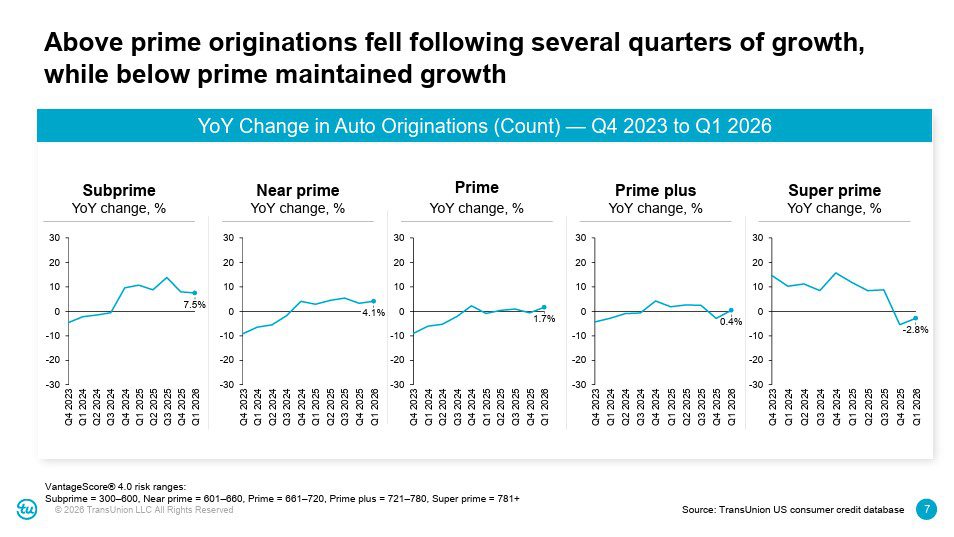
Super-prime originations remain an enormous portion of the auto finance market, but their decline comes as lower-credit tiers continue moving in the opposite direction.
That shift becomes particularly important when combined with another change occurring in the market: who is providing the financing.
–
Independent Finance Companies Are Taking More of the Used-Car Market
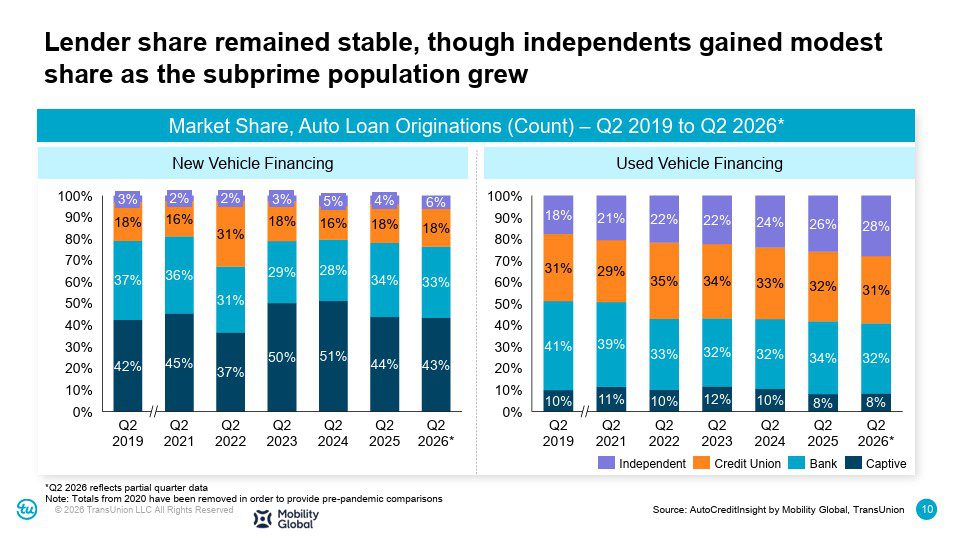
Banks and credit unions have traditionally played major roles in used-vehicle financing. But their share of that market is slipping while independent finance companies continue gaining ground.
According to the analysis of TransUnion’s data, independent finance companies now account for approximately 28% of used-vehicle financing, their largest share recorded in the data.
That represents an increase of roughly 10 percentage points since 2019.
“Independent lending is the area we’re seeing a little growth in,” Merchant told Car Dealership Guy. “It’s the largest share they’ve had, and up to 28% is remarkable.”
The combination is notable.
More lower-credit borrowers are entering the market at the same time that a larger portion of used-vehicle financing is migrating toward independent lenders.
For the collections and repossession industries, that may matter considerably more than the 1.3% increase in overall originations.
–
More Risk Is Not Yet Showing Up as a Delinquency Surge
There is an important counterpoint.
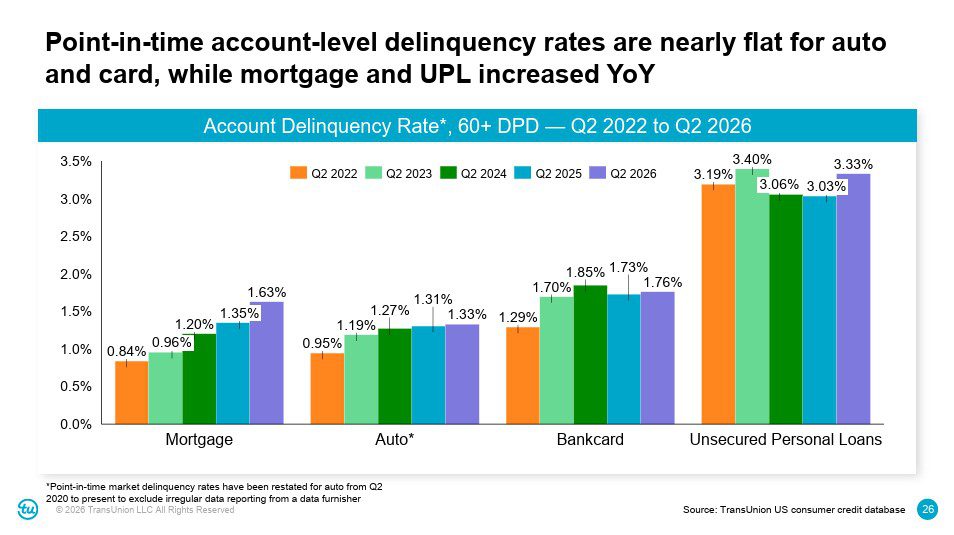
The latest TransUnion numbers do not show an immediate deterioration in overall auto credit performance.
Serious account-level auto delinquency of 60 days or more stood at 1.33% during the second quarter, just two basis points higher than a year earlier. TransUnion noted that the pace of deterioration has slowed, potentially indicating that credit performance is beginning to stabilize.
But affordability remains under substantial pressure.
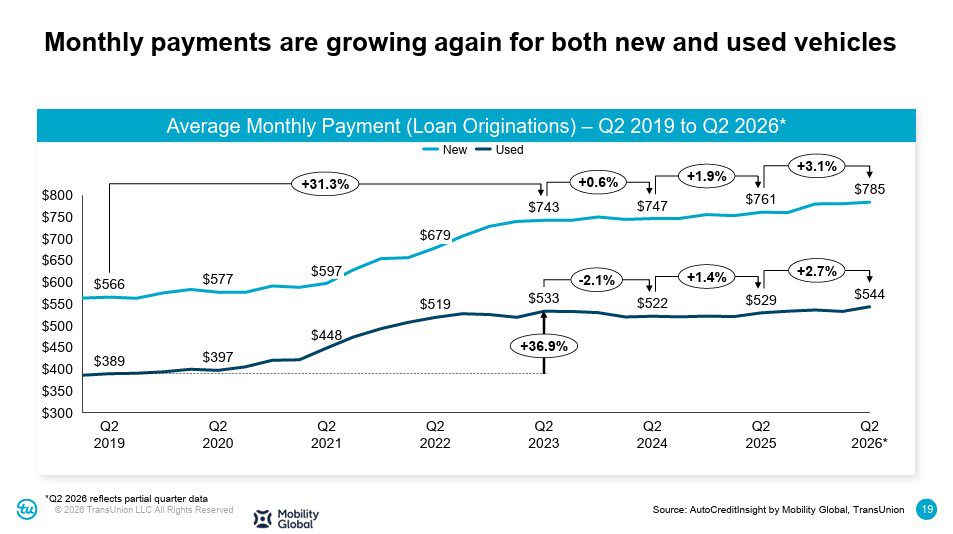
TransUnion reports that average monthly payments have increased 38.7% for new vehicles and 39.6% for used vehicles since 2019, outpacing both inflation and wage growth.
Average payments now stand at approximately $785 for new vehicles and $544 for used vehicles.
Meanwhile, the average amount financed has risen to $44,421 for new vehicles and $27,633 for used vehicles.
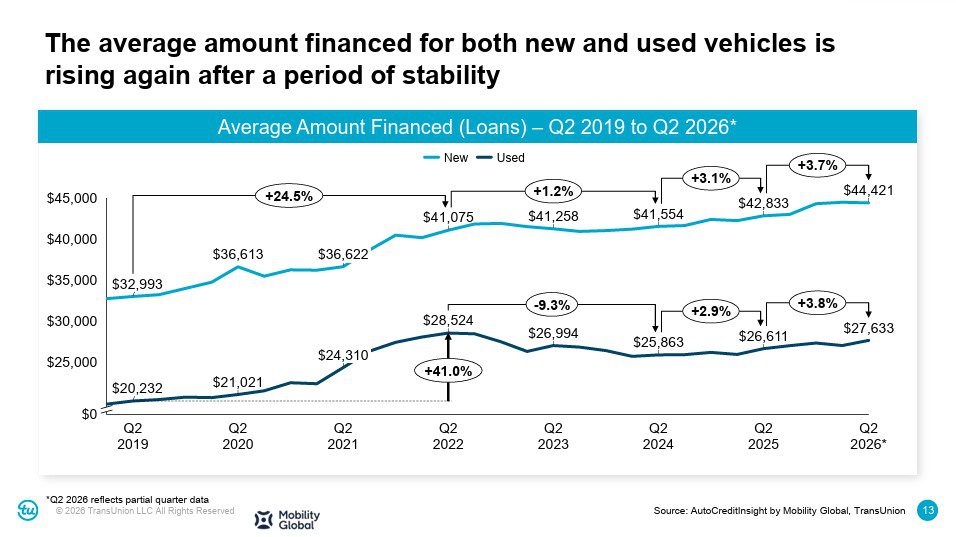
In other words, delinquency may be stabilizing, but borrowers are stabilizing at historically expensive payment levels.
And increasingly, the borrowers entering the market are coming from lower credit tiers.
Read the Entire Report Here!
–
The Repossession Market May Be Moving with Them
For the repossession industry, the lender shift may deserve just as much attention as the borrower shift.
Traditional repossession statistics and industry discussions frequently center around banks, credit unions, major captive finance companies and large national independent lenders.
But a growing portion of higher-risk auto finance activity exists outside those traditional channels.
That became particularly apparent in a Federal Reserve study of Buy-Here-Pay-Here lending published earlier this year.
The Fed found that approximately 78% of BHPH lending volume was originated to subprime borrowers, compared with about 27% among traditional auto lenders.
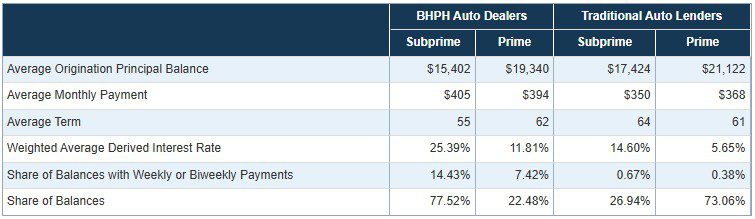
The differences became even more dramatic when researchers examined repossession activity.
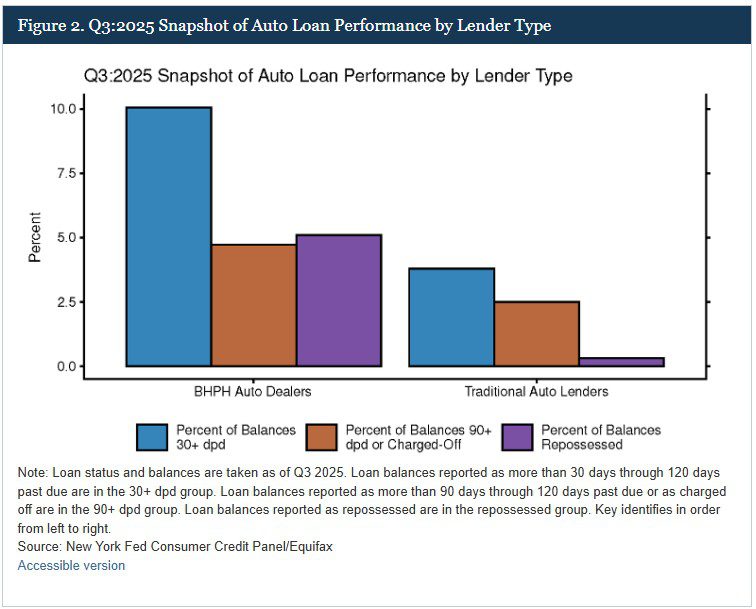
As of the third quarter of 2025, approximately 5% of BHPH loan balances were in active repossession status, compared with less than one-half of one percent among traditional auto lenders.
According to the Federal Reserve analysis, BHPH loans were approximately 16.6 times more likely to be in active repossession status than loans originated through traditional auto finance.
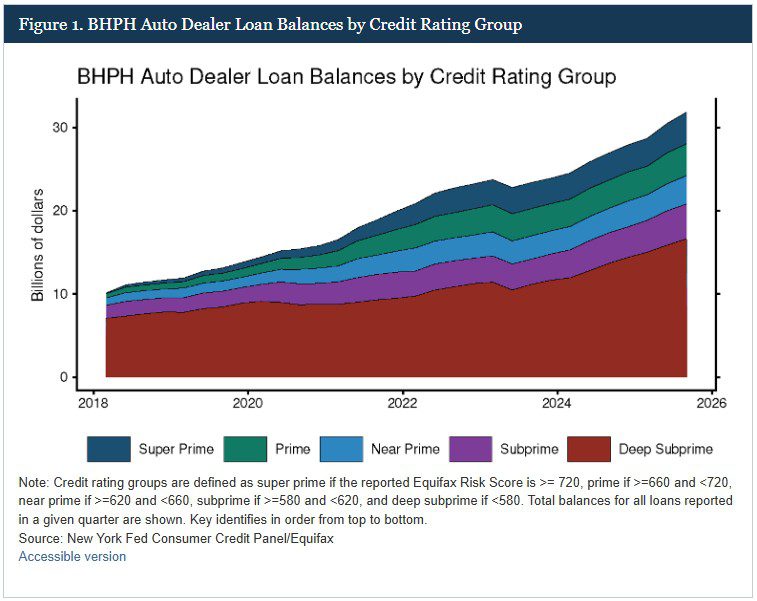
BHPH lending remains a relatively small piece of the overall $1.6 trillion auto loan market measured by the Fed. But it is growing rapidly.
The Federal Reserve found BHPH loan balances increased 214% between 2018 and 2025, compared with growth of 34% for traditional auto finance over the same period.
National estimates cited by the Fed suggest BHPH dealers originate approximately 6% of U.S. auto loans.
Read the Fed Report Here!
–
A Repossession Data Blind Spot?
Put these trends together and a potentially important question emerges.
What if the repossession market is gradually shifting toward the lenders and dealers that are least visible in conventional industry statistics?
The latest TransUnion numbers show lower-credit borrowers accounting for a growing portion of new originations.
They also show independent finance companies gaining significant share in used-vehicle lending.
Separately, Federal Reserve research shows that the BHPH sector, which serves an overwhelmingly subprime customer base, uses repossession substantially more frequently than traditional lenders.
None of this means a sudden surge in repossessions is inevitable. Current TransUnion delinquency data does not support that conclusion.
But it does suggest that simply watching aggregate auto originations or the recovery activity of major banks, credit unions and national finance companies may provide an increasingly incomplete picture of where future repossession demand is developing.
The headline growth in auto lending may only be 1.3%.
The more important story could be where that growth is going.
–
Some Repossessions May Never Enter the Traditional Industry Data Stream
There is another complication when attempting to measure repossession activity among smaller independent and Buy-Here-Pay-Here lenders.
Unlike large banks, credit unions and national finance companies, BHPH dealers may handle collections and vehicle recoveries internally or rely on local towing companies and other recovery providers operating outside the larger professional repossession networks.
That distinction matters.
A repossession assignment placed by a major lender through one of the industry’s national forwarding or assignment-management platforms has a much greater likelihood of becoming visible within the traditional repossession industry’s data ecosystem.
A vehicle recovered directly by a BHPH dealer, or assigned to a small local operator outside those systems, may not.
There is no comprehensive national dataset showing how many BHPH repossessions are performed internally, by professional repossession agencies, or through other local recovery providers. That absence of data is itself significant.
If lower-credit auto lending continues migrating toward independent finance companies and BHPH dealers, some portion of the resulting repossession activity could be occurring beyond the field of view of the statistics traditionally used to measure the professional recovery industry.
That creates the possibility of a growing disconnect between how many vehicles are actually being repossessed and how many repossessions the traditional industry can see.
–
–
Related:
Federal Reserve Data Exposes the Other Repossession Industry
Auto Lending Is Moving Down the Credit Risk Ladder – Collections and Repo May Follow – Auto Lending Is Moving Down the Credit Risk Ladder – Collections and Repo May Follow – Auto Lending Is Moving Down the Credit Risk Ladder – Collections and Repo May Follow
Auto Lending Is Moving Down the Credit Risk Ladder – Collections and Repo May Follow – Repossess – Repossession – Repossession Agency – Repossessor – Repossession – Repossession News – Credit Union Collections – Credit Union Collectors – Lending – Auto Loan – TransUnion – TransUnion – Lending – Subprime Auto Loans – Subprime Auto Loans







More Stories
STUPID STUFF FRAUDSTERS BUY: Gotta Fraud ’Em All!
The Weak Links: One Loan, Many Points of Attack
Join Us at UCC 2027 – Credit Union Attendees Receive $200 Off
Two Men. Two Stolen Identities. One Greenwich Dealership.
The Risk Didn’t Leave Auto Finance, It Changed Hands
Financed Monday. Exported Friday.