


New NICB report warns that vehicle finance fraud is rising while conventional theft statistics may be missing a significant part of the problem.
–
Oak Brook, IL – October 20, 2026 – Automobile thefts are declining across the United States, but a new report from the National Insurance Crime Bureau (NICB) warns that criminals are increasingly exploiting vehicle financing systems to acquire automobiles through fraud rather than conventional theft.
The distinction raises an important question for lenders, insurers, and law enforcement: How many vehicles obtained through fraudulent financing never appear in national motor vehicle theft statistics?
In its 2026 Vehicle Finance Fraud Threat Assessment, released October 19, NICB estimates national automobile lending fraud exposure at $10.4 billion and warns that organized criminal networks are increasingly exploiting weaknesses in vehicle financing, identity verification, and reporting systems.

–
Fraud Exposure Continues to Grow
According to NICB, industry research indicates that as many as 24% of automobile loan defaults may be associated with fraud, while 77% of dealerships reported increased fraudulent activity over the preceding two years.
Nearly 70% of vehicle finance fraud involves first-party fraud, including borrowers misrepresenting income, employment, or other financial information. Synthetic identities, stolen personal information, and organized fraud operations also contribute to the problem.
The report indicates that likely synthetic identity borrowers default at rates 12.5 times higher than ordinary consumers, with average losses ranging from $22,000 to $50,000 per case.
NICB also identifies credit washing as an expanding concern, reporting a 228% increase in suspected activity between early 2024 and mid-2025. These schemes can involve fraudulent identity-theft claims and falsified documentation intended to remove legitimate derogatory information from consumer credit reports.
The figures come from different industry studies and should not be interpreted as a single national measurement of confirmed fraud.
–
A Vehicle Can Disappear Without Being Counted as Stolen
One of the report’s more significant findings concerns how vehicles acquired through fraud are classified.
According to NICB, federal crime-reporting standards distinguish conventional motor vehicle theft from vehicles obtained through fraud, forgery, or false pretenses.
Under the FBI’s National Incident-Based Reporting System, an automobile unlawfully taken without permission may be classified as motor vehicle theft, while a vehicle obtained through fraudulent financing may instead be recorded under a fraud offense.
Consequently, a vehicle acquired using a synthetic identity, fraudulent loan application, or stolen personal information may never appear in conventional motor vehicle theft statistics.
That does not mean the transaction is legal or that the vehicle cannot be considered stolen under other criminal statutes. Federal law can recognize certain fraudulently acquired vehicles as stolen, depending on the circumstances.
The distinction is primarily one of criminal classification and statistical reporting.
–
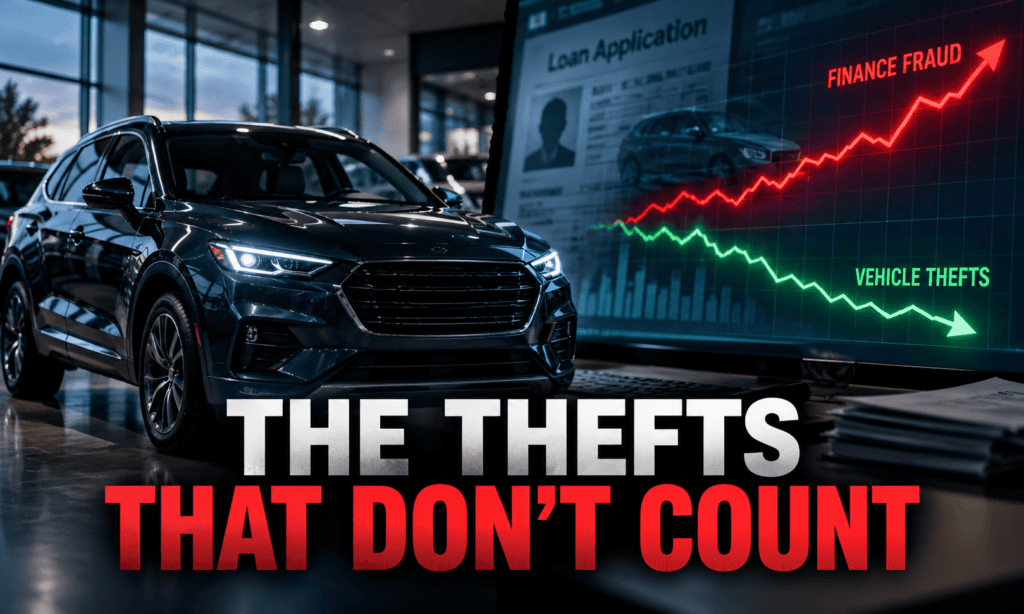
Theft Statistics Decline as Finance Fraud Threats Grow
The reporting gap is particularly relevant because NICB recently announced that conventional motor vehicle thefts declined 21% during the first half of 2026 compared with the same period in 2025.
During that period, 268,415 vehicles were reported stolen nationwide.
However, those figures do not necessarily include automobiles obtained through fraudulent financing transactions, even when the vehicles subsequently disappear, are resold, or are transported overseas.
The decline in conventional thefts does not establish that criminals are shifting into financing fraud. Nevertheless, the two trends raise questions about whether traditional vehicle theft statistics adequately reflect the full extent of criminal vehicle acquisitions.
–
NICB Calls for Better Industry Coordination
NICB warns that fragmented reporting among dealerships, lenders, insurers, and law enforcement agencies creates opportunities for organized fraud networks.
“Vehicle finance fraud has evolved from isolated credit misrepresentations into an organized, digital criminal industry that touches dealerships, lenders and insurers,” said NICB Chief Operating Officer Timothy R. Slater.
The organization is calling for improved information sharing, stronger fraud detection, and more consistent reporting across the industries involved in vehicle financing and recovery.
For credit unions and other automobile lenders, the implications extend beyond loan origination. Fraudulent financing can produce early defaults, unrecoverable collateral, and losses that may initially resemble ordinary credit deterioration.
NICB’s $10.4 billion estimate represents fraud exposure, not a confirmed total of lost or unrecovered vehicles. The report does not establish how many fraudulently acquired automobiles are excluded from national theft statistics.
But it identifies a significant limitation in how vehicle-related crime is measured.
A declining vehicle theft rate may be encouraging news, but it does not necessarily mean fewer automobiles are being acquired through criminal activity.
When a Car Is Obtained Through Fraud, Is It Counted as Stolen? – When a Car Is Obtained Through Fraud, Is It Counted as Stolen? – When a Car Is Obtained Through Fraud, Is It Counted as Stolen?
When a Car Is Obtained Through Fraud, Is It Counted as Stolen? – Police – Police – Arrest – Arrest – Credit Union Collections – Credit Union Collectors – Lending – Fraud – Fraud – Auto Loan – Skip – Skip




More Stories
Credit Union Employee Accused of Stealing from the Dead
Credit Union Promoted Employee Despite Fraud Warnings — Then Collapsed Under $3.5 Million in Losses
The New Normal? Auto Loan Delinquencies May Have Found Their Floor
When the Auto Loan Outlives the Car
Nearly One in Five American Families Fell Behind on Debt Payments
STUPID STUFF FRAUDSTERS BUY: Gotta Fraud ’Em All!