



The Stunning Numbers Behind the Jackson Area FCU Scandal and Why Every Credit Union Should Care
–
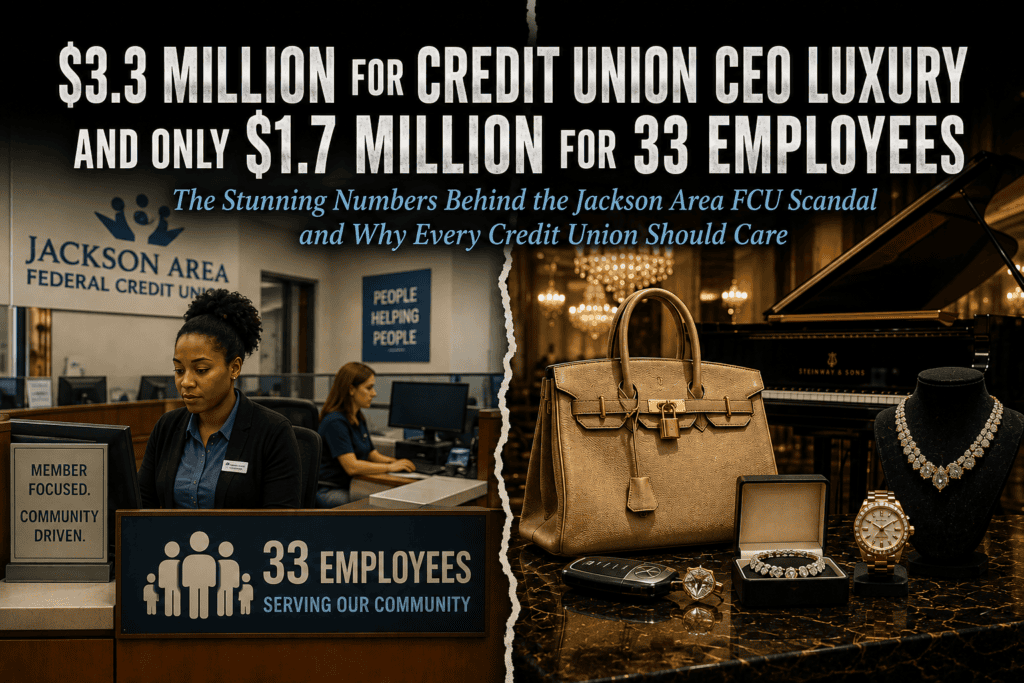
Jackson, MS – August 28, 2026 – Jackson Area Federal Credit Union spent $1.74 million on its 33-person workforce during the first nine months of 2025. The NCUA alleges former CEO Leigh Bridges spent $3.3 million at one luxury retailer, amid $95 million in alleged embezzlement that included diamonds, handbags, cars, a Steinway piano and $15 million in personal credit-card payments and a purse room. Yes, a “purse room” is a thing. The case could fuel long-standing criticism of credit unions’ federal tax exemption.
A $3.3 million jewelry and handbag bill.
A $129,300 Steinway piano.

Nearly $379,000 to Tiffany & Co.
Luxury automobiles, diamonds, designer handbags, fine art, interior decorating, a swimming pool and millions in credit-card payments.
And this wasn’t happening in one of America’s wealthiest communities. It was happening in Mississippi, consistently among the nation’s lowest-income states, at a member-owned credit union serving ordinary workers while millions allegedly flowed toward a lifestyle of diamonds, designer handbags, luxury cars and expensive homes.
Those numbers were already extraordinary when CUCollector first reported in June on allegations that former Jackson Area Federal Credit Union President and CEO Leigh Bridges had presided over a scheme that left approximately $95 million missing from the small Mississippi credit union.

But there is another number that puts the alleged spending into an entirely different perspective: 33. That was approximately how many people Jackson Area FCU employed in 2025.
Through the first nine months of that year, the credit union reported approximately $1.74 million in total employee compensation and benefits for its entire workforce.
According to the National Credit Union Administration’s lawsuit, more than $3.3 million in credit union funds went to Brooks Collection, a luxury jewelry and handbag retailer.
If the NCUA’s allegations are proven, more money went to that single luxury retailer than Jackson Area FCU spent compensating and providing benefits to its entire workforce for nine months.
Nearly twice as much. And that comparison turns an already spectacular alleged embezzlement case into something larger.
Because Leigh Bridges isn’t the only one who could ultimately pay for what allegedly happened at Jackson Area Federal Credit Union.
Every credit union may pay a little for it.
–
A Cooperative Serving Ordinary Workers
Jackson Area Federal Credit Union wasn’t JPMorgan Chase. It was a relatively small, member-owned financial cooperative serving approximately 15,500 members and dozens of employee groups, many associated with city, county and other government employment.
Its workforce numbered only a few dozen people.
Its former CEO, meanwhile, reportedly earned $193,758 in 2025.
Yet the NCUA alleges that over a period stretching back more than a decade, Bridges caused tens of millions of dollars to be diverted from the credit union while false accounting entries concealed what was happening.
The resulting deficit is alleged to be at least $95 million.
And as additional court filings have emerged, investigators have provided a remarkable window into where some of that money allegedly went.
–
A Luxury Shopping Ledger
The alleged spending is difficult to comprehend until the numbers are placed next to one another.
According to court records and reporting on the NCUA’s filings, transactions included:
- $3,315,058 to Brooks Collection for luxury jewelry and handbags
- approximately $600,000 to $617,000 involving Premier Prive and high-end jewelry
- $378,780 to Tiffany & Co.
- $295,000 to New York diamond and gemstone jeweler Joseph Gad
- $273,400 transferred to a personal Coinbase account
- $250,184 to Courtney Peters Interior Design
- $129,300 for a Steinway piano
- $127,871 to Mercedes-Benz Porsche of Jackson
- $84,325 to Cox Pools
- $66,572 for a Tesla
- $45,956 to Brown’s Fine Art & Framing
There were construction expenditures and additional jewelry purchases as well. But even that list understates the scale.
–
$15 Million in Credit-Card Payments
According to the lawsuit, between January 2025 and March 31, 2026, approximately $15 million in Jackson Area FCU funds allegedly went toward Bridges’ personal credit-card bills.
Approximately $14.4 million went to American Express, another $531,000 to Apple Card and approximately $69,000 to Chase. That averages roughly $1 million per month during the 15-month period.
Compare that again with the institution itself.
Jackson Area FCU spent approximately $1.74 million compensating and providing benefits to its entire workforce during the first nine months of 2025.
The alleged personal credit-card payments over 15 months were more than eight times that amount.
Those are not perfectly matched accounting periods, but they demonstrate the enormous scale of the alleged expenditures relative to the institution from which the money allegedly came.
–
Luxury Delivered to the Credit Union
The spending apparently wasn’t always hidden from view. NCUA Problem Case Officer Ethan Meyers said in a court declaration that luxury merchandise addressed to Bridges continued arriving at Jackson Area FCU’s main office even after she had been removed from her position.
Investigators reported deliveries associated with Bottega Veneta, Chloé, Dior and Tiffany & Co.
Inside Bridges’ former office, investigators reported seeing a Chloé leather handbag, Chanel wallet, empty Bottega Veneta boxes, Gemological Institute of America certificates and an appraisal for diamond earrings.
Then there was the Steinway.
The NCUA alleges $129,300 in credit union funds purchased the piano in 2019. Reporting on the litigation indicates that a Steinway later appeared in a photograph of Bridges’ residence published in Mississippi Magazine.
These allegations have not been proven, and Bridges is entitled to contest them.
But they present a remarkable contrast with the cooperative institution she was entrusted to lead.
–
The Purse Room, the Pool and the Warning Signs Nobody Saw
Do you have a purse room? I doubt anyone reading this even knew it was a thing. But for Bridges, it was.
Perhaps the most remarkable evidence of Bridges’ lifestyle wasn’t uncovered by federal investigators at all. Years before the allegations became public, Mississippi Magazine showcased the Bridges residence in a glossy feature titled “Calm, Cool, and Collected,” documenting an extensively remodeled home complete with a swimming pool, fine art and a custom-designed “purse room” built to display Bridges’ considerable handbag collection in boutique-style rows.
In hindsight, the article contains some striking names. The feature credits Courtney Peters with the home’s interior design, Craig Wilkinson Inc. with construction and Browns Fine Art among the sources for artwork — businesses that later appear in the NCUA’s allegations involving approximately $250,184, $906,705 and $45,956, respectively. The NCUA also alleges $84,325 went to Cox Pools and millions more went toward jewelry and luxury handbags.
None of that establishes that any particular item photographed by Mississippi Magazine was purchased with credit union funds. But the remarkable overlap between the lifestyle publicly displayed in the magazine and expenditures later identified by federal regulators raises an uncomfortable question: If the signs of extraordinary wealth were hiding in plain sight, why did nobody inside the credit union ask how it was being paid for?
–
The Best Friend and 30 to 40 Handbags
The alleged generosity extended beyond Bridges herself.
Former Jackson Area FCU branch manager Tina Funez, described in court filings as Bridges’ best friend, allegedly had access to an American Express card associated with Bridges’ account and charged more than $456,000 between 2022 and 2025.
Funez reportedly told investigators that Bridges also gave her approximately 30 to 40 handbags, high-end jewelry and luxury vacations.
There was also property in Honduras.
Investigators identified approximately 16 separate $9,500 wire transfers to a Honduran contractor associated with renovations to a home belonging to Funez’s grandfather.
Funez has maintained that she did not know the source of the money.
–
From $162 Million to $60.9 Million
Luxury goods make compelling headlines. The balance sheet tells the real story.
Jackson Area FCU reported approximately $162.4 million in assets at year-end 2025.
By June 30, 2026, reported assets had fallen to approximately $60.9 million after the financial impact associated with the alleged fraud was recognized.
The credit union reported a year-to-date loss of approximately $103 million and negative net worth of approximately $88.5 million.
For an institution of this size, this wasn’t money disappearing around the edges. It was catastrophic.
–
Taking the Fifth
The civil case is also moving closer to a potential criminal proceeding.
In responding to the NCUA’s amended complaint, Bridges invoked her Fifth Amendment right against self-incrimination at least 16 times rather than substantively responding to a number of allegations.
Invoking the Fifth Amendment is a constitutional right and is not an admission of guilt.
Her attorneys have also disclosed that federal prosecutors expect criminal charges. Court filings indicate possible charges involving misapplication of credit union funds, false entries and federal tax violations, and communications disclosed in the litigation have referenced a possible bill of information and change of plea.
As of the latest publicly available filings, however, the anticipated federal criminal proceeding had not yet produced a final adjudication.
–
The Bill Every Credit Union May Pay
And this is where Jackson Area Federal Credit Union stops being merely a Mississippi story.
For decades, the banking industry has attacked the federal income-tax exemption enjoyed by credit unions. The American Bankers Association and other banking advocates have repeatedly argued that today’s credit unions have moved too far from their cooperative roots and increasingly resemble tax-advantaged banks.
Credit unions have answered that criticism by pointing to their cooperative ownership structure, member benefits, community missions and the fundamental difference between returning value to members and generating profits for outside shareholders.
That debate isn’t new. But cases like Jackson Area FCU make the credit-union side of it considerably harder to defend.
Not because alleged criminal conduct by one CEO proves that credit unions don’t deserve their tax exemption, it doesn’t. Fraud happens at banks, corporations, governments, charities and virtually every other type of organization entrusted with money. But perception matters in Washington.
And imagine the Jackson Area allegations through the eyes of someone already hostile to the credit-union tax exemption.
A federally insured, tax-exempt financial cooperative serving ordinary workers allegedly had millions flowing toward jewelry, designer handbags, luxury vehicles, expensive home furnishings and personal credit-card bills while its CEO earned nearly $194,000 annually.
The alleged $3.3 million spent at one luxury jewelry and handbag retailer alone approached twice what the credit union spent compensating and providing benefits to its entire workforce during the first nine months of 2025.
That is political ammunition handed to credit unions’ critics on a silver platter.
–
The Reputation Problem
This is also not the first time the credit-union industry has faced an embarrassing executive embezzlement case. Go to the bottom of the story and you will see many other Credit Union CEO Embezzlement cases.
Again and again, cases emerge involving trusted executives accused of exploiting weak internal controls, insufficient segregation of duties, passive boards or supervisory committees, and years of inadequate oversight.
Each case is different. Each institution is different.
And the overwhelming majority of credit-union executives will never steal a dime. But the public doesn’t necessarily make those distinctions. Neither do lobbyists.
A headline about a credit-union CEO, millions of dollars and luxury spending doesn’t remain confined to the institution where it occurred. It becomes another exhibit available to critics arguing that the industry has strayed from the principles used to justify its special status.
That makes internal controls more than an accounting issue. They are a reputational issue for the entire movement.
–
The $95 Million Question
There will be plenty of time to determine exactly what happened at Jackson Area Federal Credit Union.
The civil litigation continues. Criminal proceedings appear likely. Assets are being identified and preserved, and the courts will ultimately determine responsibility.
But one question already deserves attention from credit-union boards across the country.
Not simply: How could $95 million allegedly disappear?
But: What does it cost the rest of the credit-union movement every time something like this happens?
Jackson Area FCU had approximately 33 employees. It spent approximately $1.74 million compensating and providing benefits to all of them during the first nine months of 2025.
And the NCUA alleges that more than $3.3 million went to one luxury jewelry and handbag retailer.
That juxtaposition may tell this story better than any Rolex, Tesla or Steinway ever could.
Because the greatest expense from this alleged shopping spree may ultimately be something that never appears on Jackson Area Federal Credit Union’s general ledger: the credibility of the credit-union movement itself.
$3.3 Million for Credit Union CEO Luxury and Only $1.7 Million for 33 Employees – $3.3 Million for Credit Union CEO Luxury and Only $1.7 Million for 33 Employees – $3.3 Million for Credit Union CEO Luxury and Only $1.7 Million for 33 Employees
Related:
$95 Million Missing: Rolexes, Teslas, a Honduras Home, and a Credit Union CEO’s Fall From Grace.
Former Credit Union CEO Convicted on Loan Fraud Charges
Former Credit Union CEO Permanently Banned by NCUA for Loan Fraud Exceeding $600,000
Former Credit Union CEO Sentenced for Embezzlement Scheme
Ex Credit Union CEO Facing $40M Embezzlement Charges
Former Credit Union CEO Pleads Guilty to Multimillion-Dollar Embezzlement
$3.3 Million for Credit Union CEO Luxury and Only $1.7 Million for 33 Employees – Credit Union Collections – Credit Union Collectors – Fraud – Fraud – NCUA – NCUA – Embezzle – Embezzlement







More Stories
STUPID STUFF FRAUDSTERS BUY: Gotta Fraud ’Em All!
The Weak Links: One Loan, Many Points of Attack
Join Us at UCC 2027 – Credit Union Attendees Receive $200 Off
STUPID STUFF FRAUDSTERS BUY: The Gold-Plated Cybertruck
CEO Pleads Guilty to Embezzling Millions from Credit Union
Two Men. Two Stolen Identities. One Greenwich Dealership.