


How Fraudulently Financed Cars Can Reach Overseas Markets Before America’s Fraud, Title and Export Systems Catch Up
–
The loan funded. The first payment isn’t even due. And somewhere between the dealership and the lender’s first collection call, the collateral may already be sitting inside a shipping container headed overseas.
For auto lenders already battling synthetic identities, stolen identities, straw buyers and first-payment fraud, there may be another vulnerability hiding beyond the dealership: America’s vehicle-export system does not necessarily see what the lender sees or see it at the same time.
And when you put the scale of auto fraud beside the size of America’s legitimate vehicle-export market, that potential blind spot becomes difficult to ignore.

–
142,465 Synthetic Applications
Point Predictive’s 2026 Auto Lending Fraud Trends Report estimates that auto-lending fraud exposure reached $10.4 billion in 2025, up from $9.2 billion the previous year. First-party fraud represented 69% of that exposure, while bust-out fraud, where individuals rapidly exploit multiple lenders to acquire and monetize vehicles, has increased 67% over five years.
Within nearly 19 million auto-loan applications it screened in 2025, Point Predictive identified 142,465 synthetic-identity applications, roughly one for every 133 applications.
And that’s only synthetic identity fraud identified within one dataset. It doesn’t encompass every stolen identity, straw buyer or other fraudulent vehicle purchase.
Now put that against America’s enormous legitimate vehicle-export market.
The Commerce Department’s historical data counted 989,531 used passenger vehicles exported from the United States in 2019, nearly one million in a single year.
The overwhelming majority were perfectly legitimate exports.
That’s precisely the point.
Fraudsters don’t have to build a smuggling network from scratch. They only have to disappear into a legitimate export market operating at enormous scale.
–
Fraudulently Financed Cars Have Already Gone Overseas
This isn’t merely theoretical.
In one federal identity-theft prosecution in Massachusetts, defendants used stolen identities, fraudulent driver’s licenses and Social Security cards to obtain 100% financing for late-model vehicles.
According to DOJ, many of the vehicles were subsequently exported from the United States.
That distinction matters.
These weren’t necessarily automobiles stolen from driveways. Dealerships handed over the keys and lenders funded the transactions.
The crime was buried inside the identity and financing transaction.
That can create a critical window during which the lender already has tens of thousands of dollars at risk but may have no reason to believe anything is wrong.
–
A Loan Can Move Faster Than a Lien
Modern auto lending moves quickly.
Applications can be approved electronically. Documents can be signed electronically. Funding can occur rapidly.
The lender immediately knows:
We just financed VIN XXXXX.
But that doesn’t necessarily mean every government system simultaneously knows:
Lender XXXXX has an active financial interest in VIN XXXXX.
Electronic Lien and Title systems have greatly improved lien security, but title and lien transactions still have to reach state motor vehicle agencies and be processed.
That’s important because federal vehicle-export regulations provide significant protection when a recorded lien exists. An exporter generally must obtain written authorization from the lienholder expressly permitting the vehicle to leave the country.
The operative words are: Recorded lien.
The export regulation doesn’t itself create a real-time nationwide inquiry asking every bank, credit union and finance company whether it has money outstanding against a particular VIN.
Loan origination and lien perfection are two different processes running on two different clocks.
And the automobile has a clock of its own.
–
Every State Is in NMVTIS , But Not on the Same Clock
All 50 states and the District of Columbia now participate in the National Motor Vehicle Title Information System. But according to AAMVA’s current NMVTIS participation data, only 33 of 51 jurisdictions conduct real-time updates and inquiries.
The remaining 18 use some form of batch updating. That means roughly 35% of jurisdictions aren’t updating NMVTIS in real time.
That’s not necessarily a problem for ordinary vehicle titling. But we’re examining fraud in which hours and days can matter.
There’s another important limitation.
AAMVA has acknowledged that NMVTIS does not contain lienholder information from every jurisdiction.
In fact, AAMVA has recommended that jurisdictions provide lien information and, where laws restrict disclosure, at least provide an indication that an active lien exists.
That gets remarkably close to the issue we’re examining.
Customs doesn’t need the borrower’s Social Security number, payment history or outstanding balance.
Perhaps it only needs to know:
VIN: XXXXXXX
ACTIVE SECURITY INTEREST: YES
EXPORT AUTHORIZATION: NO
The lender already knows that information.
The question is whether the export-enforcement system can see it at the moment it matters.
–
But Isn’t the Car Reported Stolen?
Not necessarily.
Suppose someone uses a stolen or synthetic identity to obtain a $70,000 SUV.
The dealership voluntarily releases the vehicle. The lender voluntarily funds the transaction. The VIN is legitimate.
What stolen-vehicle report exists on Day Two?
Possibly none.
The identity-theft victim may not know a vehicle loan has been opened. The lender sees a newly originated account. The first payment isn’t due.
And even after a lender discovers a fraudulent loan or skip, collateral isn’t necessarily reported to law enforcement as a stolen automobile. Lenders may instead use repossession assignments, skip tracing, insurance remedies and private license-plate-recognition networks.
That can create an extraordinary disconnect:
Lender: $70,000 collateral missing. Locate immediately.
Private recovery/LPR network: Active vehicle of interest.
Law enforcement: Not reported stolen.
All three can be accurate.
–
Then There’s the Shipping Container
Everything we’ve discussed so far assumes authorities know they’re dealing with an automobile.
A properly declared used vehicle gives Customs a VIN, ownership documents and something to investigate.
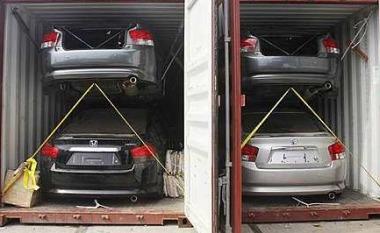
But criminals have demonstrated another method: Put the automobile inside a shipping container and lie about what’s inside.
A recent Florida federal prosecution brought several pieces of this story together.
In March, Tampa auto dealer Mohamad Jihad Fakih was sentenced to 54 months in federal prison.
According to DOJ, Fakih and others used straw purchasers and falsified loan applications to obtain fraudulent auto financing. Prosecutors specifically said Fakih attempted to export vehicles for which financing had been fraudulently obtained and finance companies still held liens.
In a separate part of the case, Fakih attempted to export a stolen Rolls-Royce Cullinan through the Port of Savannah.
The vehicle was inside a shipping container.
DOJ says the container manifest had been falsified to conceal its true contents.
CBP caught it.
But the case demonstrates two ways criminals can attack the system: Hide the true nature of the financing.
And: Hide the automobile itself.
–
You Can’t Check a VIN You Don’t Know Is There
CBP has sophisticated targeting systems and non-intrusive inspection technology. But America’s ports process enormous volumes of legitimate international commerce.
If an exporter declares: 2026 Cadillac Escalade, VIN XXXXX the vehicle-export system has a VIN to examine. If the exporter declares something else, authorities first have to discover that there’s an automobile inside the container.
Only then does the VIN become useful.
You can’t check a VIN you don’t know is there.
Now Put the Numbers Together
This is where the scale becomes striking.
142,465 synthetic-identity auto-loan applications identified in 2025.
Against a U.S. used-passenger-vehicle export market that was already moving nearly one million vehicles annually in 2019.
Those numbers should not be combined into an estimate of export fraud.
We don’t know how many synthetic applications resulted in funded vehicles. We don’t know how many fraudulent vehicles were intended for export. And there’s no reason to believe anything but a very small fraction of America’s legitimate vehicle exports involve financing fraud.
But that’s why the numbers matter. The criminal doesn’t have to overwhelm the system. He has to blend into it.
–
The Race Nobody Knew Lenders Were Running
Auto lenders have traditionally focused heavily on first-payment default.
A borrower who never makes the first payment can signal identity theft, synthetic identity, straw purchasing, bust-out activity or other fraud.
But international vehicle movement creates another clock.
The lender may be racing the physical movement of its collateral.
Consider the potential timeline:
Day 1: Fraudster obtains an $80,000 vehicle.
Day 2: Lender funds the dealership.
Day 3: Vehicle moves to a warehouse or freight operation.
Day 4: Vehicle is containerized.
Day 5: Container begins moving toward an export port.
Meanwhile, the lender sees a brand-new account.
No payment is delinquent.
No collector is calling.
No repossession assignment exists.
No LPR hot-list entry exists.
No stolen-vehicle report exists.
Depending on timing, the title and lien transaction may still be working through state processing and national reporting.
And if the automobile is concealed inside falsely declared cargo, its VIN may never have entered the normal vehicle-export process at all.
The fraudster isn’t necessarily racing the repossession agent.
He’s racing the lender’s realization that there is anything to recover.
–
The Missing Connection
America already has plenty of systems.
States record liens, NMVTIS exchanges title information nationally, law enforcement maintains stolen-vehicle databases, lenders and repossession companies use private recovery and LPR systems and the federal government regulates vehicle exports.
The problem may not be the absence of systems. The problem may be the absence of a connection among them.
Should lenders have a way to place an export alert against a VIN without reporting the automobile as stolen?
A secure inquiry could be remarkably simple: ACTIVE SECURITY INTEREST: YES
EXPORT AUTHORIZATION: NO
It wouldn’t declare the vehicle stolen or order anyone’s arrest. It would simply warn Customs that a financial institution claims an active security interest and hasn’t authorized the collateral to leave the United States.
AAMVA has already recommended something conceptually similar within NMVTIS: where complete lienholder information isn’t available, at least disclose whether an active lien exists.
Perhaps America’s ports need to be able to ask the same question.
–
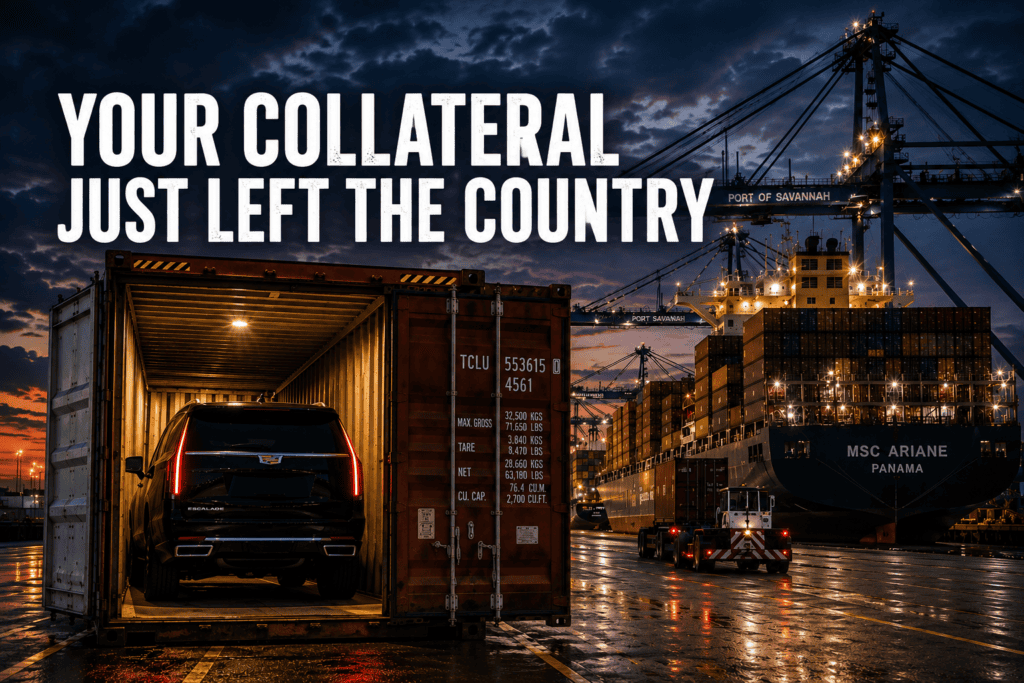
Your Collateral Just Left the Country
America has spent decades making auto financing faster. Applications can be decided in seconds. Contracts are electronic. Funding moves quickly. Vehicles can cross several states in a matter of days.
Fraudsters have gotten faster too. And they don’t necessarily need to invent an international transportation system capable of getting vehicles overseas.
We already built one.
Freight forwarders, railroads, trucking companies, container terminals, ports and ocean carriers already connect American vehicles with buyers around the world and as we recently saw in the Armenian Fraud connection, they’ve infiltrated those too.
The fraudsters don’t have to build a smuggling network from scratch. They only have to disappear into a legitimate export market operating at enormous scale.
Federal prosecutors have demonstrated that vehicles purchased through identity fraud have been exported from the United States. They’ve documented attempts to export fraudulently financed vehicles on which lenders still held liens. And they’ve shown that criminals will conceal automobiles inside shipping containers and falsify manifests.
The lender knows what it financed.
The DMV knows what it has processed.
NMVTIS knows what states have reported.
Law enforcement knows what has been reported stolen.
Private recovery networks know what lenders are looking for.
Customs knows what has been presented for export.
But who knows all of it at the same time?
Until someone does, a newly financed vehicle could be headed toward an American port while its lender sees nothing more alarming than a brand-new loan whose first payment isn’t even due.
And by the time the lender realizes it has a problem, its collateral may already have left the country.
Your Collateral Just Left the Country – Your Collateral Just Left the Country – Your Collateral Just Left the Country
Kevin Armstrong
Publisher
Your Collateral Just Left the Country – Transport – Fraud – Fraud – Repossess – Repossession – Repossession – Credit Union Collections – Credit Union Collectors – Lending – Auto Loan – Dealer– Dealer – Straw Buyer – Skip – Skip






More Stories
The Weak Links: One Loan, Many Points of Attack
Join Us at UCC 2027 – Credit Union Attendees Receive $200 Off
STUPID STUFF FRAUDSTERS BUY: The Gold-Plated Cybertruck
CEO Pleads Guilty to Embezzling Millions from Credit Union
Two Men. Two Stolen Identities. One Greenwich Dealership.
The Seasonal Loan Delinquency Reprieve May Be Ending