




Auto Loan Delinquencies Send Mixed Signals as Lenders Tighten Risk Exposure
–
The latest TransUnion Credit Industry Snapshot for April 2026 paints a complicated picture for the auto finance market. While deeper-stage delinquencies improved modestly, early-stage payment stress continued to rise, suggesting many consumers are still struggling under the weight of elevated vehicle prices, higher interest rates, and persistent economic pressure.
Read the Entire Report Here
For lenders, forwarders, repossession agencies, and credit unions, the report reflects an industry still attempting to normalize after years of inflated vehicle values, extended loan terms, and aggressive subprime lending growth.

According to TransUnion, overall serious delinquency rates declined across all major credit products in April, including auto loans. However, auto loan 30+ day delinquencies increased to 3.54%, up 15 basis points month-over-month, while 60+ day delinquencies declined to 1.27%.

That distinction matters.
A rise in 30-day delinquency often signals new financial strain entering the system. Falling 60+ day delinquency, meanwhile, can indicate that lenders are modifying loans, extending payment arrangements, or that borrowers are temporarily catching up before rolling deeper into default later.
The result is a market showing signs of stress moderation, but not necessarily recovery.
Loan Amounts Continue to Drift Lower
Average new auto loan balances declined slightly in April to $30,524 from $30,643 the prior month. (Chart title error)
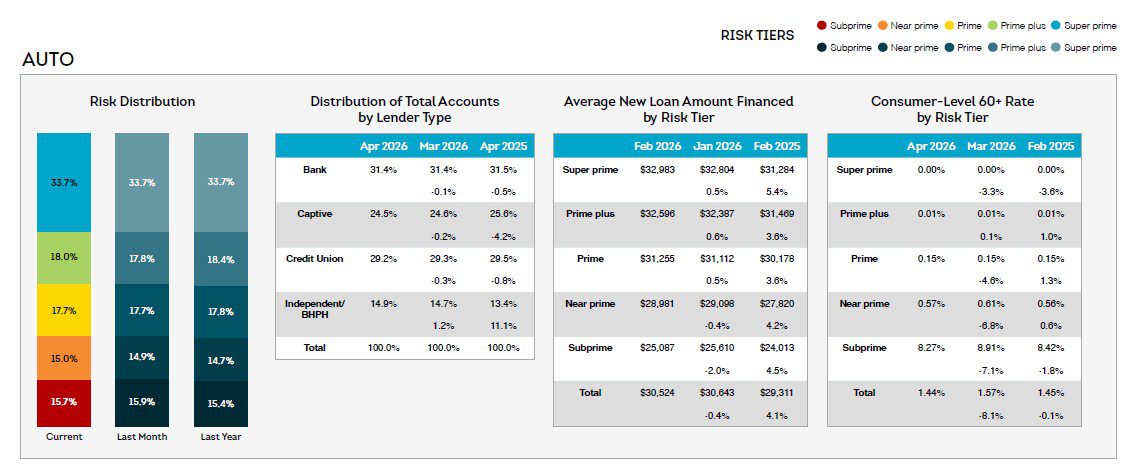
While the decline appears small, it may reflect several broader market shifts:
- Lenders tightening underwriting
- Consumers purchasing lower-cost vehicles
- Reduced affordability at current interest rate levels
- Dealers relying more heavily on incentives to move inventory
At the same time, year-over-year financed balances remain elevated. The average financed amount was still more than 4% higher than April 2025.
This continues to create downstream risk for lenders because many consumers remain heavily leveraged against depreciating collateral.
Credit Unions Continue Holding Significant Market Share
Credit unions maintained a major presence in auto lending, accounting for 29.2% of total auto accounts nationally. Banks led at 31.4%, while captives held 24.5%.
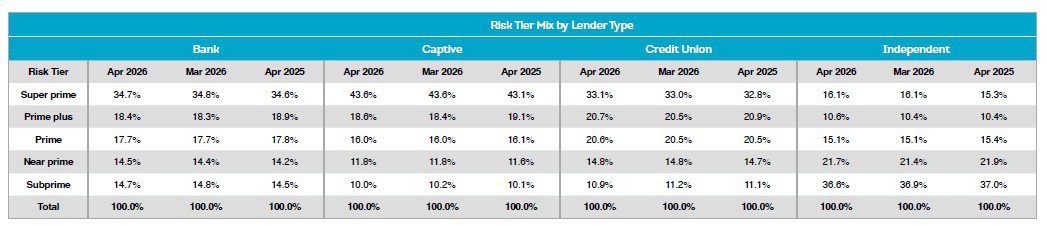
Interestingly, credit unions continued showing comparatively strong portfolio performance:
- 30+ DPD: 2.23%
- 60+ DPD: 0.80%
- 90+ DPD: 0.46%
Those figures remained materially lower than banks and dramatically below independent/BHPH lenders.
That trend reinforces what many in the collections and repossession industries have observed for years: credit union portfolios often maintain stronger borrower profiles and lower overall default severity, even during periods of economic pressure.
Still, deterioration is visible in certain regions and risk tiers.
Subprime Stress Remains Elevated
The report continues to show the greatest concentration of delinquency pressure within subprime auto lending.
Subprime borrowers posted a staggering 8.27% consumer-level 60+ delinquency rate nationally. Near-prime borrowers stood at 0.57%, while prime and super-prime borrowers remained comparatively stable.
Independent and Buy-Here-Pay-Here lenders continue carrying the heaviest risk concentrations:
- 36.6% of portfolios classified as subprime
- 6.92% of accounts 30+ DPD
- 2.73% of accounts 60+ DPD
Those numbers substantially exceed bank, captive, and credit union performance.
For repossession agencies, this remains important because assignment flow patterns often mirror these portfolio concentrations.
Geographic Pressure Continues Building in the South
Several Southern states continued reporting elevated delinquency levels.
Among the highest 30+ DPD rates nationally:
- Mississippi: 6.95%
- Washington D.C.: 6.92%
- Louisiana: 6.18%
- Georgia: 5.84%
- South Carolina: 5.31%
- Texas: 4.96%
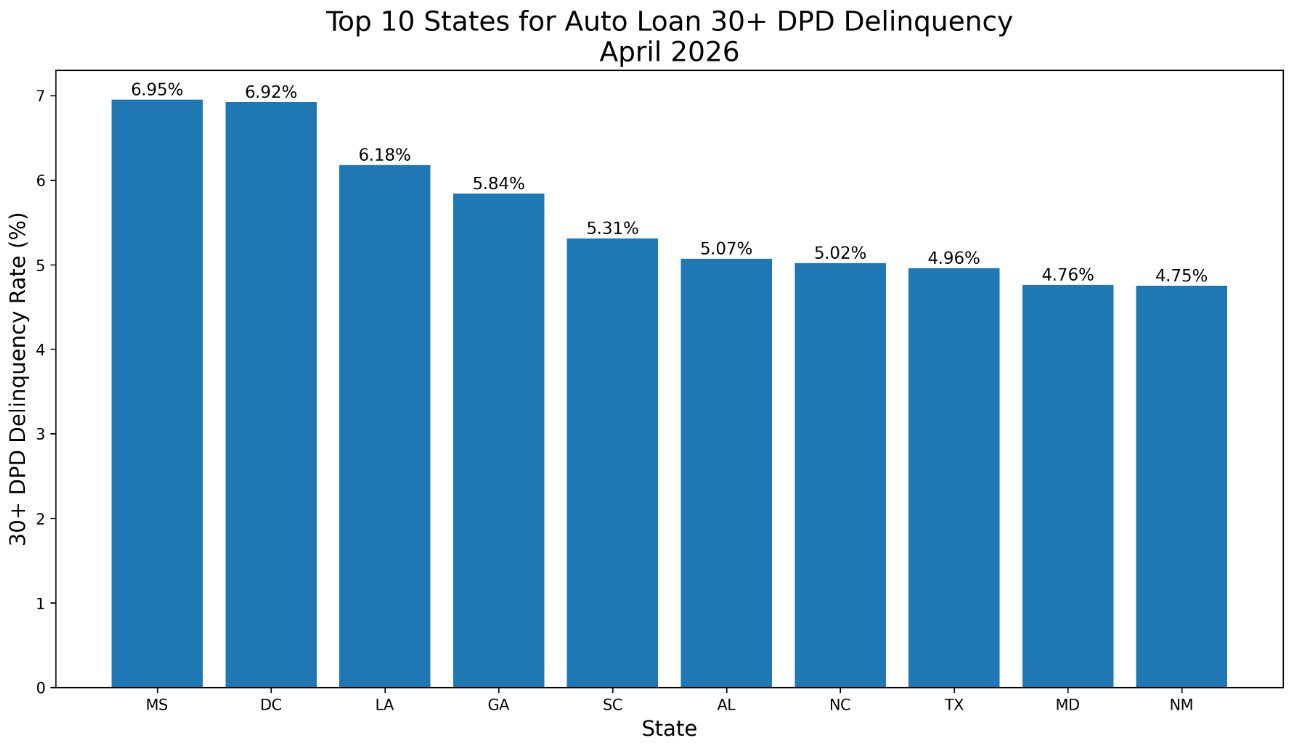
Meanwhile, states in the Upper Midwest and Mountain West generally maintained lower delinquency rates and stronger super-prime borrower concentrations.
That geographic divergence may continue influencing where repossession volumes remain elevated versus where assignment slowdowns continue.
Vintage Curves Suggest Recent Loans Are Still Under Pressure
One of the more important charts in the report may be the vintage delinquency curves. The data shows more recent loan vintages, particularly 2022 through 2025 originations, continuing to perform materially worse than pre-pandemic loans as accounts age.
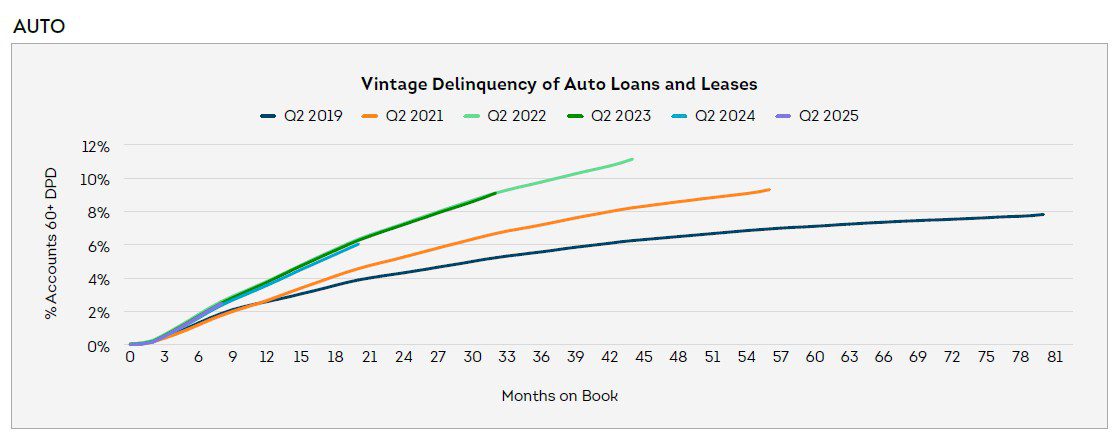
That trend aligns with several ongoing industry concerns:
- inflated vehicle pricing during 2021–2023,
- longer loan terms,
- higher interest rates,
- and increased negative equity exposure.
Many of those loans are now entering the higher-risk portions of their repayment lifecycle.
For the repossession industry, this remains significant because even if headline delinquency numbers improve temporarily, aging distressed vintages can still generate sustained recovery volume later.
The Bigger Picture
TransUnion’s April snapshot suggests the auto finance market is not collapsing, but it also is not fully stabilizing.
Consumers remain under pressure from:
- elevated borrowing costs,
- weakened purchasing power,
- persistent inflation,
- and slowing consumer sentiment.
Meanwhile, lenders appear increasingly cautious.
For repossession agencies, the data may help explain what many operators are currently experiencing in the field:
- slower assignment flow in some markets,
- delayed repo timing,
- increased workout activity,
- but continued elevated stress within subprime portfolios.
–
The numbers suggest the industry may be transitioning away from the explosive post-pandemic repossession surge, yet not returning to historical norms anytime soon.
–
Source: TransUnion April 2026 Credit Industry Snapshot
Auto Delinquencies Show Mixed Signals in April – Auto Delinquencies Show Mixed Signals in April – Auto Delinquencies Show Mixed Signals in April
Auto Delinquencies Show Mixed Signals in April – Repossess – Repossession – Repossession Agency – Repossessor – Repossession – Credit Union Collections – Credit Union Collectors – Lending – Auto Loan – TransUnion – TransUnion – Delinquency – Subprime Auto Loans – Subprime Auto Loans






More Stories
The $694 Million Paradox: When Does a Risky Loan Become Too Risky to Make?
He Bought Their Identities. Then He Bought the Cars
Catch Me If You Can: Inside the Gingerbread Man Auto-Fraud Enterprise
Case Study: Out of the Inbox, Into the System
Same FICO, Different Risk: Geography Emerges in Auto Loan Delinquencies
All Loan and No Cattle