



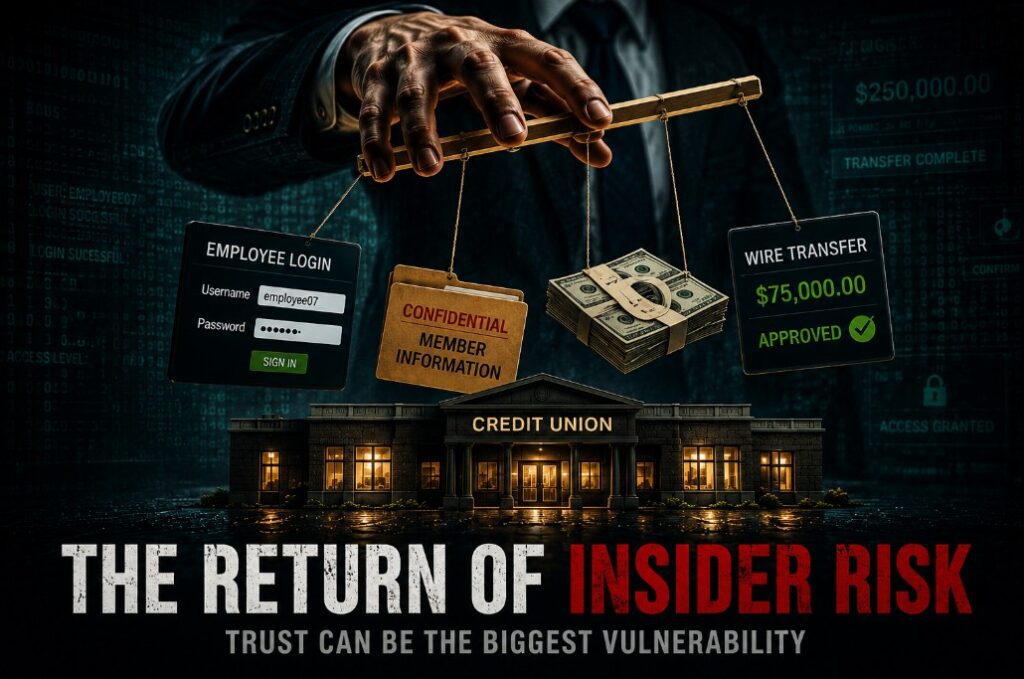
Why Credit Unions Are Facing a New Era of Internal Fraud Exposure
–
For years, credit unions focused heavily on defending against external cyber threats, ransomware gangs, phishing attacks, synthetic identity fraud, and account takeover schemes. But a quieter and potentially more dangerous threat has been steadily re-emerging inside the walls of financial institutions themselves: insider risk.
Recent enforcement actions, employee theft cases, and account manipulation investigations are shining a spotlight on a growing vulnerability across the credit union industry. From dormant member account abuse to credential-enabled fraud schemes, insiders with legitimate system access are increasingly becoming part of the threat landscape.
And unlike traditional hacking attacks, insider fraud often bypasses many of the controls institutions spent years building.

The Old Threat That Never Truly Went Away
Insider fraud is nothing new in banking or credit unions. Historically, embezzlement schemes often involved tellers skimming cash drawers, employees manipulating general ledger entries, or loan officers approving fraudulent loans for friends and family.
But the modern version looks very different.
Today’s insider risk frequently blends traditional financial misconduct with digital access exploitation. Employees no longer need to physically remove money or forge paper records. Instead, many schemes involve the misuse of legitimate credentials, internal platforms, remote access tools, and member account permissions.
In many cases, the employee technically logs into systems exactly as authorized.
That makes detection significantly harder.
Recent enforcement actions by the National Credit Union Administration and several federal prosecutions involving financial institution employees suggest regulators are increasingly concerned about insider-enabled misconduct, particularly involving dormant accounts, deceased-member accounts, and manipulated loan activity.
Dormant and Deceased Member Accounts: A Growing Exposure
One of the most concerning areas gaining attention across financial institutions involves dormant or inactive member accounts.
These accounts can become ideal targets for insider abuse because:
- Member activity is limited or nonexistent
- Statements may go unnoticed
- Contact information may be outdated
- Fraud alerts may never reach surviving family members
- Small incremental transfers can remain hidden for extended periods
Deceased-member accounts create even greater risk.
In several recent cases nationally, investigators alleged employees used internal access privileges to manipulate inactive accounts, reroute funds, alter contact information, or conduct unauthorized withdrawals while relying on the assumption that the legitimate account holder would never dispute the transaction.
For smaller credit unions already stretched thin operationally, these accounts can become difficult to monitor consistently, especially when staffing reductions reduce back-office audit frequency.
Economic Stress Cycles Often Increase Insider Fraud Pressure
Historically, insider fraud tends to rise during periods of economic strain.
As inflation pressures persist, consumer debt rises, and financial uncertainty impacts households nationwide, institutions are seeing increased operational stress both externally and internally.
Employees are not immune.
Financial pressure, rising living costs, mounting debt, medical expenses, and fear of layoffs can all increase fraud temptation among otherwise trusted workers. At the same time, reduced staffing and higher workloads can weaken oversight mechanisms designed to detect misconduct early.
Industry experts have long noted that fraud risk often emerges from what is commonly referred to as the “fraud triangle”:
- Financial pressure
- Opportunity
- Rationalization
Periods of economic instability tend to intensify all three simultaneously.
For credit unions already balancing delinquency management, loan modifications, collections pressure, and staffing shortages, insider risk may become an increasingly overlooked vulnerability.
Remote Work Changed the Control Environment
The post-pandemic shift toward hybrid and remote operations fundamentally changed internal control structures across much of the financial industry.
Many institutions rapidly expanded:
- Remote system access
- VPN connectivity
- Cloud-based workflows
- Digital document management
- Remote underwriting and servicing functions
While these changes improved operational flexibility, they also reduced layers of traditional physical oversight.
Managers no longer visually observe daily workflow activity the same way they once did in centralized branch or office environments. Informal peer monitoring has declined. Physical document verification has diminished. Segregation of duties has become harder to enforce consistently in decentralized environments.
In many institutions, cybersecurity investments improved dramatically, but operational fraud controls did not evolve at the same pace.
That gap matters.
An employee using valid credentials from an authorized device often appears “normal” within security logs. Unlike external hackers triggering intrusion alerts, insiders frequently operate within approved systems using legitimate permissions.
The result is a dangerous gray area where traditional cybersecurity tools may not identify misconduct until substantial losses occur.
Staffing Shortages Are Weakening Oversight
Credit unions, like much of the financial sector, continue facing staffing challenges.
Many institutions have experienced:
- Higher turnover
- Retirement-driven knowledge loss
- Difficulty hiring compliance and audit staff
- Increased workloads for existing employees
- Reduced segregation of duties in smaller departments
In some cases, a single employee may now oversee functions previously divided among multiple workers.
That creates concentration risk.
The fewer people involved in account oversight, reconciliation, loan review, collections monitoring, or exception auditing, the easier it becomes for suspicious activity to remain undetected.
Operational fatigue also becomes a factor.
Employees overwhelmed by volume are less likely to scrutinize irregular transactions, subtle system anomalies, or policy exceptions that may have previously triggered deeper review.
The Overlap Between Cybersecurity and Embezzlement Is Growing
Perhaps the most important shift now emerging is the convergence between traditional embezzlement and cyber-enabled fraud.
The industry increasingly faces situations where:
- Employees misuse internal credentials
- Authorized access is weaponized
- Member data is harvested internally
- System permissions exceed operational necessity
- Audit trails exist, but are rarely reviewed proactively
This is not always “hacking” in the traditional sense.
In many cases, the threat actor is simply an authorized user exploiting trust, weak oversight, or inadequate monitoring controls.
That evolution is forcing institutions to rethink fraud prevention entirely.
The question is no longer just:
“How do we keep criminals out?”
It is increasingly:
“How do we monitor legitimate access responsibly without disrupting operations or member service?”
What Credit Unions May Need to Reevaluate
As insider risk evolves, institutions may need to revisit several operational areas:
- Dormant account monitoring procedures
- Deceased-member account controls
- Access permission reviews
- Employee privilege escalation tracking
- Segregation of duties
- Exception reporting frequency
- Behavioral analytics tools
- Remote work audit procedures
- Vendor and third-party access management
Equally important is organizational culture.
Employees who feel unsupported, financially strained, or disconnected from leadership may present elevated fraud risk over time. Institutions focused solely on technical controls while ignoring operational morale may overlook important warning signs.
A Quiet Risk with Potentially Large Consequences
Unlike ransomware attacks or large-scale cyber breaches, insider fraud often unfolds quietly.
Losses may accumulate slowly. Irregularities may appear isolated. Small unauthorized transactions may go unnoticed for months or years before discovery.
But the reputational damage can be severe, particularly for member-focused institutions built heavily on trust.
For credit unions already navigating rising delinquencies, collections pressure, fraud growth, and economic uncertainty, the return of insider risk may become one of the industry’s most important operational conversations over the next several years.
And increasingly, the threat may not come from someone breaking into the system.
It may come from someone who already belongs there.
–
Kevin Armstrong
Publisher
The Return of Insider Risk – The Return of Insider Risk – The Return of Insider Risk
The Return of Insider Risk The Return of Insider Risk – Credit Union Collections – Credit Union Collectors – Lending – Fraud – Fraud – Fraud







More Stories
STUPID STUFF FRAUDSTERS BUY: Et Tu, Fraudster?
When a Car Is Obtained Through Fraud, Is It Counted as Stolen?
Credit Union Employee Accused of Stealing from the Dead
Credit Union Promoted Employee Despite Fraud Warnings — Then Collapsed Under $3.5 Million in Losses
The New Normal? Auto Loan Delinquencies May Have Found Their Floor
When the Auto Loan Outlives the Car