



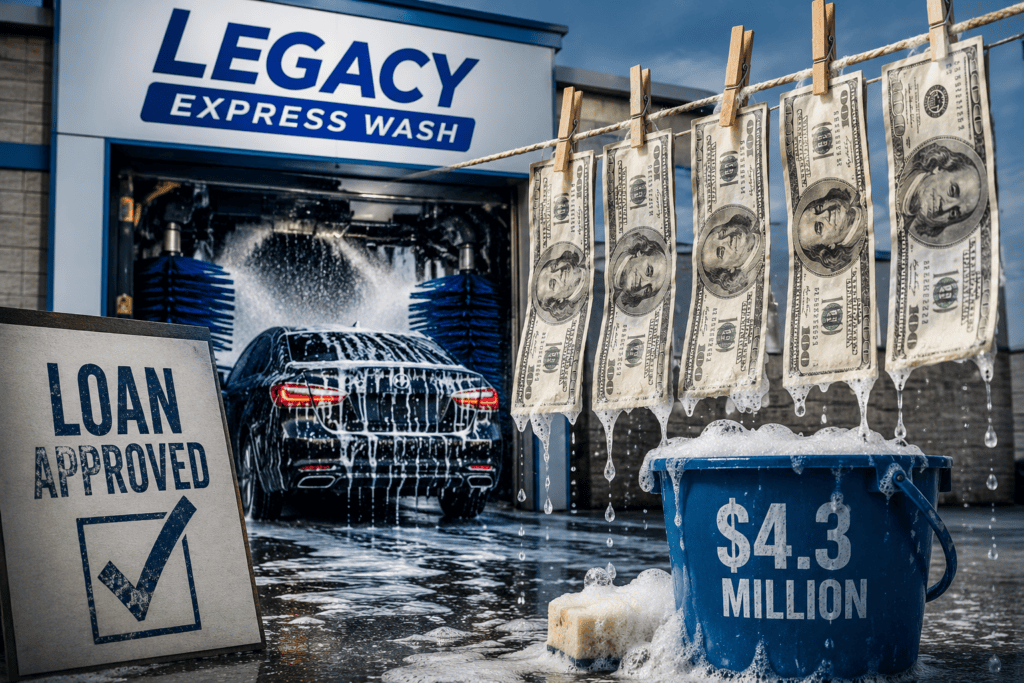
Ex-CFO receives three-year prison sentence after orchestrating multimillion-dollar loan fraud tied to Nebraska car wash project.
–
A Nebraska car wash project turned into something far more expensive than a wash and wax.
A former bank chief financial officer has been sentenced to three years in federal prison after prosecutors proved he used inflated construction invoices and concealed personal debts to obtain more than $4.3 million in fraudulent financing for a car wash development.
The U.S. Department of Justice announced that Aaron T. Luneke, 44, of Columbus, Nebraska, was sentenced to 36 months in federal prison following his conviction on charges of bank fraud and attempted bank fraud. The scheme centered on financing for the Legacy Express Wash in Columbus.


According to federal prosecutors, Luneke attempted to deceive Stearns Bank by submitting fraudulent and inflated contractor invoices that overstated the value of the car wash property while seeking a $3.5 million refinancing loan. Investigators also found he failed to disclose substantial personal debts owed to family members during the loan application process.
Jurors further determined that Luneke defrauded Bank of the Valley by using the same inflated contractor invoices to obtain additional construction loan proceeds, ultimately securing approximately $4.32 million in financing.
The court found that Luneke’s position as chief financial officer at Bank of the Valley significantly facilitated the fraud, enabling him to conceal the scheme while exploiting the trust associated with his executive role.
During sentencing, the judge also concluded that Luneke employed sophisticated methods to carry out the fraud, directed others in executing portions of the scheme, obstructed justice by providing false testimony at trial, and caused substantial financial hardship to one of the victim institutions.
In addition to his prison sentence, Luneke was ordered to serve five years of supervised release upon completion of his incarceration and pay a $10,000 fine. Because the case was prosecuted in the federal system, he will not be eligible for parole.
A Different Kind of Money Laundry – A Different Kind of Money Laundry – A Different Kind of Money Laundry
A Different Kind of Money Laundry – A Different Kind of Money Laundry – A Different Kind of Money Laundry A Different Kind of Money Laundry- Police – Police – Arrest – Arrest – Credit Union Collections – Credit Union Collectors – Lending – Fraud






More Stories
Financed Monday. Exported Friday.
The Seasonal Loan Delinquency Reprieve May Be Ending
The $694 Million Paradox: When Does a Risky Loan Become Too Risky to Make?
He Bought Their Identities. Then He Bought the Cars
Catch Me If You Can: Inside the Gingerbread Man Auto-Fraud Enterprise
Same FICO, Different Risk: Geography Emerges in Auto Loan Delinquencies