



Auto delinquencies are climbing again just as the calendar turns against lenders, and higher rates are narrowing one of the remaining exits for distressed borrowers
–
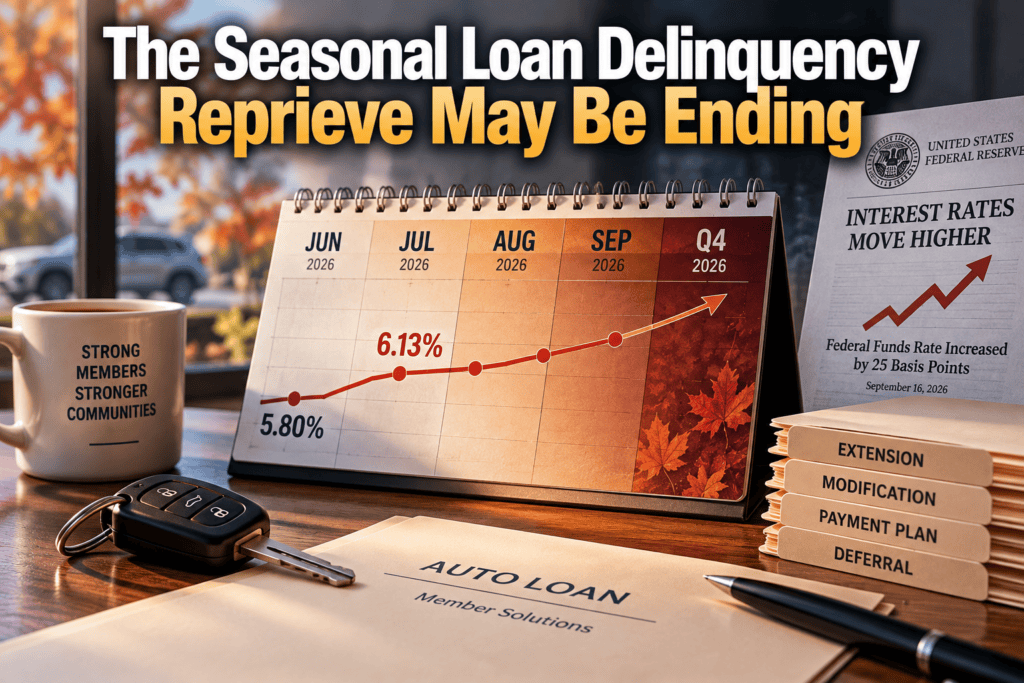
For several months, the direction of auto credit appeared to be getting better. Perhaps not good. But better. After subprime 60-plus-day delinquency in the Fitch Auto ABS indices reached record territory early this year, the measure retreated through the first half of 2026, eventually falling to 5.80% in June.
Then came July. Subprime delinquency jumped 33 basis points in a single month to 6.13%.
One month does not establish a trend. But July’s reversal becomes considerably more important when viewed against the calendar.

Because the easiest months may now be behind us.
–
We’ve Seen This Seasonal Turn Before
Auto delinquency does not move evenly throughout the year.
Tax refunds can provide financially stressed borrowers with additional cash during the first half, helping cure delinquent accounts and temporarily improving credit performance. As that money disappears, the seasonal pattern begins working in the opposite direction.
That was evident last year.
In its July 2025 Auto Loan ABS report, KBRA reported increases in early- and late-stage delinquencies and described the deterioration as consistent with the industry’s typical seasonal pattern during the summer months, with further weakening expected into early fall.
The deterioration continued through the second half of 2025 and eventually carried into the record-setting delinquency levels reached at the beginning of 2026.
This year does not have to follow the same path. But the similarities deserve attention.
Early 2026 produced extraordinary delinquency levels. Spring brought improvement. June brought subprime delinquency down to 5.80%.
And now, just as the seasonal calendar begins turning against lenders, July has reversed course to 6.13%.
Fitch itself expects prime and subprime auto ABS performance to weaken during the second half of 2026 relative to 2025, with affordability pressures continuing to weigh particularly heavily on financially stressed borrowers.
–
The Tailwind Is Fading
The first-half improvement also needs some context. Fitch reported that tax refunds supported borrowers and used-vehicle recoveries before that benefit faded into summer.
Subprime recovery rates peaked during April before declining to 39.5% in June and 38.0% in July.
The first-half improvement also needs some context. Fitch reported that tax refunds supported borrowers and used-vehicle values before that seasonal benefit faded into summer.
Financial recovery rates on defaulted subprime auto loans—reflecting proceeds recovered against gross losses, including collateral disposition—peaked in April before declining to 39.5% in June and 38.0% in July. These are not delinquency cure rates; they measure how much lenders recovered after loans reached the loss stage.
At essentially the same time, delinquency reversed direction.
That doesn’t prove the two are directly connected. But it is another reason not to assume that the first-half decline in delinquency meant the underlying affordability problem had disappeared.
Some borrowers may simply have received temporary breathing room. Now we begin finding out what happens after that breathing room is gone.
–
And Then the Fed Raised Rates
As the seasonal turn begins, distressed borrowers just encountered another obstacle.
On September 16, the Federal Reserve raised the federal funds target range by 25 basis points to 3.75%–4.00%.
That doesn’t change the payment on an existing fixed-rate auto loan.
But it can affect one alternative available to a borrower who can no longer comfortably afford that payment: Refinancing it.
For some distressed borrowers, refinancing can extend the term, restructure the obligation or reduce the monthly burden enough to make the loan sustainable.
But refinancing only works when the numbers work. A borrower already struggling with a high payment, deteriorating credit and potentially negative vehicle equity is difficult enough to refinance. Increasing borrowing costs doesn’t improve the equation.
Following the Fed’s move, the bank prime loan rate increased from 6.75% to 7.00%.
The Fed didn’t create the auto-affordability problem. But its latest rate increase narrows one of the possible exits for borrowers already struggling with it.
–
That Leaves the Collections Department
For credit unions, more of the problem may therefore fall back on familiar tools:
Extensions. Payment arrangements. Deferrals. Due-date changes. Loan modifications.
All can be extremely useful when a member’s problem is temporary.
But what if it isn’t?
CUCollector recently examined that question in “The Payment Moved, The Depreciation Didn’t”.
LoanTape’s analysis of standardized SEC ABS-EE filings found that, depending upon loan-to-value range, previously extended subprime loans that ultimately charged off lost approximately 50.1% to 60.0% of their outstanding balances.
Comparable loans that had never received an extension lost approximately 40.6% to 52.1%.
Those numbers do not establish that extensions caused the additional losses. Borrowers receiving extensions were already experiencing financial difficulty.
But they raised a much more important question: Did the extension cure the member’s problem, or merely postpone it?
–
Moving the Payment Doesn’t Change the Math
An extension can make a delinquent loan contractually current.
A modification can lower a payment.
A deferral can give a member another month or two.
But none can manufacture income.
For a temporary hardship, additional time may be exactly what a member needs.
For a structural affordability problem, moving two payments to the back of the loan may simply move today’s delinquency into tomorrow’s collections queue.
That becomes particularly important with the longer-term loans increasingly used to make expensive vehicles fit household budgets.
As we examined previously, LoanTape found that among prime auto ABS loans, loans originated with terms of 76 months or longer received extensions at a rate of 0.76%, compared with just 0.08% for loans originated at 60 months or less.
That’s roughly a 9.7-to-1 difference.
The term stretched until the payment fit. If the payment eventually stops fitting anyway, collections may then be asked to stretch it again.
–
Don’t Just Count Cures
That suggests another metric may become particularly important heading toward the fourth quarter.
Not simply: How many delinquent accounts did we cure?
But: How many stayed cured?
An account extended in May that returns to collections in August tells a different story from one that resumes contractual payments and remains current.
The same applies to repeated payment arrangements, multiple extensions and successive modifications.
Most collections departments know how many extensions they grant. Perhaps the more revealing number is how many of those members are still performing six months later.
As we noted in the earlier CUCollector analysis: “Current is an accounting status. It isn’t necessarily a forecast.”
–
July Is One Month, But Not One Data Point
There are important limitations here. Fitch’s figures represent securitized auto loans contained within its ABS indices. They are not a measurement of every automobile loan in the United States and should not be interpreted as representative of every credit-union portfolio.
July is also only one month. The 6.13% reading could decline again.
But Fitch isn’t alone in seeing renewed deterioration.
KBRA’s July 2026 Auto Loan ABS report found non-prime 60-plus-day delinquency increased 19 basis points from June and 26 basis points from July 2025, while non-prime annualized net losses increased 61 basis points year over year.
That independent benchmark makes the July Fitch reversal harder to dismiss as an isolated curiosity.
–
The Question Heading into Q4
Looking backward, the pattern is uncomfortable.
Last summer brought seasonal deterioration. Conditions worsened through the second half. Early 2026 eventually produced record delinquency.
Tax-refund season then provided some relief.
By June, Fitch subprime delinquency had retreated to 5.80%.
Now July has moved it back to 6.13%.
Looking forward, the tax-refund tailwind has faded, the seasonally more difficult portion of the calendar has begun, Fitch expects weaker second-half performance, and higher rates have made refinancing less attractive for at least some distressed borrowers.
That leaves credit unions increasingly reliant on the same internal collection tools they have been using throughout the affordability crisis.
Those tools can move a payment. They can provide time. And when the hardship really is temporary, they can work.
But as we head toward the fourth quarter, the most important question for collections departments may no longer be whether they can make a delinquent account current.
It may be: Can the member afford to stay there?
The Seasonal Loan Delinquency Reprieve May Be Ending – The Seasonal Loan Delinquency Reprieve May Be Ending – The Seasonal Loan Delinquency Reprieve May Be Ending
The Seasonal Loan Delinquency Reprieve May Be Ending – Subprime Auto Loans – Subprime Auto Loans – Credit Union Collections – Credit Union Collectors – Lending – Auto Loan – Delinquency






More Stories
Nearly One in Five American Families Fell Behind on Debt Payments
STUPID STUFF FRAUDSTERS BUY: Gotta Fraud ’Em All!
The Weak Links: One Loan, Many Points of Attack
Join Us at UCC 2027 – Credit Union Attendees Receive $200 Off
CEO Pleads Guilty to Embezzling Millions from Credit Union
Two Men. Two Stolen Identities. One Greenwich Dealership.