



Dozens of Defendants, 120+ Vehicles, $2.3 Million in Documented Loans, and a Trail Leading to CarMax, Crypto and Gold
–
Suffolk County, NY – September 15, 2026 – Thirty-three people. Two corporations. More than 120 vehicles. Millions of dollars in auto loans. Straw buyers. Phony employment information. Forged lien releases. Fake out-of-state titles. Cash, cryptocurrency and even gold entering the financial trail.
And somehow, lender-financed vehicles allegedly emerged from the other end carrying New York titles declaring “NO LIENS RECORDED”, clean enough that some were sold to CarMax, which court records reviewed by CUCollector do not accuse of knowingly participating in the scheme.
It sounds less like auto-loan fraud than the plot of a financial crime movie.

But Suffolk County prosecutors gave it an almost comical name: Operation Gingerbread Man.
At the center were half-brothers Mark McCall, 34, of Centereach, and Keith Agard, 32, of Port Jefferson Station, identified by prosecutors as the ringleaders. According to the Suffolk County District Attorney’s Office, McCall led the enterprise with Agard, while their girlfriends, April Stokes and Danielle Gera, were also key players in a network that extended through family, friends and more than 20 people recruited to acquire vehicles.
By the time the case reached its current stage, 34 defendants had pleaded guilty. McCall pleaded guilty September 10 to attempted enterprise corruption and two attempted weapons-possession charges. Agard had already pleaded guilty to enterprise corruption and weapons charges and was sentenced in June to one to three years in prison. Thirty-two additional defendants have entered guilty pleas, with one case remaining pending.
The scope behind those pleas is extraordinary.
According to prosecutors, seemingly ordinary customers walked into legitimate dealerships across five New York counties using forged documents such as pay stubs and utility bills. They drove away in everything from Toyota Camrys and Honda CR-Vs to six-figure BMWs and Mercedes-Benzes.
The dealers supplied the cars.
The lenders supplied the money.
The liens were initially recorded.
Then the liens allegedly began disappearing.
CUCollector’s review of the sprawling court record has identified 50 individually documented vehicle transactions carrying approximately $2.32 million in original financing, and that’s only the portion for which sufficiently detailed loan amounts could be reconstructed. Toyota Motor Credit alone appears on 11 of those vehicles, representing nearly $600,000 in documented financing.
Prosecutors put the scale of the broader enterprise considerably higher: more than 120 vehicles purchased and resold and approximately $5.5 million in profit.
And once apparently clean titles were created, some of those vehicles didn’t disappear into chop shops or shadowy overseas markets.
They went straight back into the legitimate automobile marketplace.
Read the Entire Criminal Complaint Here!
–
The Brothers at the Center of Gingerbread Man
The indictment does not describe Operation Gingerbread Man as a loose collection of unrelated fraudsters.
It charges a criminal enterprise.
The 2025 indictment names Mark McCall, April Stokes, Keith Agard, Danielle Gera, James Cooper, David Wilson, Peter Locke, Gianni Derosa, Alicia McKenzie, Josephine Alparslan, Marvin Rowan, Gary Zielenski, Ranyia Ramos, Sarah Jacobsen, Julio Burgos, Willie Williams, Christopher McPhillips, Carlos Roman, Fernando DeJesus, David Herndon, Zymel Murray, Edward Brabham, Jason Disisto, James Austin, Antonio Wilson, Scott Holland, Zenniyah Gilman, Kenneth Jones, Anthony Tomlinson, Mark Goode, Ossama Elamrani, Ronnie Jones and Tammy Nixon, along with corporate defendants K&K Elite Haulers LLC and 86 Elite Inc.
All were charged in Count One with enterprise corruption. The indictment alleged that they acted together and with other known and unknown persons between March 3, 2022 and May 28, 2025 as part of a pattern of criminal activity.
But prosecutors have been particularly clear about the hierarchy.
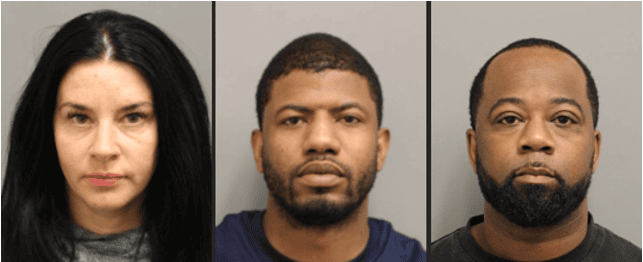
They identify McCall and Agard as the two ringleaders, with McCall leading the enterprise. Stokes and Gera were described as key players, while family members, friends and recruited vehicle purchasers filled out the network.
That hierarchy matters because the indictment repeatedly brings the same central names back into transactions involving otherwise different borrowers, vehicles and financing arrangements.
One borrower might change.
The dealership might change.
The lender might change.
The car might change.
But the network behind the transaction often did not.
–
The Lender Bought the Car
One series of transactions involving Josephine Alparslan shows how the system allegedly worked.
On July 26, 2023, Alparslan signed a retail installment contract with Mariano Rivera Honda for a 2020 Honda Accord. American Honda Finance Corp. financed $32,560.55.
The title application properly stated that American Honda Finance held a lien.
McCall and Alparslan obtained insurance on the Accord, and prosecutors say McCall later stored images showing both the DMV lien information and the New York title reflecting “One Lien Recorded.”
Then, on December 11, Alparslan allegedly used a forged American Honda Finance lien-release letter to sell the vehicle.
Another Alparslan transaction provides an even more revealing glimpse into how personal connections allegedly tied ostensibly independent borrowers to the organization.
When Alparslan applied for credit to purchase a 2019 Honda CR-V, prosecutors say she listed Keith Agard’s telephone number as both her home and work telephone number.
The vehicle was financed for $25,954 through Island Federal Credit Union.
That is the kind of connection that becomes much more obvious when loan applications are examined as a network rather than individually.
–
Turning Encumbered Collateral Into a “Clean” Car
Another Honda transaction demonstrates what happened after financing.
Alparslan financed a 2024 Honda CR-V through Atlantic Honda for $49,452.42 through American Honda Finance.
The vehicle originally carried the lender’s lien.
But prosecutors allege that a forged New Jersey title was subsequently used to obtain a New York title stating:
“NO LIENS RECORDED.”
On August 5, 2024, that apparently clean title was presented to CarMax in St. James.
CarMax bought the Honda for $31,000.
That transaction is one of the most important in the entire Gingerbread Man case.
There is no allegation in the records reviewed by CUCollector that CarMax knowingly participated in the fraud.
That is precisely what makes CarMax important.
The alleged title manipulation had apparently succeeded well enough to transform lender collateral into a vehicle that could be presented to a sophisticated national automobile retailer carrying a state-issued title saying there was no lien.
–
CarMax Didn’t Know. That’s What Makes It Important.
CarMax wasn’t an anonymous cash buyer meeting someone in a parking lot.
It is a major national used-vehicle retailer.
Yet the Honda wasn’t alone.
Court records describe a 2025 Toyota Camry carrying $50,696.55 in financing through Toyota Motor Credit. Prosecutors allege a forged New Jersey title was later used to obtain a New York title stating “NO LIENS RECORDED.”
CarMax subsequently purchased the Camry for $33,000.
Again, the significance isn’t that CarMax allegedly participated.
The significance is that it apparently didn’t need to.
Once the title system told an innocent downstream purchaser that no lien existed, the alleged fraudsters had created something immensely valuable: Liquidity.
A lender-financed vehicle could now be converted back into money through the legitimate automobile market.
–
Fifty Loans. At Least $2.3 Million Financed.
CUCollector’s review of individually documented transactions in the court record identified 50 vehicle transactions representing approximately $2.32 million in original financing.
That figure should not be confused with actual lender losses.
Amount financed represents original credit exposure. It does not subtract payments, insurance recoveries, recovered collateral, restitution or other offsets.
It is better viewed as a documented floor showing how much lender money entered just the transactions CUCollector was able to quantify.
Documented Lender Exposure
| Lender | Units | Documented Amount Financed |
| Toyota Motor Credit | 11 | $594,102.84 |
| Bank of America | 8 | $379,709.59 |
| Santander Consumer USA | 5 | $153,004.49 |
| American Honda Finance | 3 | $120,020.60 |
| Mercedes-Benz Financial Services | 1 | $106,778.07 |
| BMW Bank of North America | 1 | $102,286.64 |
| Ally Financial | 3 | $85,380.57 |
| AmeriCredit Financial Services | 2 | $85,009.91 |
| Nissan Motor Acceptance | 2 | $71,856.23 |
| Clover Commercial Corp. | 1 | $53,888.61 |
| GM Financial | 1 | $42,224.00 |
| Bethpage Federal Credit Union | 1 | $40,703.96 |
| Jovia Financial Credit Union | 1 | $29,574.25 |
| Island Federal Credit Union | 1 | $25,954.00 |
| Lender not identified in reviewed allegation | 9 | $429,487.16 |
| TOTAL | 50 | $2,319,980.92 |
Toyota Motor Credit stands out immediately.
Eleven documented Toyota Motor Credit transactions represent approximately $594,103 in original financing.
In one case, Christopher McPhillips financed a 2024 Toyota Sienna for $67,698.31. Prosecutors allege attempts were later made to send Toyota Motor Credit payments of $68,240.26 and $68,420.90 from accounts containing insufficient funds.
In another, a 2023 Toyota Sequoia carried $76,619.01 in financing. A payment of $76,885.55 was allegedly attempted from an account with insufficient funds.
The title records allegedly changed afterward.
These weren’t simply delinquent loans.
The allegations describe efforts to undermine the lenders’ security interests themselves.
–
Different Borrowers. Familiar Connections.
This is where Operation Gingerbread Man becomes especially instructive for fraud departments. The alleged enterprise didn’t necessarily need the same person to apply for loan after loan.
It could change the face sitting across from the finance manager.
But changing the borrower didn’t necessarily change the network behind that borrower.
McPhillips, for example, allegedly identified K&K Elite Haulers LLC as his employer on a credit application and supplied Mark McCall’s telephone number as the employer contact.
K&K Elite Haulers wasn’t merely a name that happened to appear in the paperwork. It was itself one of the two corporations indicted as part of the enterprise.
Another defendant, Zenniyah Gilman, allegedly listed K&K Elite Haulers as her employer while supplying April Stokes’ telephone number as both her home and cell number. She subsequently financed a 2023 Chevrolet Tahoe for $65,072.34.
Zymel Murray allegedly used Fernando DeJesus’ telephone number as his work number before financing a 2023 Nissan Altima for $32,783.97. Bank of America was subsequently recorded as lienholder.
And Marvin Rowan, when applying for a $35,000 used-auto loan from Island Federal Credit Union, allegedly gave Mark McCall’s home address as his own and stated that he worked for McCall and Alicia McKenzie’s K&K Elite Haulers.
Viewed one at a time, these were credit applications.
Viewed together, they were connections.
–
The Dealers Were Part of the Path, But Not Accused Participants
The vehicles came through legitimate dealerships across Suffolk, Nassau, Kings, Westchester and Orange counties. Some dealers appear more than once in the underlying transactions.
That deserves analysis, but it also requires caution.
Nothing reviewed by CUCollector establishes that those dealerships knowingly participated in Operation Gingerbread Man. Dealer concentration is not proof of cooperation.
The more useful question for lenders and dealer fraud departments is whether apparently unrelated buyers were submitting applications through the same stores containing common employers, telephone numbers, addresses or other identifiers tied to the alleged network.
One questionable borrower is a transaction problem.
Several supposedly unrelated borrowers sharing network identifiers may be an enterprise signal.
–
The Title-Washing Method Kept Evolving
Prosecutors say the organization changed methods over time. Court records describe forged lien releases, fraudulent out-of-state titles and even the use of New York’s garageman’s-lien process.
One 2016 Mercedes-Benz C300 illustrates the latter route.
The vehicle had originally been financed for $36,904.35. Prosecutors later allege that Gianni Derosa filed a lien and sale notice claiming $17,150 in storage fees. Derosa and Agard subsequently signed a Garageman’s Affirmation and Bill of Sale, and Agard applied for title.
Eventually, a New York title identified Agard as owner and stated:
“No Liens Recorded.”
That evolution is important.
Stopping one fraudulent document doesn’t necessarily stop an organized fraud operation.
It may simply cause it to find another door.
–
From Camrys to Six-Figure Luxury Cars
The alleged enterprise wasn’t limited to inexpensive transportation.
The quantified transactions reviewed by CUCollector include loans exceeding $100,000 through BMW Bank and Mercedes-Benz Financial Services.
Other transactions involved Lexus vehicles, Chevrolet Tahoes, a Corvette, BMWs, Mercedes-Benzes, Hondas, Nissans and Toyotas.
The indictment repeatedly describes financed vehicles being obtained with little borrower capital at risk. The lender supplied most of the purchase money.
That fundamentally changes the economics of the crime.
If an organization can obtain a $50,000 vehicle with little or no down payment, eliminate the lender’s lien and resell that vehicle for $30,000 or $40,000, it doesn’t need to recover the vehicle’s full retail value to make the transaction lucrative.
The lender already supplied the acquisition capital.
–
Then the Money Had to Go Somewhere
Operation Gingerbread Man didn’t end when the vehicle was sold. The proceeds had to move.
The indictment contains separate money-laundering allegations.
In one, prosecutors alleged Mark McCall and Peter Locke conducted a $50,000 transaction involving criminal proceeds in a manner intended to conceal or disguise their nature, location, source, ownership or control.
Another count accused McCall, Danielle Gera and 86 Elite Inc. of money laundering involving a $30,000 TD Bank check.
And then the financial trail reached cryptocurrency.
Crypto and the “22 Pack”
Authorities ultimately attached approximately $150,000 in a Coinbase account associated with Gera.
Her attorneys vigorously disputed the government’s effort to connect much of that money to the vehicle scheme.
Court filings describe prosecutors relying in part upon an intercepted conversation involving Gera’s boyfriend and another person discussing putting what was called a “22 pack” into crypto.
The defense argued that the conversation did not establish that the money originated from illegal vehicle sales.
A cryptocurrency purchase isn’t evidence of money laundering merely because crypto is involved. Prosecutors still have to trace criminal proceeds to the transaction.
But in an investigation already involving financed vehicles, resale checks, bank accounts and alleged money laundering, cryptocurrency became yet another destination investigators followed.
–
And Then There Was the Gold
Police searching Gera’s residence also seized precious metals and collectible coins.
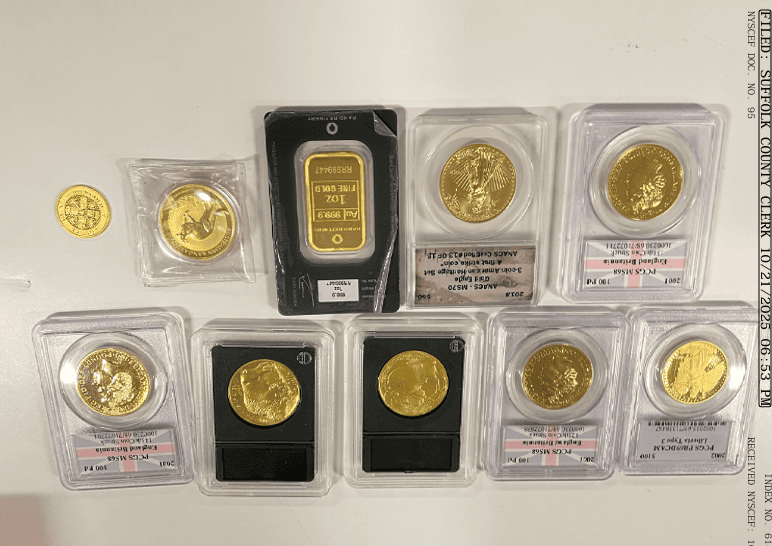
Her sworn inventory described a 50-gram Valcambi gold bar, a 10-ounce silver bar, three one-ounce gold Britannias, two one-ounce gold Buffalo coins and three one-ounce American Gold Eagles, among other property.
Gera maintained that the collection predated the conduct alleged in Operation Gingerbread Man and was connected to her legitimate work in the numismatic business.
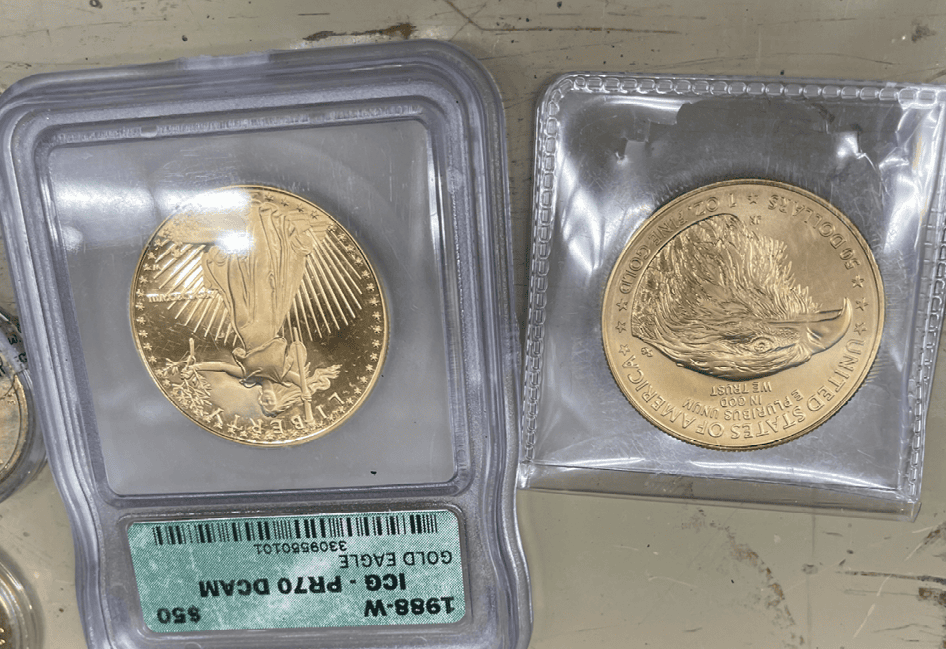
She also said 86 Elite Inc., of which she was sole shareholder, generated substantial legitimate revenue selling numismatic coins.
That defense matters because seizure is not proof that an asset constitutes criminal proceeds. But it adds another remarkable layer to the financial landscape investigators encountered:
Cars. Loans. Washed titles. Checks. Cash. Crypto. Gold.
And at the beginning of much of that trail was lender money.
–
The Guns at the End of the Trail
The June 2025 searches also produced another element not normally associated with an auto-finance fraud investigation.
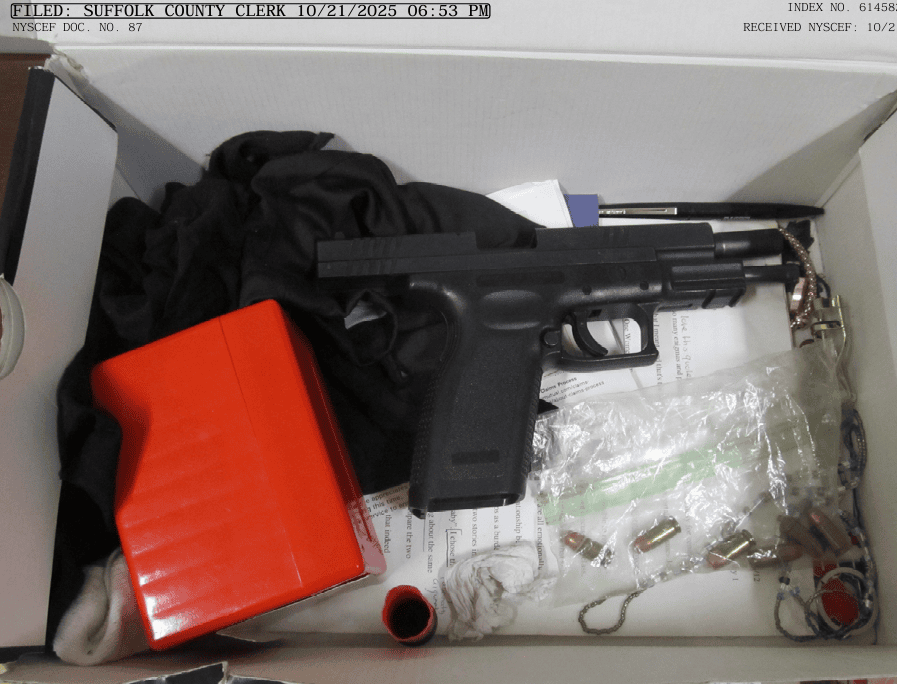
Authorities said McCall illegally possessed a Bond Arms .45-caliber derringer and a Taurus .40-caliber semiautomatic pistol. Agard was allegedly found with an Israel Weapon Industries 9mm semiautomatic pistol, while another gun was recovered from a co-defendant.
Those discoveries ultimately became part of the pleas entered by the two men prosecutors identified as Gingerbread Man’s ringleaders.
McCall pleaded guilty on September 10, 2026, to attempted enterprise corruption and two counts of attempted second-degree criminal possession of a weapon. He is expected to receive five years in prison followed by five years of post-release supervision on the weapons charges and 3½ to seven years on the enterprise charge, running concurrently.
Agard previously pleaded guilty to enterprise corruption and two weapons-possession counts and was sentenced June 3 to one to three years in prison.
Thirty-two additional defendants have pleaded guilty to their respective roles. Most received sentences ranging from six months to three years.
One case remains pending.
–
Thirty-Three People and Two Companies
The size of the defendant list is itself one of the lessons of Operation Gingerbread Man.
This wasn’t one identity thief. It wasn’t one crooked borrower. It wasn’t one fraudulent title. It wasn’t one dealer being fooled or one lender making a bad underwriting decision.
The grand jury indictment named 33 individuals and two corporations.
Prosecutors say more than 20 people were recruited to obtain vehicles. More than 120 vehicles ultimately passed through the network.
And prosecutors estimate approximately $5.5 million in profit was generated.
CUCollector’s own reconstruction of just 50 documented financing transactions already reaches $2.32 million in original loan balances.
That difference is important.
The $2.32 million isn’t the size of Gingerbread Man.
It’s merely the portion of the lender-financing trail we can presently put into rows and columns.
–
The Repossession Problem Nobody Saw Coming
For collection departments, there is a particularly uncomfortable aspect to all of this. Ordinarily, when an auto loan defaults, the lender still has something. Collateral.
The borrower may disappear. Payments may stop. The account may become a skip. But the lien gives the lender the legal foundation for locating and recovering the vehicle.
Operation Gingerbread Man attacked that assumption.
If a forged lien release, fraudulent out-of-state title or manipulated title process causes the official state record to say “NO LIENS RECORDED,” the problem has moved far beyond delinquency.
The lender isn’t simply trying to locate its car anymore.
It may be trying to establish that the official title telling everyone else that the lender doesn’t have an interest in the vehicle is wrong.
Meanwhile, the collateral can move. It can be retitled. It can be sold.
And, as the CarMax transactions demonstrate, it can potentially reenter the legitimate automobile marketplace.
–
Fifty Borrowers Can Look Like Fifty Problems
There may be an even larger lesson for lenders. Fraud systems are generally designed to evaluate an application. Organized fraud requires something else:
Evaluating relationships between applications.
One applicant using a questionable employer phone number may mean nothing. Several supposedly unrelated applicants using telephone numbers belonging to the same people is different.
One borrower claiming to work for K&K Elite Haulers may pass without notice. Multiple borrowers claiming connections to K&K Elite Haulers, while the company itself later appears among the enterprise defendants, is something entirely different.
One borrower giving Mark McCall’s telephone number or address might look like bad information. When multiple applications begin leading back to the same people, addresses, employers and companies, the individual credit files begin to form a map.
The individual loan asks:
Does this borrower make sense?
The portfolio has to ask:
Who else have we seen connected to this borrower?
Operation Gingerbread Man demonstrates why those aren’t the same question.
–
The Cars Weren’t the Target. The Credit Was.
That may ultimately be the most important lesson in this extraordinary case.
A traditional car thief wants the vehicle. An organized auto-finance fraud enterprise wants something more powerful: Someone else’s money with which to acquire the vehicle.
The dealership supplies the inventory. The lender supplies the capital.
The recruited purchaser supplies the identity. The title supplies apparent legitimacy. And if the lien can be made to disappear, an innocent downstream purchaser supplies the liquidity.
According to prosecutors, Operation Gingerbread Man connected those pieces more than 120 times.
Thirty-five defendants were indicted. Thirty-four have now pleaded guilty.
The trail ran through dealerships, lenders, DMV records, CarMax, Facebook Marketplace, bank accounts and cryptocurrency, and eventually led investigators to guns, gold and millions of dollars in alleged proceeds.
For an operation named after a children’s story character, there was very little childish about it.
Because McCall, Agard and the network around them allegedly didn’t need to steal more than 120 cars in the conventional sense.
The entire auto lending system bought the cars for them.
Catch Me If You Can: Inside the Gingerbread Man Auto-Fraud Enterprise – Catch Me If You Can: Inside the Gingerbread Man Auto-Fraud Enterprise – Catch Me If You Can: Inside the Gingerbread Man Auto-Fraud Enterprise
Catch Me If You Can: Inside the Gingerbread Man Auto-Fraud Enterprise – Police – Fraud – Fraud – Repossession – Repossession – Dealer– Dealer – Auto Loan – Lending





More Stories
The New Face of Auto Theft: Financing Fraud
Capital One Is Lending More to Subprime Borrowers. The Real Test Comes in 2027
STUPID STUFF FRAUDSTERS BUY: Et Tu, Fraudster?
Ally Keeps Growing as Auto Loan Delinquencies and Losses Edge Higher
When a Car Is Obtained Through Fraud, Is It Counted as Stolen?
Credit Union Employee Accused of Stealing from the Dead