
How Fake Employment, AI Documents, Credit Washing, and Federal Complaint Systems Have Quietly Created an Entire Underground Economy
–
There was a time when loan fraud was relatively easy to recognize. A forged signature. A stolen identity. A counterfeit driver’s license.
Today, fraud looks very different.
The modern fraudster may have a legitimate identity, a legitimate job, and even a legitimate need for a vehicle. Yet behind that seemingly ordinary loan application may exist an entire invisible support network designed to manufacture the appearance of creditworthiness.
Fake paystubs generated in minutes. AI-created bank statements. Synthetic employment verification services. Disposable business websites.
Virtual phone operators posing as human resources departments. Credit repair firms promising to erase repossessions.
And, until recently, a federal complaint system that some bad actors learned to use as leverage against furnishers and credit bureaus.
None of these services exists in isolation.
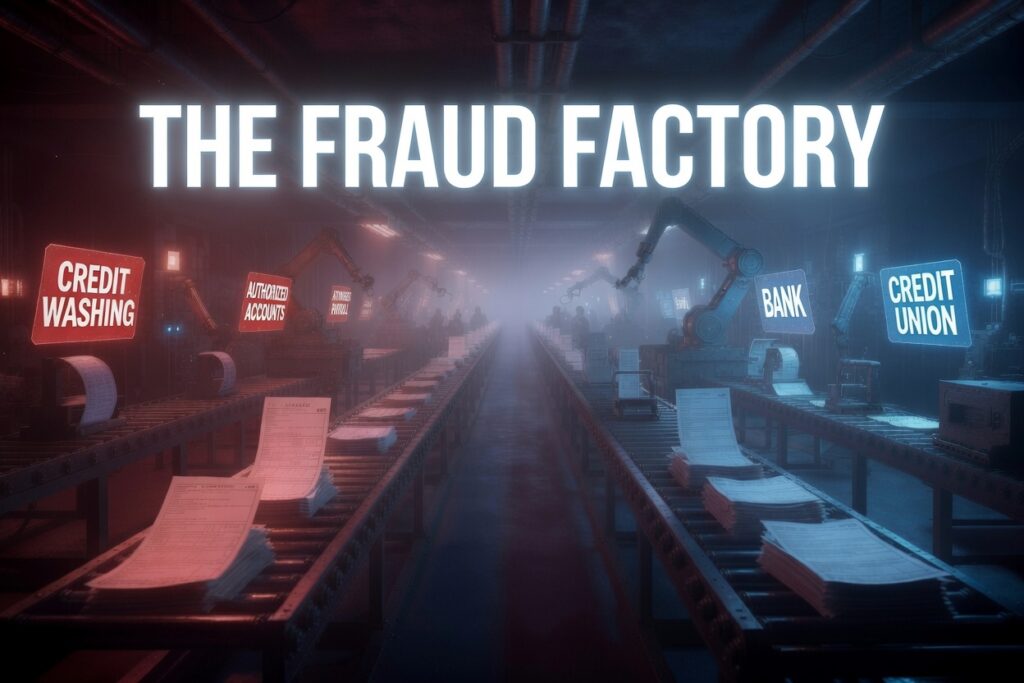
Together, they form something much larger, an underground economy that increasingly resembles a manufacturing process.
Not a fraud ring.
A fraud factory.
The Assembly Line of Modern Loan Fraud
Think of today’s fraud ecosystem as an assembly line. Each participant performs one specialized task before handing the borrower to the next.
By the time a lender reviews the application, dozens of pieces may appear perfectly legitimate despite being entirely fabricated.
The process often follows a surprisingly consistent pattern.
Stage One: Build the Borrower
Every loan begins with qualifying. For borrowers whose income, employment, or credit history falls short, there is now an online marketplace offering to fill the gaps.
Search the internet for “paystub generator” or “employment verification,” and hundreds of businesses appear. Some openly advertise “novelty” documents. Others promise documents “for entertainment purposes only.”
Yet law enforcement actions repeatedly show many are being used for exactly what lenders fear.
Consumers can purchase:
- Paystubs
- W-2s
- Tax returns
- Bank statements
- Utility bills
- Proof of residence
- Employment letters
- Business licenses
- Insurance cards
Increasingly, artificial intelligence has made these documents nearly indistinguishable from authentic records.
What once required graphic design expertise now takes minutes.
–
Stage Two: Create the Employer
A fake paystub alone isn’t enough. Someone has to answer the phone. Entire businesses now exist solely to verify employment.
Some create professional websites. Some establish business phone numbers. Some answer verification calls.
Others provide temporary email addresses that appear to belong to legitimate companies. To an overworked underwriter, everything checks out.
The employer exists. The phone works. The documents match.
The application moves forward.
–
Stage Three: Obtain the Loan
This is where the ecosystem succeeds. The lender isn’t approving fraud. The lender is approving what appears to be a qualified borrower.
Traditional underwriting relies on independent verification. But when every verification source has been manufactured, the process begins verifying the fraud itself.
Artificial intelligence only compounds the problem. Deepfake voice technology can answer verification calls.
AI-generated emails contain flawless grammar. Fake bank statements now include realistic transaction histories.
Even experienced fraud investigators acknowledge that distinguishing authentic documents from fabricated ones has become dramatically more difficult.
Then Comes Something Unexpected
Contrary to popular belief, many fraudulent borrowers don’t immediately disappear.
They make payments. Sometimes for months. Sometimes for years.
Life changes. Hours are reduced. Expenses increase.
The vehicle depreciates.
Eventually the loan becomes delinquent.
Now the second industry enters the picture.
The Credit Washing Industry
The public often thinks credit washing simply means disputing inaccurate credit information. That’s how the law intended the dispute process to work.
The abusive version looks very different.
Certain credit repair businesses encourage consumers to dispute virtually every negative tradeline regardless of its accuracy.
Late payments. Collections. Charge-offs. Repossessions.
The objective isn’t always proving the information is wrong. The objective is volume.
Repeated disputes. Repeated documentation requests. Repeated escalations.
Some firms even marketed CFPB complaints as the next step whenever standard disputes failed. For years, filing a CFPB complaint became a routine recommendation across online forums and credit repair advertisements.
Financial institutions often gave CFPB complaints priority attention. That made the Bureau’s complaint portal a powerful escalation tool.
When millions of complaints flooded the system, the CFPB itself eventually acknowledged that quality had deteriorated and announced sweeping reforms designed to curb abuse.
Whether intentional or not, the complaint system had become part of the credit washing playbook.
The Hidden Cost
Every successful credit wash affects far more than a credit report. It affects lending decisions.
A lender pricing a loan assumes the credit report reflects historical risk. When accurate derogatory information disappears, that assumption begins to break down.
TransUnion recently reported that some of the fastest-growing fraud losses are occurring among borrowers who appear to fall within traditionally lower-risk credit tiers.
That should concern every lender.
If credit reports become less reliable indicators of actual repayment behavior, underwriting models begin making decisions based on incomplete information.
The result isn’t simply higher fraud losses.
It can reshape entire portfolios.
The Ripple Effect Reaches Repossession
By the time the vehicle reaches a recovery agency, the fraud occurred years earlier. The repossession company sees only the final chapter.
Yet every fraudulent approval contributes to downstream losses.
Higher charge-offs. More defaults. Greater recovery costs. Higher insurance premiums.
Increased pressure on lenders.
Ultimately, everyone in the lending chain pays for information that wasn’t as reliable as it appeared.
Artificial Intelligence Changes Everything
Fraud has always existed.
Scale is what’s different.
Artificial intelligence dramatically lowers the expertise required. Today, someone with no design experience can generate convincing employment documents.
Voice-cloning software can mimic employers. Large language models can produce polished dispute letters. Image-generation tools create realistic supporting documentation.
Instead of isolated fraudsters, investigators increasingly confront organized service providers offering every step as a menu of products.
An Industry Supporting an Industry
Perhaps the most remarkable aspect isn’t any single scam. It’s the specialization.
One company sells paystubs. Another verifies employment. Another creates websites.
Another disputes tradelines. Another files CFPB complaints.
Another promises to repair damaged credit.
Individually, each appears to offer a legitimate service.
Collectively, they can form a sophisticated pipeline capable of transforming an unqualified borrower into an approved applicant, and, after default, preparing that borrower for the next loan.
That isn’t merely fraud.
It’s infrastructure.
Where Do Lenders Go from Here?
Technology alone won’t solve the problem. Neither will regulation.
Lenders will need stronger document authentication, behavioral analytics, AI detection tools, enhanced employment verification, and a renewed emphasis on first-party fraud detection.
Credit bureaus will continue refining methods for identifying abusive disputes.
Federal regulators are beginning to recognize that complaint systems themselves can be manipulated. The CFPB’s recent overhaul of its Consumer Complaint Portal is one sign that policymakers are acknowledging this reality.
But the larger challenge remains. The fraud industry evolves quickly because it is decentralized.
When one service disappears, another takes its place.
Editorial: Seeing the Entire Factory
Too often, the financial services industry investigates fraud one case at a time.
A fake paystub. A forged bank statement. A fraudulent dealership. A questionable CFPB complaint.
A repossession. A charge-off. Each appears unrelated. Viewed together, however, they reveal something much larger.
An interconnected marketplace has quietly emerged where specialized businesses support every stage of the borrower lifecycle, from qualifying for a loan to removing the evidence after default.
The greatest risk may not be any individual fraudulent document. It may be failing to recognize that these documents, services, technologies, and dispute processes increasingly operate as components of a sophisticated underground economy.
The financial industry has spent decades building better underwriting systems.
The fraud industry has spent the same decades building a better borrower.
The race between those two industries may define the next decade of consumer lending.
–
Kevin Armstrong
Publisher
The Fraud Factory – The Fraud Factory – The Fraud Factory
The Fraud Factory – Credit Union Collections – Credit Union Collectors – Lending – Fraud – Fraud – Auto Loan – Skip – Skip





More Stories
STUPID STUFF FRAUDSTERS BUY: The Gold-Plated Cybertruck
CEO Pleads Guilty to Embezzling Millions from Credit Union
Two Men. Two Stolen Identities. One Greenwich Dealership.
The Seasonal Loan Delinquency Reprieve May Be Ending
The $694 Million Paradox: When Does a Risky Loan Become Too Risky to Make?
Catch Me If You Can: Inside the Gingerbread Man Auto-Fraud Enterprise