
A dark-web identity scheme put $333,000 in vehicles on the street before investigators caught up with the man behind the wheel.
–
St. Louis, MO – September 17, 2026 – The names were real. The personal information was real. The people buying the cars were not.
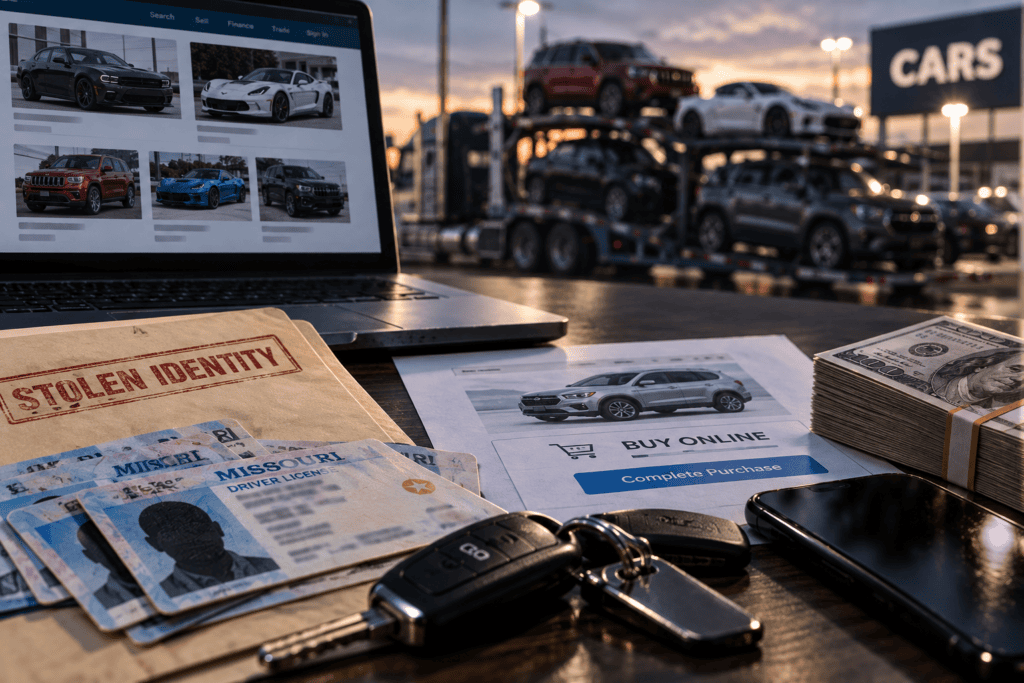
A Missouri man has been sentenced to 51 months in federal prison after prosecutors say he purchased stolen personal information on the dark web, manufactured false identification and used those identities to buy more than $333,000 worth of vehicles online from dealerships across the country.
The case provides another example of how identity theft has evolved beyond simply opening fraudulent credit accounts. Once a stolen identity can successfully pass through an online vehicle transaction, the fraud becomes a collateral problem, and the clock begins ticking on finding a vehicle that may already be hundreds of miles away.

According to the U.S. Attorney’s Office for the Eastern District of Missouri, 45-year-old Michael Calvin purchased stolen personal information belonging to victims as well as a template for a Missouri driver’s license on the dark web. He then created counterfeit driver’s licenses and identification cards containing the victims’ information.
–
Five Cars, Four States and $333,970
Between November 2023 and August 2024, prosecutors say Calvin used the stolen information and false identification to purchase five vehicles online.
The first was a Chevrolet Camaro purchased in Iowa for $45,122 on November 1, 2023.
Three months later came a Jeep Cherokee from Wisconsin for $43,967.
Then the values began climbing.
In April 2024, Calvin obtained a Dodge Charger Hellcat in Tennessee for $90,785. In July, a Chevrolet Corvette in Oklahoma for $61,175 followed.
Finally, on August 2, 2024, another Wisconsin transaction put a $92,921 Dodge Durango into his hands.
Together, the five vehicles were worth $333,970.
What makes the case particularly relevant to auto lenders, collectors and fraud departments is how the vehicles were obtained. According to federal prosecutors, the purchases were conducted online.
Calvin didn’t have to walk into dealerships across Iowa, Wisconsin, Tennessee and Oklahoma and repeatedly convince someone standing across a desk that he was the person named on his driver’s license.
The transactions crossed state lines while the identities did the traveling for him.
–
Eleven Days Later, the Durango Was Being Sold
What happened to the $92,921 Durango provides a glimpse into the next stage of the problem.
Just 11 days after its August 2 purchase, Calvin was in St. Louis attempting to sell the Durango, according to court documents cited by federal prosecutors.
During that attempted sale on August 13, 2024, Calvin was shot.
The circumstances surrounding the shooting aren’t detailed in the Justice Department’s announcement, but the timing demonstrates how quickly fraudulently obtained collateral can move from an apparently legitimate retail transaction into an entirely different marketplace.
For a lender or dealer, discovering the identity fraud is therefore only part of the problem.
By the time the legitimate consumer discovers an account he never opened, or a dealership or creditor realizes the person who received the vehicle wasn’t the person whose identity was used to obtain it, the collateral may already be moving again.
And in Calvin’s case, federal prosecutors say some of the five vehicles have still not been recovered. Dealers also incurred expenses recovering others.
–
From the Dark Web to the Dealer’s Inventory
The case also illustrates the growing divide between determining whether an identity is real and determining whether the person presenting that identity is actually its owner.
Calvin wasn’t simply inventing fictitious borrowers from scratch. According to prosecutors, he was purchasing the personal information of actual identity-theft victims and combining it with counterfeit identification.
That distinction creates a particularly difficult fraud problem.
A name can be legitimate.
A Social Security number can belong to a real consumer.
A credit history can be genuine.
And yet the person using all of them can still be someone else.
The vulnerability becomes even more significant as more of the vehicle-shopping and financing process moves online, where the traditional face-to-face interaction between a buyer and dealership personnel may never occur.
The losses in this case were substantial enough that U.S. District Judge Stephen R. Clark ordered Calvin to pay approximately $193,000 in restitution, in addition to the 51-month prison sentence.
Calvin pleaded guilty in May to two counts of wire fraud and one count of aggravated identity theft.
Investigators eventually found him living in a motel in Rolla, Missouri, where he was arrested.
–
A Fraud Problem That Becomes a Collateral Problem
The geographic footprint required to unravel the case was enormous compared with the number of vehicles involved.
The investigation included the U.S. Secret Service, Missouri State Highway Patrol, Ohio State Highway Patrol, St. Louis Metropolitan Police Department and police departments in multiple Missouri communities as well as Davenport, Iowa; El Reno, Oklahoma; Fond du Lac, Wisconsin; and Lombard, Illinois.
Five fraudulent purchases ultimately generated investigative activity spanning numerous jurisdictions.
For lenders and recovery professionals, that may be the most important takeaway from the case.
Fraud prevention happens before the keys change hands.
Collateral recovery begins after they do.
Once a fraudster successfully converts a stolen digital identity into a physical vehicle, the problem moves out of the credit file and onto the street.
In this case, more than $333,000 worth of vehicles made that transition.
Some of them still haven’t come back.
He Bought Their Identities. Then He Bought the Cars – He Bought Their Identities. Then He Bought the Cars – He Bought Their Identities. Then He Bought the Cars
He Bought Their Identities. Then He Bought the Cars – Police – Police – Arrest – Arrest – Credit Union Collections – Credit Union Collectors – Lending – Fraud – Fraud – Auto Loan – Department of Justice



More Stories
Catch Me If You Can: Inside the Gingerbread Man Auto-Fraud Enterprise
Same FICO, Different Risk: Geography Emerges in Auto Loan Delinquencies
All Loan and No Cattle
Regulators Clarify What Credit Unions Can Tell Members About Suspicious Activity
$3.3 Million for Credit Union CEO Luxury and Only $1.7 Million for 33 Employees
The Pastor, the Credit Repairmen and $460,000 in Fraudulent Auto Loans