



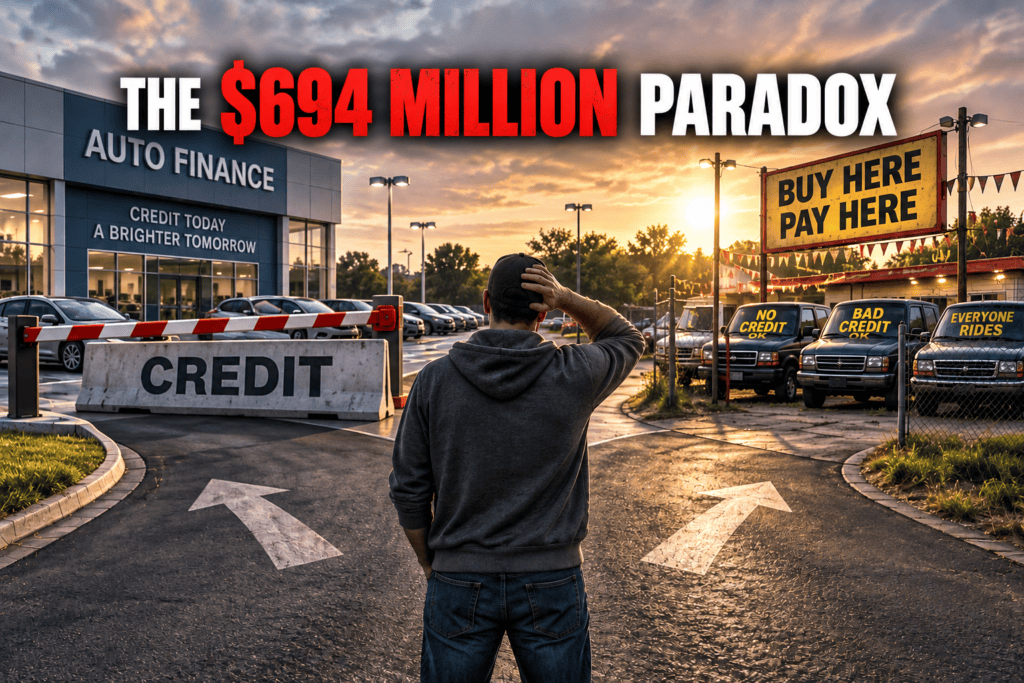
The Credit Acceptance settlement targets loans expected to fail, but raises a harder question about who will lend to the borrowers left behind.
–
September 18, 2026 – $694 million is a difficult number to look past and it is the number that is making the headlines. That is the amount of cash and debt relief contained in the nationwide settlement announced September 17 between Credit Acceptance Corporation (CAC) and a bipartisan coalition of 40 state attorneys general and Washington, D.C.
The allegations are serious. The relief is enormous. And the settlement will undoubtedly be studied throughout the auto finance industry.
But buried underneath that $694 million headline is a much more complicated question, one that reaches well beyond Credit Acceptance.

How much expected loss is too much?
Because lenders are supposed to predict losses.
They are supposed to understand which borrowers are more likely to default. They are expected to estimate how much they will collect, how much they will lose, what collateral may eventually be worth and how much risk they are accepting when they make a loan.
Those aren’t necessarily signs of predatory lending. They’re fundamental elements of lending.
And that is what makes this settlement so interesting.
–
The $694 Million Settlement
The states allege that Credit Acceptance originated auto loans that it knew some consumers could not afford and were likely to default.
According to the California Attorney General’s settlement announcement, CAC assigned loans a proprietary score designed to predict how much it expected to collect. The states contend that some loans were originated despite indications that consumers were unlikely to repay even the principal.
The settlement provides $694 million in cash and debt relief, including enormous amounts of loan forgiveness for consumers whose vehicles have already been repossessed and others who still have their vehicles. It also imposes reforms involving vehicle prices, dealer practices, ancillary products and particularly risky loans.
Credit Acceptance admits no fault or wrongdoing.
In its statement announcing the resolution, CAC said the agreement resolves litigation dating to 2023 and a multi-state investigation begun in 2020, provides greater regulatory clarity and does not require material changes to its operations.
Those are two very different characterizations of the same settlement.
But neither resolves the bigger question it leaves behind.
–
Every Lender Predicts Failure
A sophisticated lender doesn’t simply originate thousands of loans and wait to see what happens. It models them. Probability of default, loss severity, expected collections, collateral values, delinquency curves and recoveries are all part of understanding a portfolio. CECL itself requires financial institutions to estimate expected credit losses.
The important distinction is between knowing that some loans within a portfolio are likely to fail and knowing that a particular borrower will fail.
Those aren’t the same thing.
Imagine a lender has 100 similarly situated high-risk borrowers and its historical data indicates that 40 are likely to default.
The lender may be very good at predicting that approximately 40 will fail. That doesn’t necessarily mean it can identify exactly which 40.
Sixty may pay.
And therein lies one of the most difficult questions raised by the Credit Acceptance case.
If an expected 40% failure rate is unacceptable, what about 30%? Twenty-five percent?
Where is the line?
Or is a percentage the wrong measure altogether, with individual affordability rather than portfolio default probability determining whether a loan should be originated?
The settlement doesn’t establish a simple industry-wide numerical answer.
And that uncertainty may ultimately matter almost as much as the $694 million.
–
The Mystery Ratio
Put yourself in the risk department of another subprime auto lender this morning.
Your company wasn’t sued. You aren’t a party to the settlement. But you have models.
You know approximately how borrowers in each risk tier historically perform and you know which pools produce the greatest delinquencies. You know your expected losses and recoveries.
And now one of the country’s largest subprime auto finance companies has entered into a settlement approaching $700 million over allegations that include originating loans expected to perform poorly.
So, what do you do?
A rational response may be to create some distance between your company and whatever boundary regulators appear to be establishing.
Compliance tightens, underwriting tightens, exceptions get harder and minimum FICO score tranche levels rise. Maximum LTVs fall, payment-to-income tolerances change and the bottom of the credit box gets smaller.
None of that requires another lawsuit, regulation or attorney general settlement. It requires only uncertainty.
And the people removed from that credit box don’t become less risky because the lender declined their application. They still need transportation. They still have the same credit history.
And that brings us to a strange contradiction sitting right alongside the Credit Acceptance settlement.
–
The Buy Here Pay Here Paradox
Four months before the CAC settlement, the Federal Reserve published an unusually detailed examination of Buy Here Pay Here lending.
The results deserve another look today.
The Federal Reserve’s May 2026 BHPH study found that approximately 78% of BHPH lending volume involved subprime borrowers and that deep-subprime consumers represented more than half of BHPH loan balances.
The Fed also found substantially worse loan performance.
In the third quarter of 2025, approximately 10% of BHPH balances were delinquent. BHPH delinquency and default rates were 2.65 and 1.88 times those of traditional auto lenders.
But repossession was where the difference became extraordinary.
BHPH loans were 16.63 times more likely to be in active repossession status than loans from traditional auto lenders.
Approximately 5% of BHPH balances were in active repossession at that single point in time, compared with less than one-half of one percent among traditional auto lenders.
And yet the Federal Reserve did not present repossession itself as proof that the lending model was predatory.
Instead, it described higher interest rates, more frequent payments and greater use of repossession as methods BHPH dealers use to mitigate and compensate for their higher credit risk.
Read that again in the context of the Credit Acceptance settlement.
One lending sector serves extremely risky borrowers, charges considerably higher rates, experiences substantially higher defaults and uses repossession far more frequently.
The Federal Reserve describes those practices in part as risk mitigation.
Meanwhile, the states’ case against Credit Acceptance includes allegations involving its ability to predict poor loan performance and the collections it expected to receive when those loans failed.
The situations aren’t identical. But they are similar enough to raise an obvious question.
If extremely high expected failure becomes evidence that certain loans should never have been made, where does that leave Buy Here Pay Here?
–
The Lender That Owns the Car
There is another significant difference between traditional subprime finance and BHPH.
The BHPH dealer isn’t merely the lender. It owns the car.
It acquires the vehicle, puts it on the lot, sells it, finances it and services the loan. If the borrower defaults, the vehicle can be repossessed. And often, they perform the repossession themselves instead of using legally trained, insured and compliant repossession agencies.
And after repossession and whatever reconditioning is necessary, that same piece of collateral can potentially return to inventory and be sold again. Rinse, wash, repeat.
The Federal Reserve specifically recognized this integrated structure and concluded that BHPH dealers’ ability to recover vehicles can reduce loss severity. Researchers even suggested that greater use of repossession can improve the collateral quality supporting bank financing provided to BHPH dealers. The Fed identified more than $2 billion in bank loan commitments to BHPH dealers in its sample.
Think about that juxtaposition.
Repossession is simultaneously being examined as part of the economics surrounding extremely risky loans while also being recognized as a mechanism that helps make another extremely risky lending model economically viable.
Again, that does not mean either model is inherently abusive.
It means we haven’t adequately answered the underlying question.
How much expected failure is too much?
–
Sophisticated Enough to Know
There is an additional irony here.
A company the size of Credit Acceptance has resources available for compliance, legal review, dealer oversight, credit reporting, vendor management, consumer notices, analytics and regulatory requirements that many small independent dealers could never economically duplicate.
That does not mean CAC complied with every applicable requirement. The states alleged otherwise, while CAC settled without admitting wrongdoing.
But it creates a curious problem.
The more sophisticated a lender becomes at measuring risk, the more evidence it creates showing that it understood the risk.
A large lender can tell you that a particular class of loans is expected to collect X percent.
It can measure historical defaults. It can estimate recoveries. It can model loss severity. It can identify deteriorating performance.
A small independent dealer may have nowhere near that analytical infrastructure.
But the absence of a sophisticated model doesn’t mean its customers are less risky. It may simply mean there is less sophisticated documentation predicting exactly how risky they are.
Should the ability to measure expected failure accurately create greater regulatory exposure than operating a similarly risky lending model without the same analytical sophistication?
That’s another question this settlement leaves hanging.
–
Protecting Consumers, and Potentially Removing Their Credit
The attorneys general aren’t trying to eliminate subprime lending. Their stated objective is to protect consumers from unaffordable loans and other practices they allege caused financial harm.
There is an obvious benefit when an unaffordable loan that would end in default, repossession, damaged credit and years of deficiency collection is never made.
But consumer protection rarely operates without trade-offs.
The Federal Reserve itself acknowledges that many BHPH borrowers would likely have difficulty obtaining credit from banks, credit unions or captive finance companies.
That tells us something important about the bottom of the auto credit market.
A deep-subprime borrower isn’t necessarily choosing between a 25% interest rate loan and an 8% credit union loan rate. Sometimes the alternatives may be a very expensive loan or no loan at all.
And that creates the third question raised by this settlement: Where do the borrowers go?
Suppose Credit Acceptance tightens its credit box. Then suppose other subprime lenders look at the size of this settlement and independently tighten theirs.
Some consumers will buy cheaper vehicles. Some will find co-signers. Some will increase their down payments. Some will postpone purchasing.
Some won’t receive financing.
And some may migrate farther down the credit spectrum toward the Buy Here Pay Here world. And that would create an extraordinary unintended consequence.
Regulators attempting to protect financially vulnerable consumers from potentially unaffordable loans offered through large, sophisticated finance companies could inadvertently push some of those same consumers toward smaller lenders operating with fewer compliance resources and in a lending sector where the Federal Reserve has already documented dramatically higher delinquency, default and repossession activity.
That outcome isn’t established yet. But after this settlement, it deserves to be watched.
–
The File That Should Have Failed
I learned this lesson firsthand when I moved from the repossession industry into subprime lending in the mid-1990s. Not long after I arrived, my vice president called me into his office and put two loan files in front of me.
One borrower had paid the loan all the way through without any significant delinquency and ultimately paid it off. The other loan had failed, the vehicle had been repossessed and the remaining balance charged off.
He challenged me to look at the two files and tell him which was which.
I got it wrong.
The file that looked better on paper, the one I expected to perform, turned out to be a straw deal and failed.
The borrower with the thin credit file, tight income and low FICO score, the one who appeared far more likely to fail, made the payments and paid the loan off.
My VP wasn’t trying to teach me that underwriting didn’t matter. He was teaching me that there is no perfect underwriting criteria.
Thirty years later, that lesson seems particularly relevant to the questions raised by the Credit Acceptance settlement.
Lenders can identify characteristics associated with greater risk. They can build increasingly sophisticated models around millions of historical accounts. They can predict default rates, expected collections and loss severity with accuracy we couldn’t have imagined in the mid-1990s.
But there remains a fundamental difference between predicting the performance of a population and predicting the behavior of a person.
The borrower with the ugly credit file may pay every penny.
The borrower with the better-looking file may be the fraud.
And no model can tell us with absolute certainty which person sitting across the desk will ultimately become which borrower.
That doesn’t mean lenders should ignore risk. It means that drawing an increasingly hard line around acceptable risk inevitably excludes some borrowers who would have performed.
Which brings us back to the question regulators, lenders and consumer advocates ultimately have to confront: What happens to the borrower who would have paid?
–
The Borrower Who Would Have Paid
Return to those hypothetical 100 borrowers. Suppose historical data tells a lender that 40 are likely to fail. Regulators may have very good reasons for worrying about those 40 loans.
But the lender doesn’t necessarily know their names.
If the answer becomes not making loans to the entire risk group, the 40 potential failures may be prevented.
So might loans to the 60 borrowers who would have paid.
Those 60 people don’t appear in repossession statistics. They don’t generate collection complaints. They don’t become deficiency judgments.
They simply made their payments.
And after tightening, some of them may never get the opportunity. That is the difficult balance regulators and lenders face.
The objective should not be to preserve bad loans merely because some borrowers need credit. Nor should the existence of high defaults automatically establish that every loan made to a high-risk population was irresponsible.
The challenge is finding the boundary between the two.
–
The $694 Million Question
Credit Acceptance says its financing programs allow dealers to sell vehicles to consumers who might otherwise be unable to obtain financing and give those consumers an opportunity to improve their credit and eventually move toward more traditional financing sources.
The attorneys general contend that CAC went too far, originating certain loans that consumers could not afford and were likely to default.
Those positions frame a much larger debate than the settlement itself. Because somebody has to decide how much risk is acceptable.
And if regulators believe lenders shouldn’t originate loans beyond a particular level of expected failure, the auto finance industry needs to understand where that boundary is.
Not just Credit Acceptance.
Not just large finance companies. Everyone. Banks, credit unions, independent finance companies and, eventually, Buy Here Pay Here dealers.
Otherwise, we risk creating a peculiar system in which the most sophisticated lenders become increasingly reluctant to finance the riskiest consumers while those consumers migrate toward lenders with fewer resources, less oversight and even higher historical rates of default and repossession.
Perhaps some borrowers shouldn’t receive the loan. Perhaps some loans really are so likely to end badly that denying the credit is the better consumer outcome.
But that still leaves one extraordinarily important question:
What about the borrower who would have paid?
The $694 million Credit Acceptance settlement may eventually be remembered for far more than its enormous price tag.
It may become a test of where America decides to draw the line between protecting high-risk consumers from unaffordable credit and protecting their ability to obtain credit at all.
–
Kevin Armstrong
Publisher
The $694 Million Paradox: When Does a Risky Loan Become Too Risky to Make? – The $694 Million Paradox: When Does a Risky Loan Become Too Risky to Make? – The $694 Million Paradox: When Does a Risky Loan Become Too Risky to Make?
The $694 Million Paradox: When Does a Risky Loan Become Too Risky to Make? – Subprime Auto Loans – Subprime Auto Loans – Credit Union Collections – Credit Union Collectors – Lending – Fraud – Fraud – Auto Loan – Lawsuit – Lawsuit






More Stories
Catch Me If You Can: Inside the Gingerbread Man Auto-Fraud Enterprise
Case Study: Out of the Inbox, Into the System
Same FICO, Different Risk: Geography Emerges in Auto Loan Delinquencies
All Loan and No Cattle
Auto Lending 2026: State of the Union, the Repo Squeeze, and What Comes Next
Your Newer Collateral May Be Losing Value Faster