

Seven Days Apart, Two Men Used Stolen Identities to Finance Six-Figure Luxury Cars. Federal Prosecutors Have Not Publicly Connected Them.
–
Greenwich, CT – September 25, 2026 – A Queens man has been sentenced to 42 months in federal prison for participating in an identity theft scheme that used stolen personal information to finance more than $650,000 in luxury vehicles from a Greenwich car dealership.
On its own, the case is significant.
But it also looks remarkably familiar.

According to the U.S. Attorney’s Office for the District of Connecticut, Lei Zhou, also known as “Lei Lei,” 43, of Flushing, New York, and others used stolen personal and financial information along with stolen or counterfeit identification belonging to multiple identity theft victims to obtain loans or leases for at least six luxury vehicles.
The vehicles, worth more than $650,000 combined, were transported to New York for resale.
Most were repossessed before that could happen.
On October 4, 2022, prosecutors say Zhou used a stolen identity to obtain $114,175.31 in financing for a 2021 Chevrolet Corvette from the Greenwich dealership.
For the down payment, Zhou allegedly presented a forged $14,000 check belonging to another identity theft victim.
The Corvette then went to New York.
Zhou has been detained since his August 30, 2024 arrest. He pleaded guilty on May 22, 2026, to conspiracy to commit bank and wire fraud and aggravated identity theft.
On September 23, U.S. District Judge Sarala V. Nagala sentenced him to 42 months in federal prison.
Zhou is a Chinese citizen and lawful permanent resident of the United States. His criminal history includes convictions for menacing with a weapon, aggravated harassment and attempted robbery, as well as a previous federal conviction related to methamphetamine trafficking.
The FBI investigated the case with assistance from the Greenwich Police Department and New York City Police Department. Assistant U.S. Attorney Elena L. Coronado prosecuted the case.
That could be the end of the story, except we’ve seen this story before.
–
Seven Days Earlier
Earlier this year, CURepossession reported the federal prosecution of Huachun Zheng, also known as “Ri Yuan.”
Zheng was also 43 and also a Chinese citizen living in Queens.
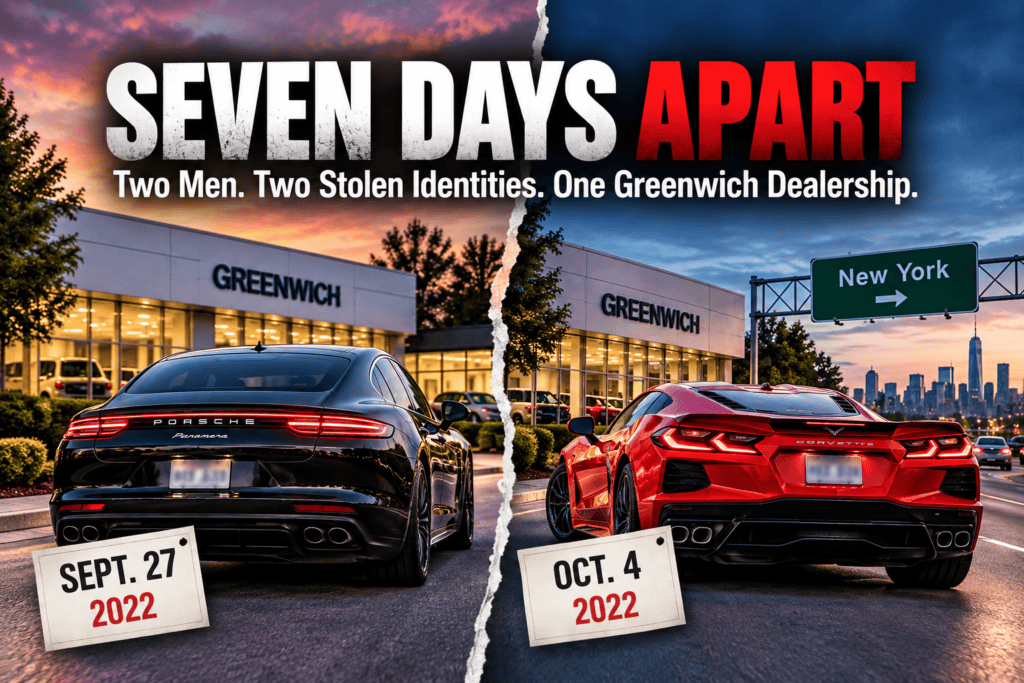
And on September 27, 2022, exactly seven days before Zhou obtained the Corvette, Zheng walked into a Greenwich car dealership using someone else’s identity.
According to federal prosecutors, Zheng used stolen personal and financial information and a stolen or counterfeit identity card to obtain $94,742.73 in financing for a 2019 Porsche Panamera.
The Porsche was then transported to New York for resale.
After the fraud was discovered, the dealership repossessed it before it could be sold.
But the similarities don’t stop there.
–
Two Cases That Look Remarkably Alike
Zheng’s Porsche was obtained in Greenwich on September 27, 2022.
Zhou’s Corvette was obtained in Greenwich on October 4.
Both men were 43.
Both were Chinese citizens residing in the New York City area.
Both allegedly used stolen identities and stolen or counterfeit identification.
Both obtained financing for six-figure luxury automobiles.
Both vehicles were transported from Greenwich to New York for intended resale.
Both vehicles were ultimately associated with repossession before resale.
Both men pleaded guilty to conspiracy to commit bank and wire fraud and aggravated identity theft.
Both cases were investigated by the FBI with assistance from Greenwich Police and the NYPD.
Both cases were prosecuted by Assistant U.S. Attorney Elena L. Coronado.
And both defendants were sentenced by U.S. District Judge Sarala V. Nagala.
There is another connection buried in Zheng’s case.
Federal prosecutors said Zheng’s co-conspirators also fraudulently financed other vehicles from the Greenwich dealership.
That description sounds remarkably similar to what prosecutors now say about Zhou and others obtaining at least six luxury vehicles worth more than $650,000 from a Greenwich dealership.
But there is something the government has not said. It has not publicly identified Zhou and Zheng as co-conspirators.
–
Did They Even Know Each Other?
That’s the question raised by the odd timing.
If Zhou and Zheng were working together directly, returning to the same dealership only seven days apart using essentially the same fraud seems extraordinarily risky.
But if they weren’t working together, the similarities become even more curious.
Were they independently exploiting the same dealership?
Was someone at the dealership in on it?
Were they working with different people who happened to use the same method?
Or was someone else supplying identities, documents or instructions to people who may not have known one another?
The public court information released by federal prosecutors doesn’t answer those questions.
And without those answers, there is no basis to say Zhou and Zheng were members of the same organization. But there is enough similarity to ask those questions.
–
Zheng Had Done It Before
The Zheng case contains another unusual detail.
On September 10, 2022, just 17 days before obtaining the Porsche, Zheng was arrested in Nassau County in connection with an unrelated scheme involving fraudulent checks used to purchase jewelry.
When police arrested him, Zheng was driving a Maserati.
That Maserati had been purchased from a dealership in Jamaica, Queens and registered in the name of an identity theft victim.
Then, less than three weeks later, Zheng allegedly used that same victim’s identity to obtain financing for the Porsche in Greenwich.
One stolen identity had apparently already produced one luxury automobile.
Then it produced another only a couple of weeks after being arrested.
–
And Then Came the Corvette
Seven days after Zheng obtained the Porsche, Zhou arrived for the Corvette.
Different defendant.
Different stolen identity.
Different car.
But apparently the same basic play.
A real person’s identity and financial information were presented to a dealership.
Financing was obtained.
A six-figure automobile left the lot.
The vehicle was transported to New York for resale.
And eventually the fraud was discovered.
In Zhou’s broader case, prosecutors say most of the vehicles were repossessed before they could be resold.
The government has not disclosed how the vehicles were located, who recovered them, where in New York they were recovered or who was supposed to purchase them.
Those details could answer some of the larger questions surrounding the operation.
–
Coincidence or Connection?
There is no evidence in the publicly released information establishing that Lei Zhou and Huachun Zheng knew one another.
There is no disclosed evidence that one recruited the other.
There is no disclosed evidence identifying a common organizer.
And there is no basis at this point to connect either man to the larger identity-theft and vehicle-export organizations prosecuted elsewhere around the country.
Those distinctions are important.
But so are the similarities.
Two 43-year-old Chinese citizens from the New York City area.
Two stolen identities.
Two six-figure luxury vehicles.
One Greenwich dealership—or potentially two dealerships in the same small Connecticut community.
The same destination.
The same intended resale.
The same federal charges.
The same investigative agencies.
The same prosecutor.
The same judge.
And two transactions separated by only seven days.
Maybe the federal court record will eventually explain how those pieces fit together.
For now, the government has given us two remarkably similar stories.
It just hasn’t told us whether they are actually one story.
Two Men. Two Stolen Identities. One Greenwich Dealership. – Two Men. Two Stolen Identities. One Greenwich Dealership. – Two Men. Two Stolen Identities. One Greenwich Dealership.
Two Men. Two Stolen Identities. One Greenwich Dealership. – Police – Police – Arrest – Arrest – Credit Union Collections – Credit Union Collectors – Lending – Fraud – Fraud – Auto Loan – Dealer– Dealer – Skip – Skip



More Stories
The Risk Didn’t Leave Auto Finance, It Changed Hands
Financed Monday. Exported Friday.
The Seasonal Loan Delinquency Reprieve May Be Ending
The $694 Million Paradox: When Does a Risky Loan Become Too Risky to Make?
He Bought Their Identities. Then He Bought the Cars
Catch Me If You Can: Inside the Gingerbread Man Auto-Fraud Enterprise