




TransUnion’s September Report Suggests a Troubling Stability in Consumer Auto Debt
–
For years, the auto finance industry has watched delinquency rates climb, worried about the next wave of defaults, and waited for signs that financially strained borrowers might finally find some relief. Every new report seems to deliver another warning about rising delinquencies, growing loan balances, or the mounting cost of vehicle ownership.
But what happens when those troubling numbers stop getting substantially worse?
What happens when elevated delinquency rates become so familiar that they no longer signal an approaching crisis, but instead describe the ordinary conditions under which lenders, collectors, and repossession companies conduct business?

TransUnion’s September 2026 Credit Industry Snapshot raises that possibility. While the latest figures show another monthly increase in auto loan delinquencies, a closer examination reveals something potentially more significant.
The industry may be settling into a new normal.
Download or Read The Report Here!
–
Delinquencies Are Rising, but the Bigger Picture Is Remarkably Stable
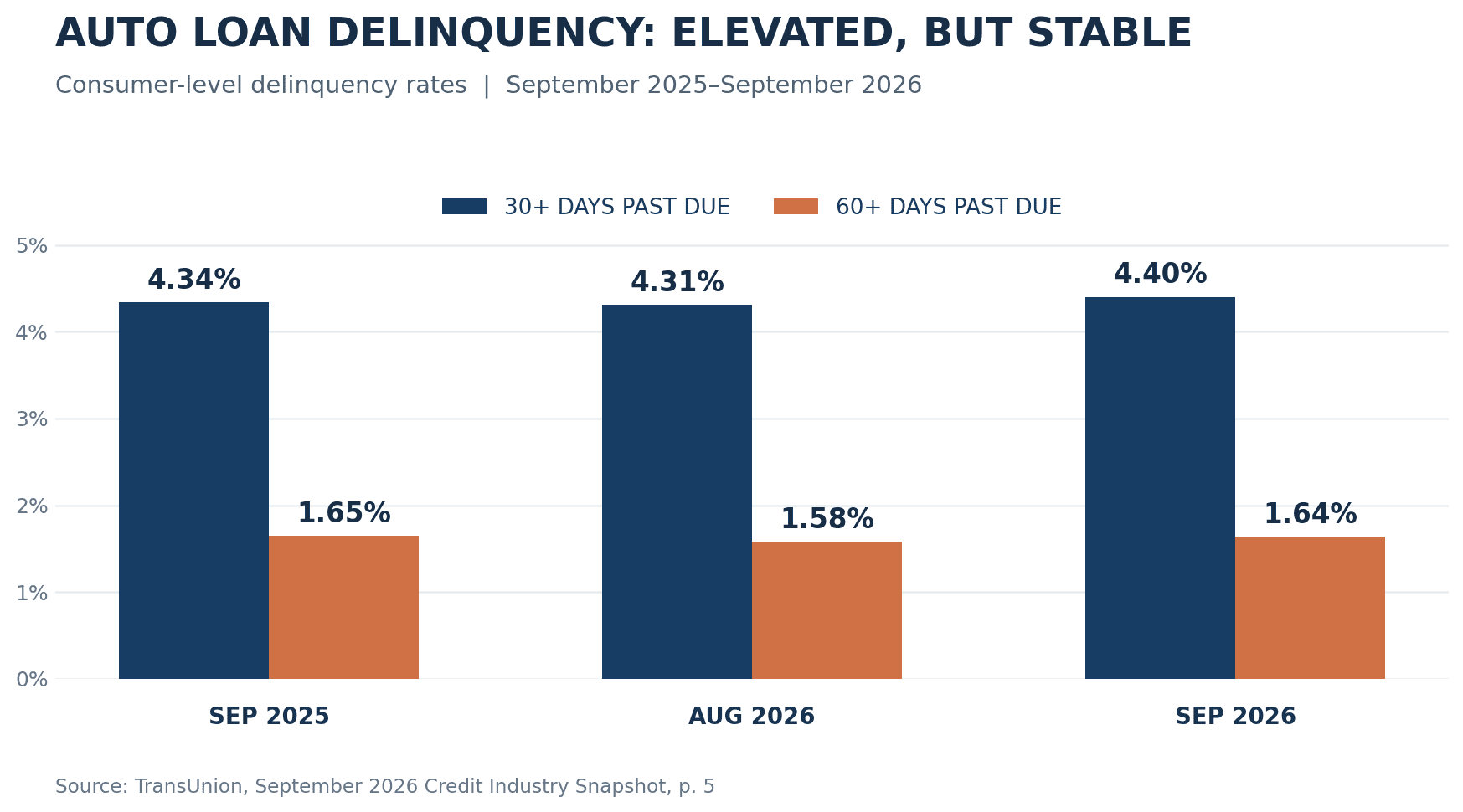
According to TransUnion, the percentage of consumers with auto loans at least 30 days past due increased from 4.31% in August to 4.40% in September. Serious delinquency, measured at 60 days or more past due, increased from 1.58% to 1.64%.
Viewed in isolation, those increases might appear to signal renewed deterioration in borrower performance.
But compare September 2026 with September 2025, and the picture changes considerably.
A year ago, the 30-day delinquency rate stood at 4.34%, just six basis points below its current level. More revealingly, the 60-day delinquency rate was 1.65%, virtually identical to September 2026’s 1.64%.
In other words, despite another year of inflation concerns, high vehicle ownership costs, and persistent affordability pressures, the national serious delinquency rate is essentially unchanged.
This does not mean consumers are doing particularly well. It means the rate at which they are falling seriously behind on their auto loans has shown little net movement over the past year.
That is a very different story from one of accelerating financial distress.
–
Subprime Lending: Elevated Risk Without a New Collapse
Nowhere is the distinction between elevated delinquency and accelerating delinquency more apparent than in the subprime market.
TransUnion reports that 9.18% of subprime auto borrowers were at least 60 days delinquent in September, up from 8.82% in August.
That monthly increase deserves attention. However, the September 2025 rate was 9.42%, meaning serious subprime delinquency is actually lower than it was a year ago.
The level of risk remains substantial, particularly compared with near-prime borrowers, whose serious delinquency rate stands at just 0.60%.
Yet the data does not show a subprime market suddenly falling apart. Instead, it suggests a market continuing to operate with a high and relatively persistent level of borrower distress.
For lenders specializing in higher-risk borrowers, this may represent an uncomfortable but increasingly familiar operating environment.
For collection departments and repossession companies, it could mean continued demand for their services without necessarily producing the dramatic surge in assignments that some have anticipated.
The distinction is important. A sustained high level of delinquency can generate significant collection and recovery activity even when the rate itself is no longer increasing.
–
Credit Unions Are Holding Their Ground
The September figures also reveal substantial differences in delinquency performance among lender types.
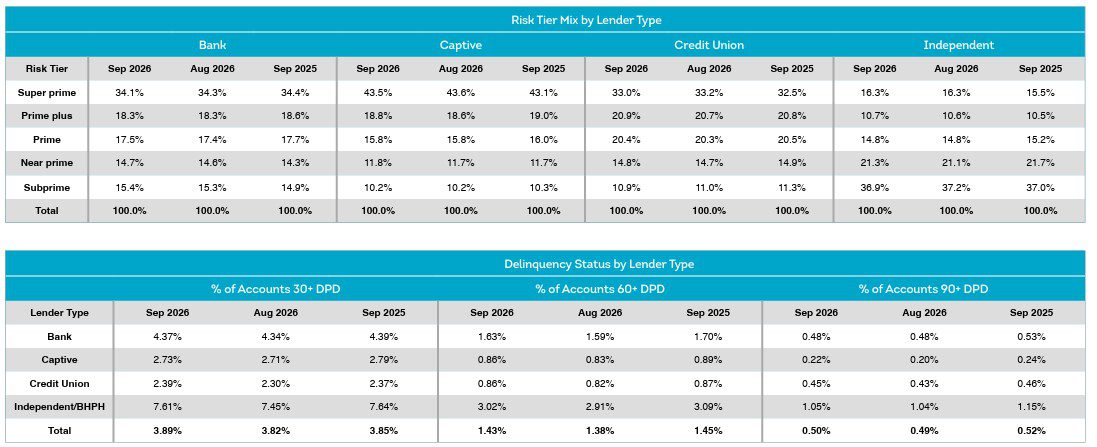
Credit unions reported a 60-day delinquency rate of just 0.86%, compared with 1.63% for banks and 3.02% for independent and buy-here-pay-here lenders.
Captive finance companies matched credit unions at 0.86%.
Perhaps more importantly, credit union serious delinquency was virtually unchanged from September 2025, when the rate stood at 0.87%.
Independent and BHPH lenders also experienced a slight year-over-year improvement, declining from 3.09% to 3.02%.
These comparisons are influenced by the types of borrowers each institution serves. Only 10.9% of credit union auto accounts fall within the subprime risk tier, compared with 36.9% among independent lenders.
Still, the results suggest that lenders across different segments of the market are managing relatively stable delinquency conditions, even though the levels of risk they carry differ substantially.
There is one interesting exception worth watching. Credit unions’ 90-day delinquency rate stands at 0.45%, compared with just 0.22% for captive lenders. The report does not explain that difference, but it suggests that similar 60-day delinquency rates do not necessarily produce similar outcomes as accounts move further into default.
–
The Geography of Financial Stress Hasn’t Disappeared
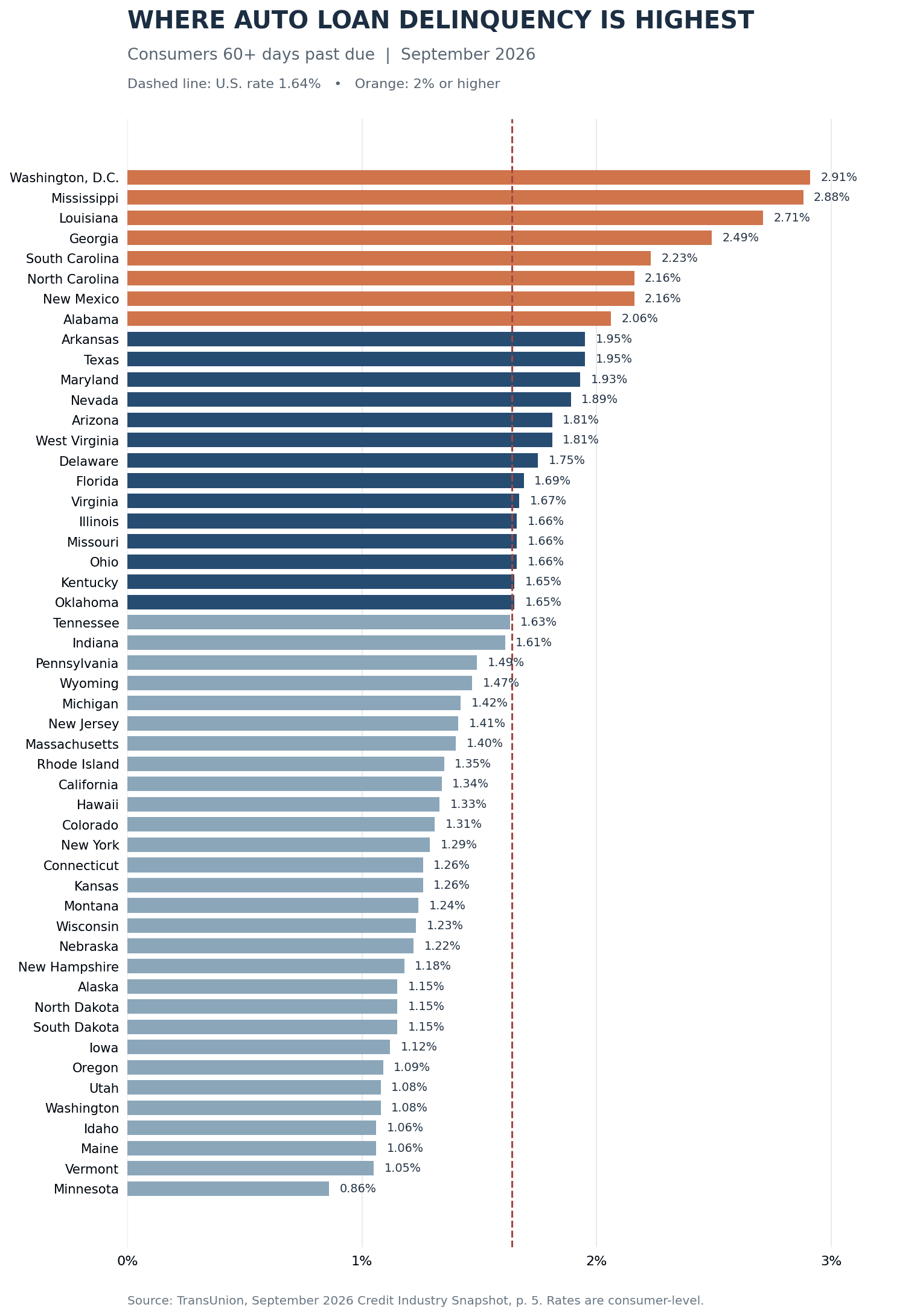
National averages can also conceal considerable regional differences.
Mississippi recorded a 30-day auto delinquency rate of 7.85% in September, while Louisiana stood at 6.98% and Georgia at 6.51%.
At 60 days past due, Washington, D.C., reported 2.91%, followed closely by Mississippi at 2.88%, Louisiana at 2.71%, and Georgia at 2.49%.
Compare those figures with Minnesota’s 0.86% serious delinquency rate, and it becomes clear that borrowers are not experiencing the same financial conditions everywhere.
Differences in household income, local economies, transportation costs, borrower credit profiles, and lending practices may all contribute to these disparities.
For the repossession industry, these regional differences are particularly relevant. A relatively stable national delinquency rate does not necessarily translate into stable recovery activity in every market.
However, delinquency rates alone cannot establish repossession volumes. Portfolio size, lender practices, and the number of financed vehicles in each state also influence recovery demand.
The broader observation remains that financial stress is not distributed evenly, and neither are the operational challenges facing lenders and their recovery partners.
–
The Loans That Never Fully Recovered
Perhaps the most revealing information in TransUnion’s report appears in its vintage delinquency analysis.
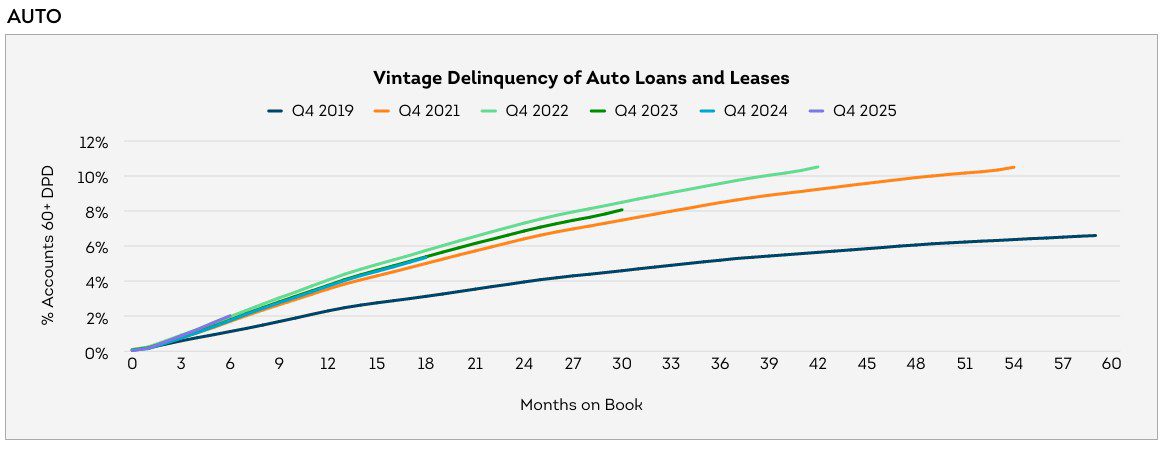
Unlike monthly delinquency rates, which provide a snapshot of current borrower performance, vintage analysis follows groups of loans originated during particular periods and measures how their performance changes as they age.
The differences are striking.
The chart shows that auto loans originated in the fourth quarters of 2021 and 2022 accumulated substantially more serious delinquency than loans originated in the fourth quarter of 2019 at comparable ages.
Those older post-pandemic loan cohorts continue to demonstrate the lasting effects of a lending environment shaped by rapidly rising vehicle prices, changing financing conditions, and extraordinary economic disruptions.
The more recent vintages have not yet accumulated enough history to determine their ultimate performance, but the comparison illustrates how substantially the lending environment changed after 2019.
These are not simply temporary fluctuations in a monthly report. They reflect differences in loan performance that can persist for years after origination.
And they raise a larger question about whether the industry’s traditional benchmarks remain appropriate.
–
The Cost of Owning a Vehicle Has Changed
There is another reason to question whether pre-pandemic comparisons still tell the whole story.
The cost of purchasing, financing, and maintaining a vehicle has changed substantially since 2019.
TransUnion’s second-quarter 2026 Credit Industry Insights Report found that average monthly payments had increased 38.7% for new vehicles and 39.6% for used vehicles since 2019.
Those increases exceeded both general inflation and wage growth over the same period.
The September snapshot provides another indication of the financial burden. The average amount financed on newly originated auto loans was $31,549 in July 2026, compared with $30,231 in July 2025, an increase of 4.4%.
For many households, the vehicle payment is only one part of the expense. Insurance, maintenance, repairs, registration, and fuel all compete for the same limited household income.
Borrowers may be adapting to these costs, but adaptation does not necessarily mean financial comfort.
A household that consistently struggles to make its vehicle payment may remain current for months before an unexpected repair, medical expense, or interruption in income pushes it into delinquency.
From the lender’s perspective, that uncertainty becomes part of the continuing cost of managing the portfolio.
From the borrower’s perspective, it can mean living perpetually one unexpected expense away from losing essential transportation.
–
Stability Is Not the Same as Recovery
None of this suggests that auto loan delinquencies have permanently peaked or that another period of deterioration is impossible.
Interest rates, employment conditions, vehicle values, and household finances can change. A weakening labor market or another significant economic disruption could quickly alter the present picture.
Nor does one year of relatively stable serious delinquency establish a permanent floor.
But the September figures, considered alongside TransUnion’s broader 2026 findings, suggest that the rapid deterioration experienced during earlier post-pandemic years may have given way to a more stable, if still financially strained, environment.
For lenders, this may require a different approach to portfolio management, one that treats elevated collection costs and persistent borrower vulnerability as continuing business conditions rather than temporary disruptions.
For repossession companies, it may suggest a sustained need for recovery services rather than the sudden explosion in assignments that periodic delinquency headlines sometimes imply.
And for collectors, it reinforces the importance of distinguishing borrowers experiencing temporary payment problems from those whose financial obligations have become fundamentally unsustainable.
The industry has spent years waiting for delinquency rates to return to what was once considered normal.
Perhaps the more important question is whether that expectation is still realistic.
Are we still measuring today’s auto loan performance against a pre-pandemic lending environment that no longer exists?
–
Download or Read The Report Here!
Sources: TransUnion, September 2026 Credit Industry Snapshot, pp. 2–5; TransUnion, Q2 2026 Credit Industry Insights Report, August 2026.
The New Normal? Auto Loan Delinquencies May Have Found Their Floor – The New Normal? Auto Loan Delinquencies May Have Found Their Floor – The New Normal? Auto Loan Delinquencies May Have Found Their Floor
The New Normal? Auto Loan Delinquencies May Have Found Their Floor – Credit Union Collections – Credit Union Collectors – Lending – Auto Loan – Delinquency – TransUnion – TransUnion






More Stories
When the Auto Loan Outlives the Car
Nearly One in Five American Families Fell Behind on Debt Payments
STUPID STUFF FRAUDSTERS BUY: Gotta Fraud ’Em All!
The Weak Links: One Loan, Many Points of Attack
Join Us at UCC 2027 – Credit Union Attendees Receive $200 Off
CEO Pleads Guilty to Embezzling Millions from Credit Union