



New York Fed data shows auto originations rising as median borrower credit scores fall
–
The auto lending market showed signs of renewed expansion during the second quarter, but new Federal Reserve data suggests lenders may also be moving farther down the credit spectrum.
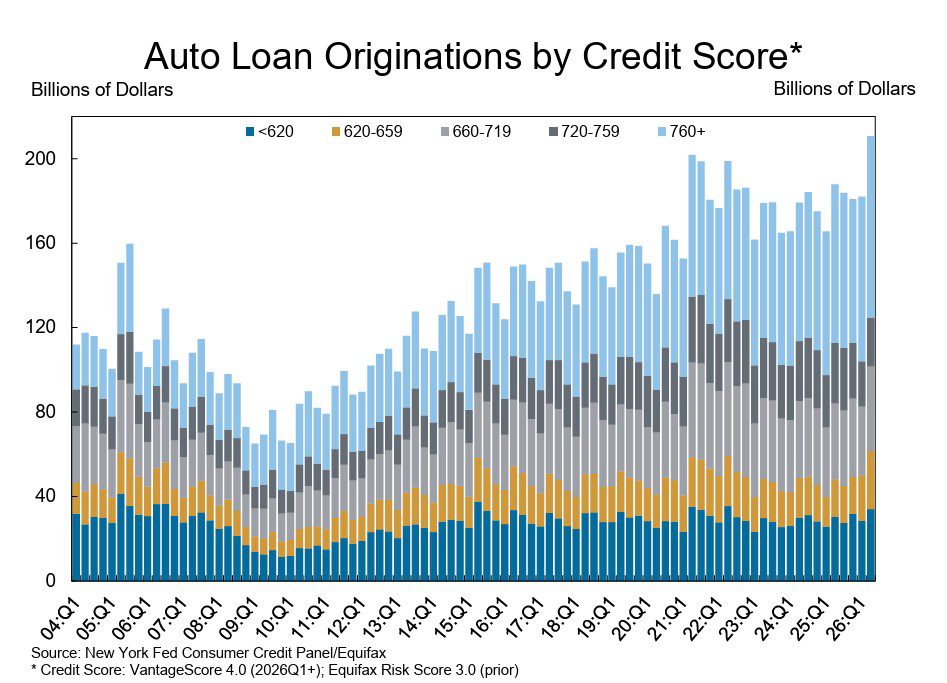
Auto loan originations climbed to $211 billion during the second quarter of 2026, while outstanding auto loan balances increased another $28 billion, or 1.7%, according to the Federal Reserve Bank of New York’s latest Quarterly Report on Household Debt and Credit.
At the same time, the median credit score of newly originated auto loans declined by seven points during the quarter.

That combination may be more important to lenders and collectors than any of those numbers individually.
More auto credit is being originated. Outstanding balances are growing. And the credit profile of the borrowers receiving those loans is beginning to weaken.
The shift comes while auto loan delinquency remains elevated and the New York Fed reports that transitions into early auto delinquency ticked slightly higher during the quarter.
For credit unions and other auto lenders, the second-quarter numbers suggest that credit availability may be expanding before existing borrower stress has fully retreated.
–
Auto Lending Picks Up
Overall household debt was essentially flat during the second quarter, declining $13 billion to approximately $18.8 trillion.
Non-housing debt moved in the opposite direction.
Those balances increased by $48 billion, or 0.9%, with auto loans accounting for more than half of that increase.
Outstanding auto loan balances rose $28 billion during the quarter, reaching approximately $1.71 trillion.
More importantly, new lending accelerated.
The New York Fed reported $211 billion in newly originated auto loans appearing on consumer credit reports during Q2.
The Fed described auto originations simply as having “picked up.”
But another movement occurred at the same time.
–
Borrower Credit Quality Moves Lower
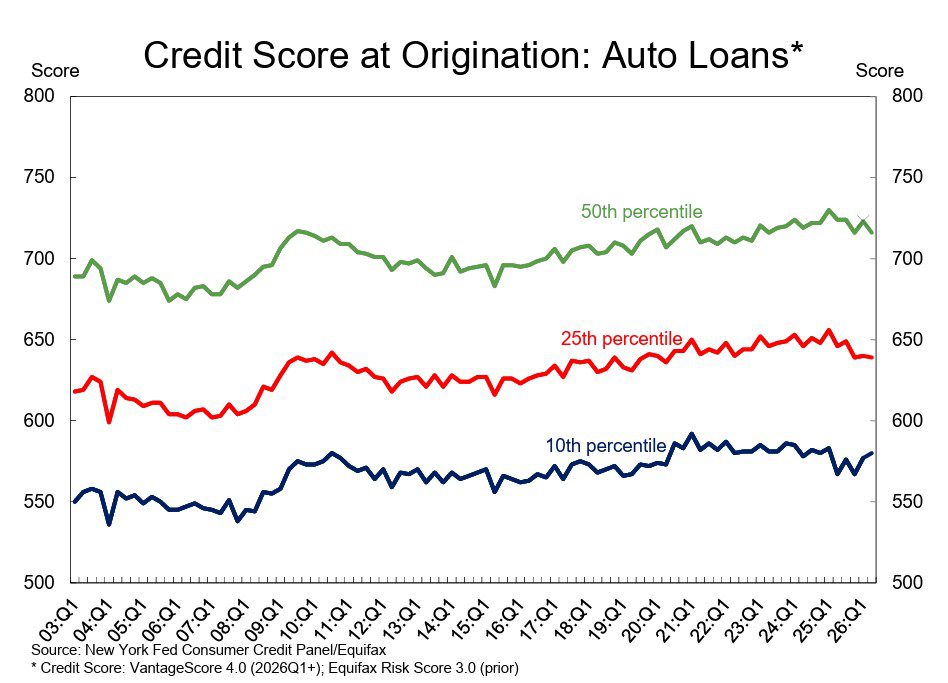
The median credit score of borrowers receiving newly originated auto loans declined seven points during Q2.
It does not necessarily mean underwriting standards are suddenly becoming loose. A seven-point quarterly movement by itself is hardly evidence of reckless lending.
It does, however, provide another indication that lenders may be becoming increasingly willing to extend credit farther down the credit spectrum.
There is an important qualification to the data.
Beginning in the first quarter of 2026, the New York Fed changed the credit score used in these charts from Equifax Risk Score 3.0 to VantageScore 4.0. Historical score levels before 2026 therefore should not be directly compared with current scores.
The seven-point Q1-to-Q2 decline, however, occurs under the same scoring methodology.
And it happened as auto originations increased.
That makes the direction worth watching.
–
Credit Expansion Meets Persistent Delinquency
Ordinarily, expanding auto credit alongside relatively stable delinquency might be interpreted as a healthy normalization of the market.
The current environment is more complicated.
The New York Fed reported that 4.7% of total household debt was in some stage of delinquency at the end of June, down slightly from the previous quarter.
Transitions into serious delinquency were also described as largely unchanged.
Auto loans, however, showed a different movement at the front end of the delinquency cycle.
The Fed reported that transitions into early delinquency ticked slightly higher for auto loans during Q2.
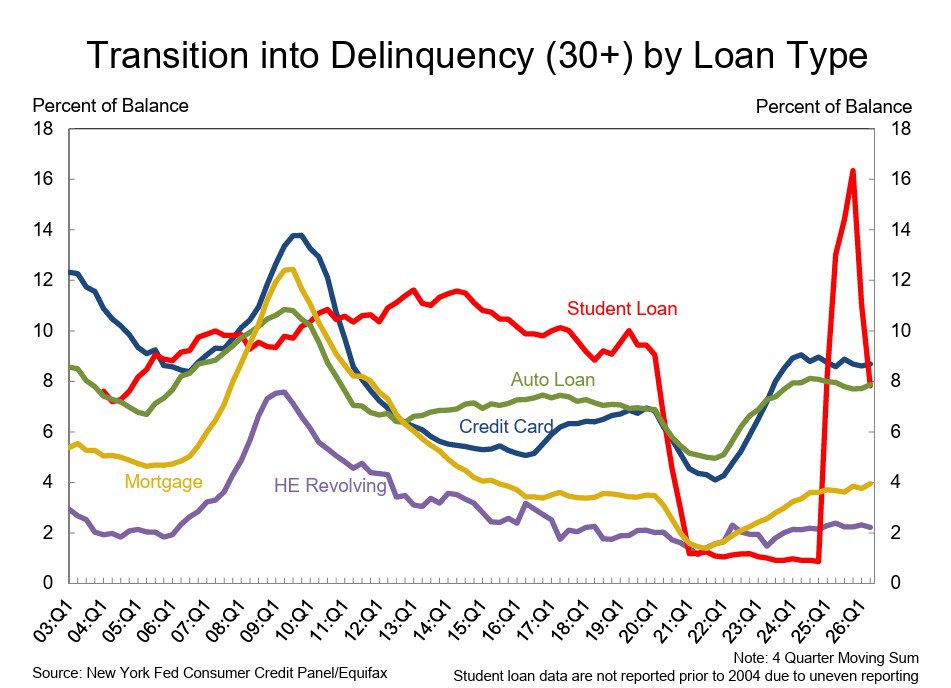
In other words, the second-quarter data is not showing a sudden deterioration in auto credit.
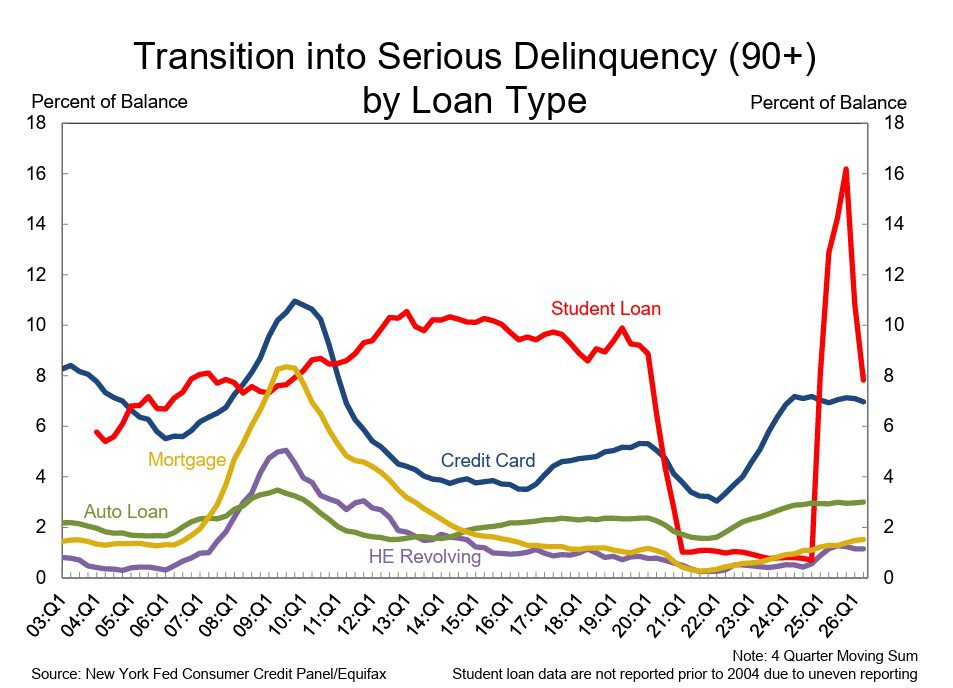
But neither is it showing that borrower stress has disappeared.
–
The Risk May Be Moving Forward
For collections departments, the most important part of the report may not be today’s delinquency rate.
It may be the composition of the loans entering portfolios now.
A loan originated today generally does not become tomorrow’s collection account immediately. Credit deterioration develops through vintages as borrowers encounter income disruptions, affordability pressures and other financial stresses.
That creates a lag between changes in underwriting and changes in collection activity.
If lenders continue increasing originations while extending credit to borrowers with somewhat weaker credit profiles, today’s lending expansion could eventually influence future delinquency inventories.
That doesn’t make higher losses inevitable.
It does make the performance of 2026 auto loan vintages increasingly important to watch.
Collectors may ultimately be among the first people inside financial institutions to see whether those vintages perform differently.
–
A Different Kind of Warning Signal
The second-quarter report is notable precisely because it isn’t an alarm bell.
Auto lending is growing.
Borrower credit quality has weakened somewhat.
Early delinquency edged higher.
Serious delinquency transitions remain comparatively stable.
Those conditions can coexist for a considerable period of time.
But collectively they create an important question for auto lenders:
Is credit expanding because consumer financial conditions have genuinely improved, or because lenders have become more willing to accept risk while borrower stress remains elevated?
The answer may not become clear for several quarters.
For credit unions, that makes underwriting discipline, vintage analysis and communication between lending and collections increasingly important.
Collections departments frequently deal with credit decisions long after those decisions were made.
The New York Fed’s second-quarter numbers provide another reason for lenders to pay attention not only to how much auto credit they are putting on the books, but also to who is receiving it and how those newer loans begin to perform.
–
The Numbers to Watch
$211 billion — Auto loans originated during Q2 2026
$28 billion — Increase in outstanding auto loan balances during Q2
1.7% — Quarterly increase in auto loan balances
7 points — Decline in the median credit score of newly originated auto loans
4.7% — Share of total household debt in some stage of delinquency
4.9% — Share of consumers with a third-party collection account on their credit report
The second quarter doesn’t show an auto lending crisis.
It shows something potentially more useful to lenders and collectors: the direction in which risk may be moving.
–
Read or Download The Entire Report Here!
Auto Lending Accelerates as Borrower Credit Quality Slips – Auto Lending Accelerates as Borrower Credit Quality Slips – Auto Lending Accelerates as Borrower Credit Quality Slips
Auto Lending Accelerates as Borrower Credit Quality Slips – Credit Union Collections – Credit Union Collectors – Lending – Auto Loan – Delinquency – Repossession – Repossession







More Stories
STUPID STUFF FRAUDSTERS BUY: Gotta Fraud ’Em All!
The Weak Links: One Loan, Many Points of Attack
Join Us at UCC 2027 – Credit Union Attendees Receive $200 Off
Two Men. Two Stolen Identities. One Greenwich Dealership.
The Risk Didn’t Leave Auto Finance, It Changed Hands
Financed Monday. Exported Friday.