



What rising underwater loans, longer financing terms, and affordability pressures mean for borrower protection and portfolio risk.
–
At a Glance
- Nearly 3 in 10 new-vehicle trade-ins carried negative equity in Q2 2026.
- Borrowers rolling negative equity into new loans reached a record $944 average monthly payment.
- Even vehicles with historically strong resale value are experiencing significant negative equity.
- Financial institutions are rethinking borrower protection and portfolio risk as affordability pressures persist.
The problem is not just vehicle depreciation. It is the intersection of loan structure, purchase timing, affordability pressures, and accumulated debt.
Record levels of negative equity, longer loan terms, and continued depreciation are reshaping how financial institutions approach borrower protection and portfolio risk. As consumers finance vehicles over longer periods, roll existing debt into new loans, and face greater uncertainty around vehicle values, more borrowers owe substantially more than their vehicles are worth. This shift is increasing the importance of vehicle protection strategies that help lenders manage risk while supporting borrowers throughout the loan lifecycle.

The conversation has expanded beyond interest rates and vehicle affordability. It is now about helping borrowers navigate greater financial uncertainty while protecting portfolio performance in an increasingly complex lending environment.
–
The Negative Equity Problem Continues to Grow
One of the most significant trends in auto finance is the continued rise of negative equity among consumers trading in vehicles.
According to Edmunds, 29.6% of trade-ins toward new-vehicle purchases carried negative equity in Q2 2026, marking the highest second-quarter level since 2020. While slightly lower than the record 30.9% reported in Q1, the share increased from 26.6% in Q2 2025 and highlights how widespread underwater loans have become.
The average amount owed on those loans reached $6,884 in Q2 2026, the highest level recorded for a second quarter.
These numbers reflect more than changing vehicle values. They illustrate how purchasing decisions made years earlier, combined with longer loan terms and higher vehicle prices, continue to influence borrower financial positions today.
Many consumers who purchased vehicles during the constrained inventory environment of 2022 paid elevated prices with limited incentives. As those vehicles return to the market, borrowers are bringing thousands of dollars in unpaid loan balances with them, creating challenges that extend into their next vehicle purchase.
–
Negative Equity Is Driving Higher Payments and Interest Costs
The impact of negative equity extends beyond the trade-in transaction. It directly affects affordability and the long-term cost of borrowing.
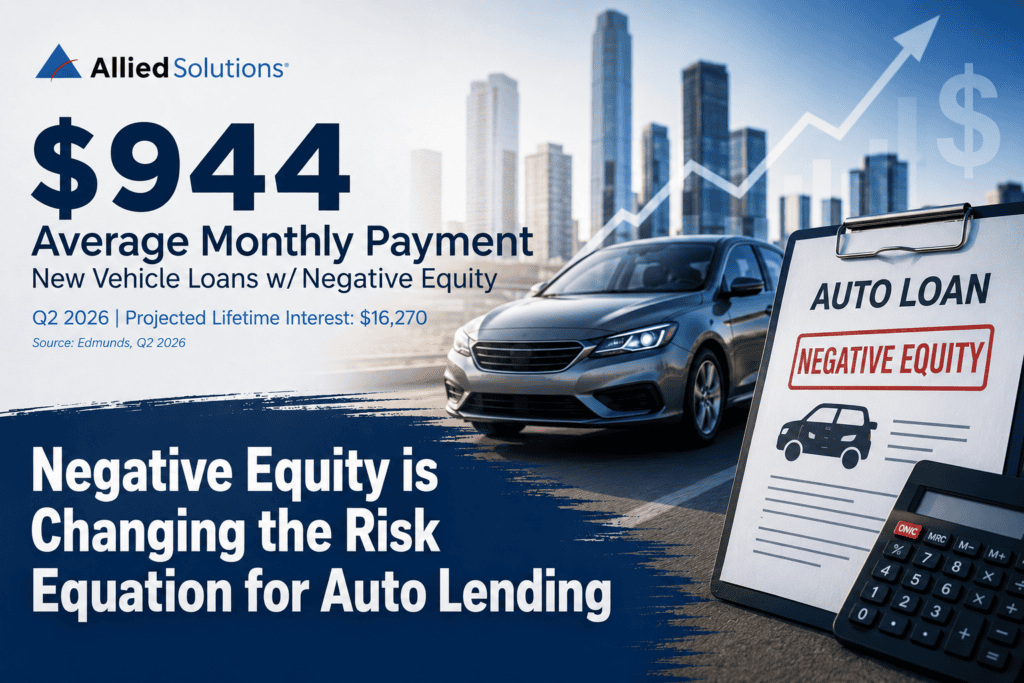
Edmunds reports that consumers rolling negative equity into a new vehicle loan reached an average monthly payment of $944 in Q2 2026, the highest level on record and $167 higher than the industry average new-vehicle payment of $777.
Over the life of those loans, borrowers carrying forward negative equity are projected to pay an average of $16,270 in interest, nearly $6,500 more than the average new-vehicle buyer.
For borrowers, this creates a challenging cycle. Extending loan terms may provide short-term payment relief, but it can also delay equity accumulation and increase the amount of interest paid over time.
For lenders, these dynamics reinforce the importance of strategies that help manage borrower risk throughout the life of the loan.
–
Depreciation Still Matters
Vehicle values have become more stable than they were during the pandemic, but depreciation remains a significant financial reality.
Cox Automotive data indicates used vehicle values continue to experience downward pressure, particularly in market segments where inventory is increasing and resale demand is softening.
Electric vehicles and certain luxury vehicles continue to depreciate faster than the broader market, creating additional challenges for borrowers financing those purchases.
Depreciation isn’t just a resale issue. It directly affects equity positions, influences loan performance, and shapes the financial outcome when an unexpected loss occurs.
–
These Trends Are Changing How Lenders Think About Risk
Negative equity is only one part of today’s evolving auto finance landscape.
Financial institutions are simultaneously navigating affordability pressures, higher insurance costs, rising repair expenses, increased operational complexity, and changing borrower expectations. Together, these factors are reshaping how lenders evaluate portfolio risk and borrower support strategies.
No single trend defines today’s market. Rather, it is the combination of these pressures that creates greater uncertainty for both borrowers and lenders.
–
What Do These Trends Mean for Lenders?
As market conditions evolve, many financial institutions are reevaluating how they support borrowers throughout the ownership cycle.
Products such as Guaranteed Asset Protection (GAP), Depreciation Protection Waivers (DPW), and other vehicle protection products are becoming increasingly relevant because they address specific risks created by today’s lending environment.
When a vehicle is declared a total loss, standard auto insurance generally reimburses the vehicle’s actual cash value rather than the remaining loan balance. If a borrower owes more than the vehicle is worth, that difference becomes their responsibility. GAP helps address that exposure by covering eligible loan deficiencies after a covered total loss.
DPW addresses a different challenge by helping offset the impact of vehicle depreciation when consumers replace or trade their vehicles. As borrowers hold vehicles longer and affordability remains a concern, programs that help preserve value throughout the ownership cycle can support both the borrower experience and portfolio performance.
Together, these protection strategies can help reduce borrower financial hardship, mitigate deficiency balance challenges, improve portfolio stability, and create opportunities for sustainable non-interest income.
More importantly, they reflect a broader shift in how lenders approach portfolio resilience. Protection products are increasingly becoming part of a comprehensive strategy to help borrowers navigate financial uncertainty while supporting long-term lending relationships.
–
Looking Ahead
Auto lending risk is becoming increasingly driven by financing dynamics, not just vehicle values.
For years, competitive advantage in auto lending was largely measured by originations. Today, lenders are increasingly being judged by what happens after the loan is booked. Borrower resilience, servicing performance, and protection against unexpected financial shocks are becoming just as important as acquisition.
Financial institutions that recognize these trends and build strategies around borrower support, risk management, and long-term value creation will be better positioned to navigate changing market conditions.
In this environment, vehicle protection products are not solving yesterday’s problems. They are helping lenders address today’s risks while preparing for tomorrow’s challenges.
Negative Equity is Changing the Risk Equation for Auto Lending – Negative Equity is Changing the Risk Equation for Auto Lending – Negative Equity is Changing the Risk Equation for Auto Lending
–

Amanda Mueller
Content Marketing Manager
Grow. Protect. Evolve.
Negative Equity is Changing the Risk Equation for Auto Lending – Credit Union Collections – Credit Union Collectors – Lending – Auto Loan






More Stories
Nearly One in Five American Families Fell Behind on Debt Payments
The Weak Links: One Loan, Many Points of Attack
Two Men. Two Stolen Identities. One Greenwich Dealership.
The Seasonal Loan Delinquency Reprieve May Be Ending
The $694 Million Paradox: When Does a Risky Loan Become Too Risky to Make?
Catch Me If You Can: Inside the Gingerbread Man Auto-Fraud Enterprise