


New report examines AI-driven credit washing, fraud trends and emerging risks facing auto lenders
–
Credit unions looking to stay ahead of rapidly evolving lending fraud should consider downloading Point Predictive’s newly released Q2 2026 Fraud Risk Intelligence Report, which explores several emerging fraud trends affecting consumer and automotive lending.

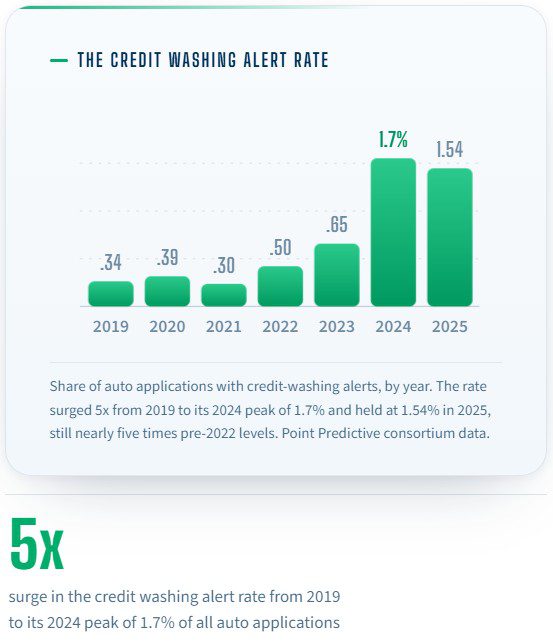
While the report covers a broad range of fraud intelligence, one section in particular deserves the attention of credit union lending and risk professionals: AI-Industrialized Credit Washing & #CreditHacks.
For several years, so-called “credit washing” schemes have circulated across social media, promising consumers a quick way to remove legitimate negative information from their credit reports through mass disputes. What was once largely a manual process has evolved into something far more scalable.

According to Point Predictive, artificial intelligence is now accelerating the trend by enabling consumers to generate sophisticated dispute letters, automate documentation, and follow step-by-step “credit hack” instructions promoted across social media platforms. The result is an industrialized approach that can temporarily alter a borrower’s apparent credit profile during the loan application process.
For lenders, the concern extends beyond the disputes themselves.
A borrower whose credit score appears to improve dramatically over a short period may not necessarily represent reduced credit risk. In some cases, the improvement may simply reflect disputed tradelines that could later reappear once investigations conclude. As AI makes these tactics easier and faster to execute, lenders face growing pressure to distinguish between genuine credit improvement and temporary manipulation.
The report also examines several additional fraud trends, including:
- Growth in first-party fraud.
- Bust-out fraud activity.
- AI-generated documents and synthetic application risks.
- Income and employment misrepresentation.
- Emerging fraud patterns identified through Point Predictive’s lending consortium.
For credit unions expanding indirect auto lending or reviewing underwriting strategies, the report provides useful insight into how fraud tactics continue to evolve alongside advances in artificial intelligence.
As fraudsters increasingly leverage AI to automate deception, lenders will likely need to place greater emphasis on verification, consortium intelligence, behavioral analytics, and layered fraud detection rather than relying solely on traditional credit attributes.
The complete Q2 2026 Fraud Risk Intelligence Report is available as a free download from Point Predictive after completing a brief registration form.
Point Predictive Releases Q2 2026 Fraud Risk Intelligence Report – Point Predictive Releases Q2 2026 Fraud Risk Intelligence Report – Point Predictive Releases Q2 2026 Fraud Risk Intelligence Report

Point Predictive Releases Q2 2026 Fraud Risk Intelligence Report – Credit Union Collections – Credit Union Collectors – Lending – Auto Loan – Fraud – Fraud






More Stories
The Weak Links: One Loan, Many Points of Attack
Join Us at UCC 2027 – Credit Union Attendees Receive $200 Off
STUPID STUFF FRAUDSTERS BUY: The Gold-Plated Cybertruck
CEO Pleads Guilty to Embezzling Millions from Credit Union
Two Men. Two Stolen Identities. One Greenwich Dealership.
The Seasonal Loan Delinquency Reprieve May Be Ending