



Debt Collection Lawsuits Surge as the Credit Cycle Finally Catches Up
–
EDITORIAL
For the past several years, much of the conversation surrounding consumer credit has focused on what lenders were doing to keep borrowers in their vehicles. Loan modifications, payment extensions, deferments, longer loan terms, and a variety of loss mitigation programs helped millions of consumers avoid immediate default.
But every delay has an expiration date.

New research from The Pew Charitable Trusts suggests that the next chapter of the post-pandemic credit cycle is no longer playing out in servicing departments or repossession assignments. It is increasingly unfolding in courtrooms across the country. (Pew Charitable Trusts)
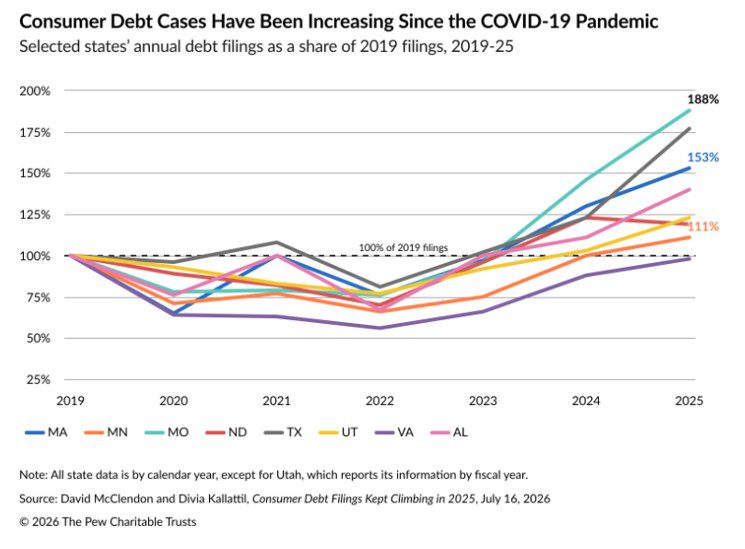
According to Pew’s latest report, “Debt Collection Lawsuits Continue to Flood State and Local Courts,” debt collection lawsuits continued to rise throughout 2025, exceeding pre-pandemic levels in nearly every state studied. Missouri filings increased 188 percent over 2019 levels, Texas rose 177 percent, and Massachusetts climbed 153 percent. Alabama reached its highest level on record, while several other states continue trending toward previous peaks. (The Wall Street Journal)
The findings build upon earlier research from the National Center for State Courts (NCSC), which has documented sustained increases in contract filings—the category that includes most consumer debt collection cases—following the pandemic. Pew’s analysis, conducted in partnership with January Advisors, indicates that these increases are continuing rather than subsiding. (The Wall Street Journal)
–
The Collection Cycle Is Moving Downstream
For credit union collections departments, the trend should come as little surprise.
The traditional collection lifecycle has always been straightforward. Borrowers become delinquent. Collection efforts intensify. Accounts either cure, collateral is recovered, or the loan ultimately charges off.
Over the past several years, however, that process changed dramatically.
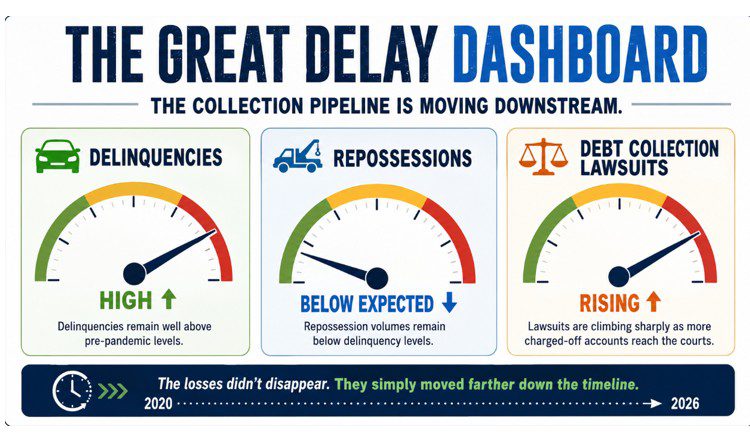
Rather than moving quickly through the collection pipeline, many accounts remained in servicing far longer than historical norms. Financial institutions offered payment accommodations, extensions, and modifications designed to give borrowers additional time to recover financially. At the same time, repossession volumes remained well below delinquency levels despite growing consumer stress.
Those strategies delayed losses. They did not eliminate them.
Eventually every troubled loan reaches a decision point.
If the borrower still cannot resume payments, lenders are left with only a handful of remaining options: charge off the balance, sell the debt, or pursue legal action.
The increasing volume of collection lawsuits may simply represent the back end of that delayed credit cycle finally arriving.
–
An Important Signal for Credit Unions
Credit unions have traditionally emphasized member relationships and workout solutions before pursuing litigation. That philosophy is unlikely to change.
However, the broader legal environment offers an important signal.
Higher lawsuit volumes suggest that more accounts across the lending industry are reaching the point where every other collection alternative has already been exhausted.
The broader economic backdrop reinforces that conclusion. As recently reported by the Wall Street Journal, U.S. credit card balances have climbed to approximately $1.25 trillion, while researchers estimate that roughly 70 percent of debt collection lawsuits end in default judgments because consumers fail to respond. Most lawsuits involve balances under $4,000, illustrating that relatively modest debts are increasingly finding their way into court. (The Wall Street Journal)
For many borrowers, the financial flexibility that existed during the pandemic has largely disappeared.
–
Looking Beyond the Numbers
One of the more interesting aspects of Pew’s research is that much of the increase appears concentrated among large debt buyers rather than original creditors. That reinforces another reality of today’s marketplace. Many charged-off accounts eventually enter the secondary debt market, where litigation often becomes a primary recovery strategy. (The Wall Street Journal)
For credit unions, this should serve as more than an interesting legal statistic.
It is another reminder that collection activity does not end when a loan is charged off. Every stage of the collection lifecycle influences the next, whether through recoveries, deficiency balances, debt sales, or litigation.
–
The Next Phase of The Great Delay
For the past year, we’ve discussed what we’ve called The Great Delay—the widening gap between rising delinquencies and historically depressed repossession volumes as lenders relied on modifications, extensions, and other borrower assistance programs to postpone losses.
Perhaps the latest surge in debt collection lawsuits represents the next phase of that story.
The losses were never eliminated. They were simply deferred.
Now, after years of extending timelines, restructuring loans, and delaying difficult decisions, many of those same accounts appear to be arriving at the final stop in the collection process—not in the repossession lot, but in the courtroom.
For collection professionals, the lesson may be the same one we’ve been discussing all along:
Delaying a loss may improve the timing of recognition, but it rarely changes the outcome.
Further Reading
- The Pew Charitable Trusts – Debt Collection Lawsuits Continue to Flood State and Local Courts
- Loan Modifications – The Illusion of Stability Suppressing Repossession Volume
- The Auto Finance Paradox
- National Center for State Courts (NCSC) Civil Justice Research
- Wall Street Journal – Debt Collectors Chase More Consumers in Court
- NCUA and FDIC Memos Advocate Liberal Loan Modification Underwriting
The Great Delay Reaches the Courthouse – The Great Delay Reaches the Courthouse – The Great Delay Reaches the Courthouse
The Great Delay Reaches the Courthouse – Credit Union Collections – Credit Union Collectors – Lending – Auto Loan – Skip – Skip – Modifications – Lawsuit – Lawsuit – Delinquency






More Stories
Credit Union Promoted Employee Despite Fraud Warnings — Then Collapsed Under $3.5 Million in Losses
The New Normal? Auto Loan Delinquencies May Have Found Their Floor
When the Auto Loan Outlives the Car
Nearly One in Five American Families Fell Behind on Debt Payments
The Weak Links: One Loan, Many Points of Attack
Join Us at UCC 2027 – Credit Union Attendees Receive $200 Off