



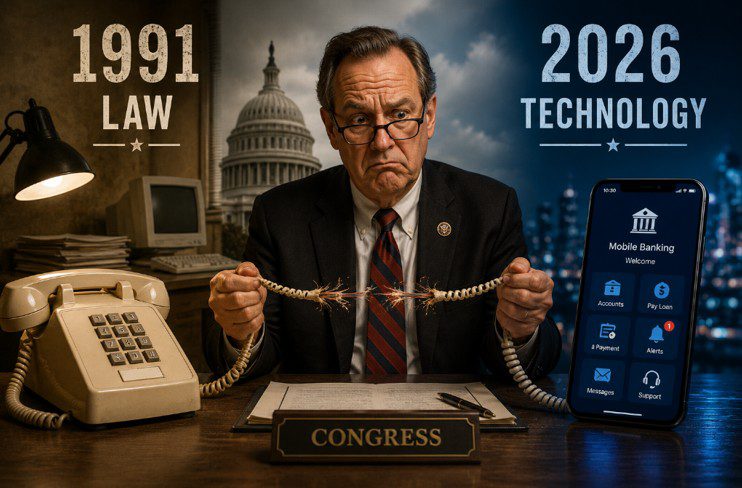
A law written for landlines, enforced in the smartphone era
–
The Telephone Consumer Protection Act (TCPA) was good legislation, for 1991. At the time, Congress had a legitimate problem to solve. Americans were being bombarded with prerecorded telemarketing calls generated by technology capable of dialing thousands of random telephone numbers. Cellular phones were expensive, incoming calls often cost consumers money, and caller ID was still a novelty.
None of those realities accurately describe how consumers communicate today.
Fast forward thirty-five years.
Most Americans no longer have a landline. Many have never owned one. Nearly every borrower voluntarily provides a cell phone number when applying for an auto loan and expects to receive account alerts, payment reminders, fraud notifications, and customer service communications on that same device.
Yet lenders continue operating under statutory language written when fax machines were considered cutting-edge technology.
The recent settlements involving Flagship Credit Acceptance and Nissan Motor Acceptance are simply the latest examples of an increasingly familiar story. Companies deny wrongdoing, but they settle anyway because the alternative is potentially catastrophic statutory damages that can multiply into hundreds of millions of dollars through class-action litigation.
That’s not because every lender is intentionally harassing consumers.
It’s because the financial risk of litigating under a decades-old statute has become nearly impossible to justify.
Even the Supreme Court recognized that technology has fundamentally changed. In 2021, the Court unanimously narrowed the definition of an automatic telephone dialing system, acknowledging that today’s customer-contact platforms bear little resemblance to the random-number generators Congress sought to prohibit in 1991.
But while the courts have modernized portions of the law, Congress has not.
This illustrates a broader problem that extends well beyond telecommunications.
Legislatures frequently enact technology laws aimed at solving today’s problem. Unfortunately, technology evolves exponentially while legislation evolves incrementally. By the time Congress revisits the issue, entire industries may have already spent billions complying with outdated requirements, defending lawsuits, and paying settlements based on statutory language that no longer reflects modern reality.
That doesn’t mean consumers should lose protection from abusive robocalls. They absolutely deserve protection.
But protecting consumers and modernizing the law are not mutually exclusive goals.
A borrower who voluntarily provides a mobile number to communicate with their lender is not the same as a consumer receiving random telemarketing calls from a company they’ve never heard of.
Congress can recognize that distinction, but nothing changes.
Until it does, lenders will continue spending millions defending lawsuits over communication technologies that didn’t exist when the law was written, while consumers ultimately bear those costs through higher compliance expenses, higher borrowing costs, and reduced operational efficiency.
But what incentive does Congress have to modernize the TCPA?
Very little.
Consumers receive modest settlement checks. Plaintiff attorneys earn substantial fees. Companies settle rather than gamble on potentially catastrophic statutory damages. The system keeps functioning, even as nearly everyone acknowledges that the technology has fundamentally changed.
Without meaningful public pressure, outdated laws rarely become legislative priorities. Instead, they linger on the books like relics from another era, creating billions of dollars in compliance costs and litigation over communication methods their authors could never have imagined.
The cycle repeats because everyone pays a little, but no one pays enough to demand reform.
Technology has changed. Consumer expectations have changed. The courts have begun adapting.
Congress still has some catching up to do.
Editorial: TCPA – The Law Technology Left Behind – Editorial: TCPA – The Law Technology Left Behind – Editorial: TCPA – The Law Technology Left Behind
Kevin Armstrong
Publisher
Editorial: TCPA – The Law Technology Left Behind – Credit Union Collections – Credit Union Collectors – Lending – Auto Loan – Lawsuit – Lawsuit






More Stories
Regulators Clarify What Credit Unions Can Tell Members About Suspicious Activity
The Payment Moved, The Depreciation Didn’t
Your Collateral Just Left the Country
$3.3 Million for Credit Union CEO Luxury and Only $1.7 Million for 33 Employees
The Pastor, the Credit Repairmen and $460,000 in Fraudulent Auto Loans
One Employer, Hundreds of Auto Loans: The Fed Warns About Concentrated Credit Risk