


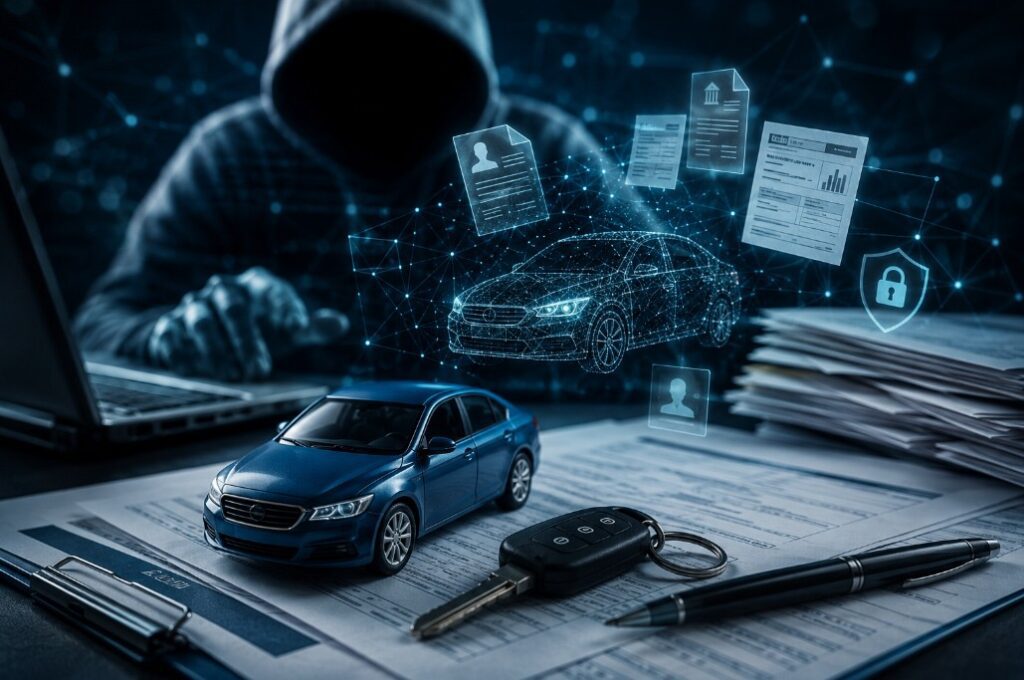
Artificial intelligence isn’t just helping lenders make decisions. It’s helping fraudsters create applications convincing enough to fool them.
The New Face of Auto Loan Fraud: When AI Becomes the Borrower’s Co-Signer
A loan officer reviews an application from a borrower with a respectable credit score. The pay stubs look authentic. Employment is verified. The bank statements appear consistent. Nothing immediately raises concern.
The loan is approved.
Months later, the payments stop.
Investigators eventually discover the borrower really existed—but the income didn’t. The employer was fictitious. The pay stubs were generated in minutes using artificial intelligence. The employment verification letter was written by AI. The supporting financial documents were digitally manufactured to tell a believable story.

No hacker breached the lender’s systems. No stolen identity was used.
Instead, artificial intelligence quietly became the borrower’s most valuable accomplice.
Fraud Is Changing Faster Than Many Lenders Realize
For years, the auto finance industry focused on traditional fraud schemes: stolen identities, counterfeit driver’s licenses, synthetic identities, fake dealerships, and forged signatures. Those threats remain very real, but they are no longer the fastest-growing challenge.
Industry fraud analysts now report that first-party fraud has become the dominant source of fraud exposure in auto lending. In these cases, the borrower is exactly who they claim to be. The deception lies not in their identity, but in the financial story presented to qualify for the loan.
That distinction matters.
Identity verification tools have become increasingly sophisticated. But verifying a person’s identity is very different from verifying the truthfulness of every document supporting the application.
AI Has Lowered the Barrier to Fraud
Until recently, producing convincing financial documents required specialized software and considerable effort. Today, generative AI has dramatically reduced that barrier.
With carefully crafted prompts, fraudsters can create documents that closely resemble:
- Pay stubs
- Employment verification letters
- W-2 forms
- Bank statements
- Utility bills
- Insurance cards
- Business correspondence
Many of these documents are not perfect. They don’t need to be.
In a busy lending environment where loan officers review hundreds of applications, a document only needs to appear credible long enough to move the application forward.
The Biggest Lie May Be Income
Recent fraud trend reports identify income and employment misrepresentation as the largest category of fraud exposure in auto lending.
A borrower earning $42,000 annually can appear to earn $82,000 with a few altered figures.
That single change can transform:
- Debt-to-income ratios
- Loan eligibility
- Maximum loan amount
- Interest rate
- Approval decision
The borrower may even intend to make the payments. But the loan itself was approved using materially false information.
First-Party Fraud Doesn’t Look Like Crime
One reason this trend is so dangerous is that it rarely resembles traditional fraud.
There may be:
- No stolen identity
- No forged signature
- No counterfeit driver’s license
- No fake Social Security number
Instead, the borrower simply exaggerates income, invents employment, conceals liabilities, or submits AI-generated supporting documents.
Because the borrower is a real person using legitimate identifying information, many fraud detection systems never recognize the deception until after the loan begins to fail.
Early Payment Defaults Are Becoming a Warning Sign
For years, lenders often viewed early payment defaults as poor underwriting or unexpected financial hardship.
Today, fraud investigators increasingly view them as potential indicators of fraud at origination.
When a borrower misses payments almost immediately after funding, investigators now ask different questions:
- Was employment legitimate?
- Was income accurately reported?
- Were the supporting documents authentic?
- Was the dealership aware?
- Did multiple lenders finance similar applications?
What once appeared to be collections problems may increasingly become criminal investigations.
Organized Fraud Is Growing More Sophisticated
Investigators are also seeing growth in “bust-out” fraud schemes.
Rather than targeting a single lender, organized groups establish or rehabilitate credit profiles before applying for multiple vehicle loans across several institutions in rapid succession. Vehicles are then exported, dismantled, or quickly resold before lenders recognize the pattern.
Artificial intelligence makes these operations more scalable.
Instead of manually creating each fraudulent application, AI can produce customized supporting documents in minutes, allowing fraud rings to process significantly more applications than in previous years.
What This Means for Credit Unions
Credit unions have long balanced member service with prudent underwriting. AI-generated document fraud makes that balance more difficult.
Questions lenders increasingly face include:
- Should every stated income be independently verified?
- How should AI-generated documents be detected?
- When should additional employment verification be required?
- How much friction will members tolerate before abandoning the application?
The challenge is protecting honest borrowers without creating unnecessary barriers to legitimate lending.
Why This Matters to the Repossession Industry
Repossession agencies are often the first to encounter the consequences of fraudulent loans.
A vehicle assigned for recovery after only one or two missed payments may not simply represent financial hardship. It could be connected to:
- Income fraud
- Employment fraud
- Bust-out operations
- Organized criminal activity
- Dealer collusion
Understanding that possibility can influence documentation, communication with lenders, and cooperation with law enforcement when suspicious patterns emerge.
The Next Wave of Headlines
The industry has spent the past several years reading headlines about fake dealerships, insider theft, identity fraud, and loan officer embezzlement.
The next wave of prosecutions may look different.
Instead of stolen identities, prosecutors may increasingly focus on borrowers who used their own identities while systematically fabricating every financial detail supporting the loan.
Artificial intelligence did not create fraud.
It simply made sophisticated deception faster, cheaper, and available to nearly anyone with an internet connection.
The next major fraud ring may not begin with a counterfeit driver’s license.
It may begin with a well-written prompt.
The New Face of Auto Loan Fraud: When AI Becomes the Borrower’s Co-Signer – The New Face of Auto Loan Fraud: When AI Becomes the Borrower’s Co-Signer – The New Face of Auto Loan Fraud: When AI Becomes the Borrower’s Co-Signer
The New Face of Auto Loan Fraud: When AI Becomes the Borrower’s Co-Signer – Credit Union Collections – Credit Union Collectors – Lending – Fraud – Auto Loan – Repossess





More Stories
The Weak Links: One Loan, Many Points of Attack
Join Us at UCC 2027 – Credit Union Attendees Receive $200 Off
STUPID STUFF FRAUDSTERS BUY: The Gold-Plated Cybertruck
CEO Pleads Guilty to Embezzling Millions from Credit Union
Two Men. Two Stolen Identities. One Greenwich Dealership.
The Seasonal Loan Delinquency Reprieve May Be Ending