



New TransUnion research shows fewer fraud attempts are producing much larger losses, exposing growing weaknesses in identity verification, indirect lending and collateral recovery.
–
For years, auto lenders have measured fraud largely by volume, how many fraudulent applications were stopped before funding or how many suspicious loans entered the portfolio.
According to new research from TransUnion, that may no longer be the right metric.
The company’s latest analysis, “Auto Loan Fraud Losses More Than Triple in Key Categories,” finds that while many categories of auto lending fraud are becoming less frequent, the financial damage from successful fraud has risen dramatically. Fraudsters appear to be shifting away from high-volume schemes toward fewer, better-planned attacks capable of generating substantially larger losses.

Read the original TransUnion announcement here:
Auto Loan Fraud Losses More Than Triple in Key Categories, New TransUnion Analysis Finds
“Fraudsters are becoming increasingly targeted and efficient. While fraud volume remains an important indicator of risk, we are seeing criminals drive significantly higher losses through fewer, more strategic attacks by targeting high-value opportunities and exploiting vulnerabilities across the lending lifecycle. For lenders, effectively managing fraud risk requires a comprehensive view of both frequency and financial impact—not only how often fraud occurs, but also the severity of each incident and its potential effect on the business.
Satyan Merchant, senior vice president and automotive and mortgage business leader at TransUnion
–
Bigger Losses from Fewer Cases
TransUnion’s analysis found that first-party fraud losses in auto lending have climbed from approximately $88 million in 2018 to $323 million in 2025, an increase of more than 260 percent.
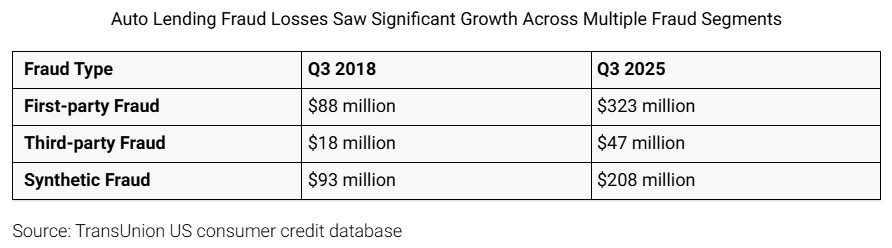
Rather than casting a wide net, today’s fraudsters appear to be targeting larger loan balances, exploiting weaknesses in identity verification and leveraging increasingly sophisticated synthetic identities and credit profile manipulation. As a result, each successful fraudulent loan carries a much higher financial impact than in previous years.
For lenders, that’s an important distinction.
A declining fraud count can create the appearance that underwriting controls are improving. In reality, fewer successful attacks may simply reflect criminals becoming far more selective, and far more profitable.
–
Credit Washing Continues to Evolve
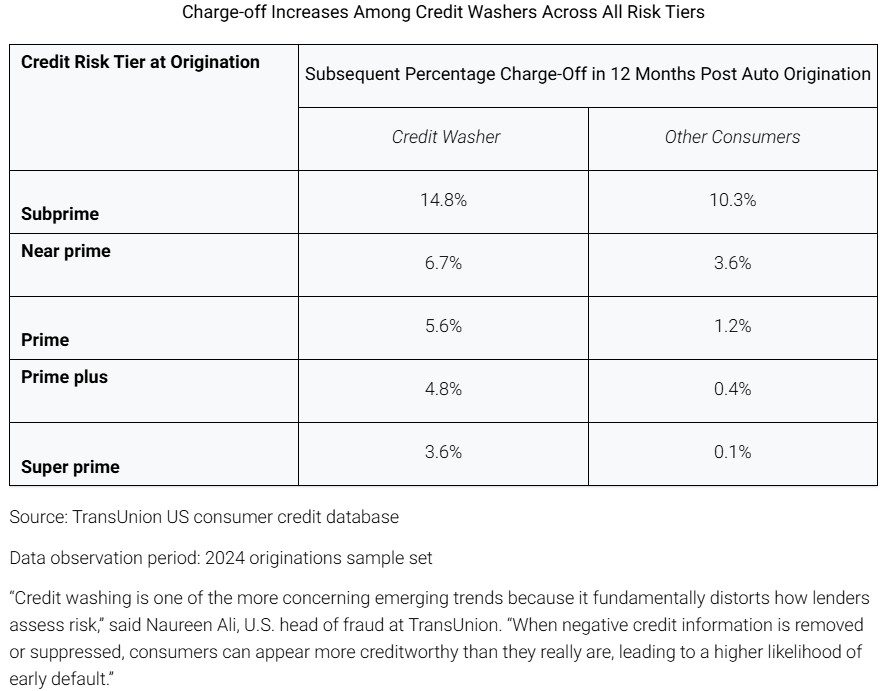
The report also reinforces another trend already receiving growing attention throughout auto finance: credit profile manipulation.
Synthetic identities, identity theft and credit washing techniques continue evolving, allowing applicants with damaged or nonexistent credit histories to appear substantially less risky than they actually are. These borrowers frequently obtain financing they otherwise would not qualify for before quickly defaulting or disappearing entirely.
For credit unions, particularly those relying heavily on indirect auto lending, detecting these applications before funding is becoming increasingly difficult.
–
Why Collections Should Pay Attention
Fraud doesn’t simply create underwriting losses.
It creates collection problems.
Accounts obtained through identity manipulation often skip traditional delinquency patterns. Borrowers may never intend to repay, contact information is frequently inaccurate, insurance may lapse immediately after funding, and collateral can disappear before the first payment is missed.
By the time collections becomes involved, many of the traditional recovery tools have already been compromised.
That significantly increases both charge-off severity and repossession costs.
–
The Repossession Connection
While TransUnion’s research focuses primarily on fraud prevention, the downstream effects extend directly into the repossession industry.
Fraudulent borrowers are far more likely to:
- conceal vehicle locations,
- abandon collateral,
- transport vehicles across state lines,
- use false addresses,
- employ identity aliases, or
- intentionally frustrate recovery efforts.
Each additional day required to locate collateral increases recovery expense while reducing vehicle value.
For recovery agents, fraud often transforms what should have been a routine repossession into a complex skip-tracing assignment.
–
An Industry Trend Worth Watching
The findings also complement several other fraud trends emerging across the industry.
Point Predictive recently estimated that annual auto lending fraud exposure has grown to more than $10 billion, fueled by synthetic identity fraud, AI-generated documents, income fabrication and organized fraud rings. Meanwhile, lenders continue reporting increased concern over credit washing and first-party fraud schemes that are becoming more difficult to distinguish from legitimate borrowers.
Viewed together, the message is becoming increasingly clear.
Auto lending fraud is no longer simply about stopping more applications.
It’s about identifying the relatively small number of applications capable of producing exceptionally large losses after funding.
For credit unions, that means continued investment in identity verification, fraud analytics and indirect lending controls.
For collections professionals, it means recognizing that tomorrow’s most expensive charge-offs may never resemble traditional credit losses.
And for the repossession industry, it serves as another reminder that fraud is no longer just an underwriting problem, it increasingly determines whether collateral can be found at all.
Auto Loan Fraud Losses Have Tripled, But the Number of Fraud Cases Is Falling – Auto Loan Fraud Losses Have Tripled, But the Number of Fraud Cases Is Falling – Auto Loan Fraud Losses Have Tripled, But the Number of Fraud Cases Is Falling
Auto Loan Fraud Losses Have Tripled, But the Number of Fraud Cases Is Falling – Credit Union Collections – Credit Union Collectors – Lending – Fraud – Auto Loan – Skip – Skip – TransUnion – TransUnion – Repossession – Repossession






More Stories
Financed Monday. Exported Friday.
The Seasonal Loan Delinquency Reprieve May Be Ending
The $694 Million Paradox: When Does a Risky Loan Become Too Risky to Make?
He Bought Their Identities. Then He Bought the Cars
Catch Me If You Can: Inside the Gingerbread Man Auto-Fraud Enterprise
Case Study: Out of the Inbox, Into the System