

First-Party Fraud Tops Identity Theft in Auto Lending, SentiLink Finds
–
For years, much of the auto lending industry’s fraud attention has focused on stolen identities, synthetic identities and increasingly sophisticated fraud rings. But new data from SentiLink suggests lenders may be facing a different problem hiding in plain sight.
The applicant is real. The identity is real. And the borrower may never have intended to repay the loan.
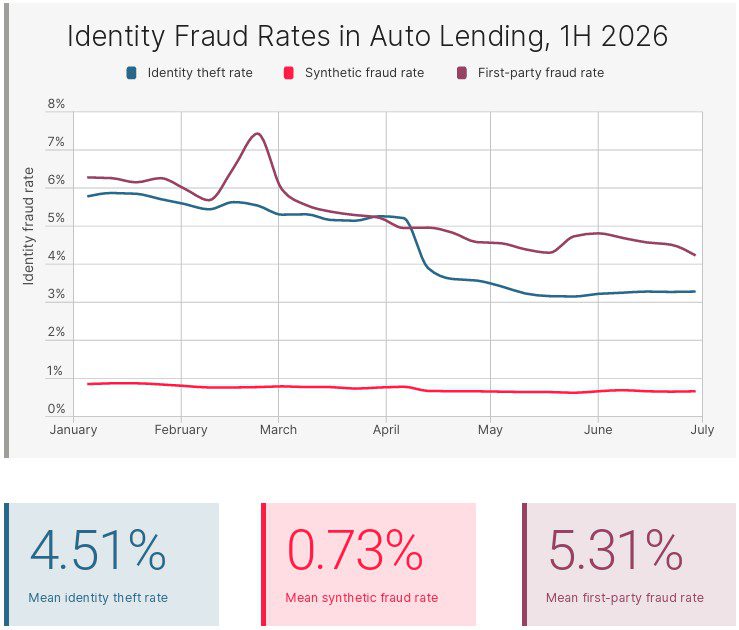
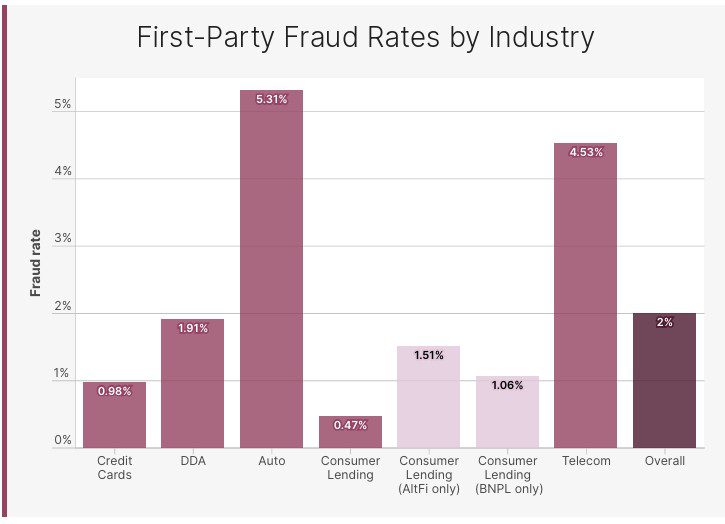
According to SentiLink’s Fraud Report: 1H 2026, first-party fraud was the largest identity-fraud category in auto lending during the first half of the year. SentiLink estimated a mean 5.31% first-party fraud rate among the auto lending applications it analyzed, compared with 4.51% for identity theft and 0.73% for synthetic fraud.

Read The Sentilink Report Here!
–
More remarkable is how unusual that makes auto lending.
SentiLink reports that auto lending was the only industry it studied in which first-party fraud exceeded identity theft. With the exception of a single week in early April, first-party fraud remained higher throughout the entire first half of 2026.
For lenders and collectors, that distinction matters.
–
When the Borrower Is the Fraudster
First-party fraud presents a fundamentally different problem from traditional identity theft.
There may be no stolen identity to discover. The name may match. The driver’s license may match. The Social Security number may belong to the applicant.
The problem is intent.
SentiLink’s First-Party Fraud Score estimates the likelihood of first-party fraud across multiple types of fraudulent activity. The company cautions that its first-party figures use a different methodology and smaller sample than its other fraud-rate calculations and should therefore be considered indicative rather than definitive.
Even with that qualification, the auto results stand out.
Several auto lending partners experienced first-party fraud rates above 10%, although SentiLink emphasizes that the problem was far from uniform; some auto lenders experienced rates as low as approximately 1%.
That enormous difference between lenders may be as important as the industry average itself.
Why is one lender seeing something close to 1% while another exceeds 10%?
Dealer relationships, underwriting standards, verification procedures, borrower demographics, loan channels and fraud controls could all warrant examination. The SentiLink report does not establish the reason for the lender-to-lender differences.
–
Where Do Straw Purchases Fit?
SentiLink does not specifically attribute its elevated auto first-party fraud rate to straw purchases, but the findings raise another question familiar to experienced auto lenders: how much of this activity involves a legitimate applicant obtaining credit for a vehicle that was never really intended for them?
Straw-purchase fraud can be particularly difficult to detect because the borrower may be exactly who the application says they are. Their Social Security number, driver’s license and credit history may all be legitimate. What is false is the underlying transaction—the intended user of the vehicle, who will actually make the payments, the source or accuracy of the income information, or the borrower’s true purpose in obtaining the loan.
That distinction becomes especially important when straw purchasing moves beyond a family member helping someone obtain a vehicle and becomes organized fraud. Creditworthy borrowers can be recruited specifically to obtain vehicles for others, sometimes using falsified income or employment information and with little or no intention of personally possessing or paying for the collateral.
SentiLink does not establish that such schemes account for its 5.31% first-party fraud estimate. But the characteristics of straw-purchase fraud illustrate why first-party auto fraud can be so difficult to identify: sometimes there is nothing wrong with the identity because the lie is the transaction itself.
–
Something About Auto Lending Is Different
SentiLink does, however, identify several structural characteristics that could help explain why first-party fraud is unusually prominent in auto finance.
Ironically, some of the industry’s defenses against other forms of fraud may contribute to the difference.
Buying and financing a vehicle commonly involves an in-person dealership interaction and more documentation than many other forms of consumer credit. That can make traditional identity theft and third-party synthetic fraud more difficult.
But those protections are considerably less useful when the person sitting in the dealership is exactly who they claim to be.
SentiLink also points toward one of auto lending’s oldest potential conflicts: the incentive to sell the vehicle.
The report notes that less-scrupulous dealers may overlook warning signs or encourage applicants to misrepresent information such as income to get a transaction approved.
Then there is the collateral itself.
A vehicle represents a substantially larger potential payoff than many other forms of consumer credit. SentiLink suggests that the high value and resale value of vehicles may make fraudsters more willing to put their actual identities behind loans they intend to default on.
In other words, auto lending may have become particularly attractive to a fraudster who doesn’t need to steal somebody else’s identity at all.
–
Where Is First-Party Fraud Happening?
SentiLink’s interactive map allows lenders to explore first-party fraud rates by county. Search for your county, zoom into your lending footprint, or hover over individual counties to see reported rates.
INSERT INTERACTIVE MAP
Interactive map courtesy of SentiLink. County rates are based on the address submitted with the application. SentiLink notes that first-party fraud locations therefore roughly reflect where the fraudsters are located. Counties without sufficient application volume may not display a rate.
–
Tax Refund Season Brought Another Clue
SentiLink detected an unusual spike in auto first-party fraud during late February.
The company does not believe the increase resembled an organized attack. Instead, researchers suggest it may have resulted from the combination of Presidents’ Day vehicle promotions and the arrival—or anticipated arrival—of tax refunds.
But the applicants associated with that spike shared an interesting characteristic.
They were younger.
The average identity associated with high-risk first-party fraud applications during the period was under 35 years old, more than ten years younger than the average among low-risk applications.
SentiLink raises another possibility in its conclusion.
Across its first-party fraud research, younger identities may lend some support to the theory that social media is helping normalize certain fraud methods by presenting them to users as financial “hacks” or “glitches” rather than crimes.
If so, lenders may be dealing with something different from the professional fraud rings they have spent years learning to identify.
–
The Collections Department May Discover What Underwriting Missed
This is where the SentiLink findings should be particularly interesting to credit union collection departments.
A loan that reaches collections is generally treated first as a delinquency problem.
The member didn’t pay.
Collectors attempt contact, seek arrangements, verify hardship, pursue collateral and eventually recommend repossession or charge-off when appropriate.
But what if some portion of those accounts were never ordinary delinquency in the first place?
An early payment default accompanied by questionable income, rapidly disappearing collateral, unreachable borrowers, inconsistent application information or other unusual behavior could potentially warrant a second look at the original application rather than simply moving down the traditional collection waterfall.
That does not mean an early default proves fraud. Job losses, financial emergencies and simple overextension can produce similar behavior. Nor does the SentiLink report establish that 5.31% of funded auto loans ultimately become fraud losses.
In fact, that distinction is critical.
SentiLink’s fraud rates estimate fraud attempts among applications, not successful funded fraud. The company notes that many high-risk applications identified by its systems are likely rejected before an account is ever opened.
Still, the findings raise an important question for lenders: How much of what eventually arrives in collections began as fraud at origination?
–
Fraud Is Expensive When It Gets Through
SentiLink’s separate charge-off analysis demonstrates why that question deserves attention.
Using performance information from more than 1.6 million applications submitted between 2022 and 2026, the company retroactively scored accounts and compared those results with subsequent charge-offs.
Across the industries included in that analysis, the average charge-off associated with a high-risk fraud application was $6,149.
For applications identified as high-risk first-party fraud, the average was considerably higher at $8,746. Synthetic fraud produced an average of $9,277, while high-risk identity-theft applications averaged $5,223.
Those figures should not be mistaken for average auto-loan fraud losses. SentiLink does not provide an auto-specific first-party charge-off amount in this section of the report.
But they illustrate the broader point.
Fraud that gets through underwriting can be expensive.
–
The Fraud Signals Are Changing
Traditional auto fraud controls aren’t becoming irrelevant.
SentiLink found that among auto lending identity-theft applications, the leading signals continued to involve manipulated contact information. A phone number that did not belong to the applicant was the leading signal, appearing in 34.2% of the relevant high-risk cases, followed by unusual geographic phone activity at 27% and risky phone lines or carriers at 15.3%.
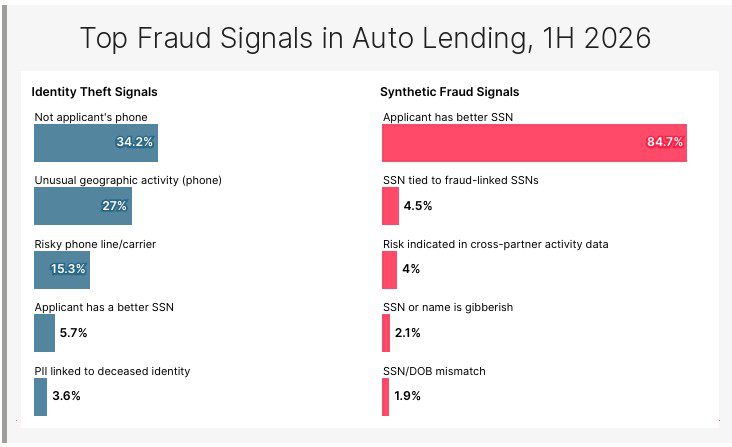
Synthetic fraud produced a different picture. An applicant having what SentiLink describes as a “better SSN” dominated the synthetic indicators at 84.7%.
Those are useful defenses when something about the identity has been manipulated.
First-party fraud creates the more uncomfortable problem.
Sometimes the identity isn’t the lie. The intention behind the loan is.
And if SentiLink’s first-half 2026 findings are indicative of the broader auto finance market, identifying that difference may increasingly require cooperation between the people approving the loans and the people who eventually have to collect them.
Read The Sentilink Report Here!
When the Borrower Is the Fraudster – When the Borrower Is the Fraudster – When the Borrower Is the Fraudster
When the Borrower Is the Fraudster – Credit Union Collections – Credit Union Collectors – Lending – Fraud – Auto Loan – Dealer– Dealer – Straw Buyer – Delinquency



More Stories
When a Car Is Obtained Through Fraud, Is It Counted as Stolen?
Credit Union Employee Accused of Stealing from the Dead
Credit Union Promoted Employee Despite Fraud Warnings — Then Collapsed Under $3.5 Million in Losses
The New Normal? Auto Loan Delinquencies May Have Found Their Floor
When the Auto Loan Outlives the Car
Nearly One in Five American Families Fell Behind on Debt Payments