


Organized fraud rings aren’t beating the system with better technology, they’re exploiting weaknesses in underwriting, dealer oversight, and outdated reporting timelines.
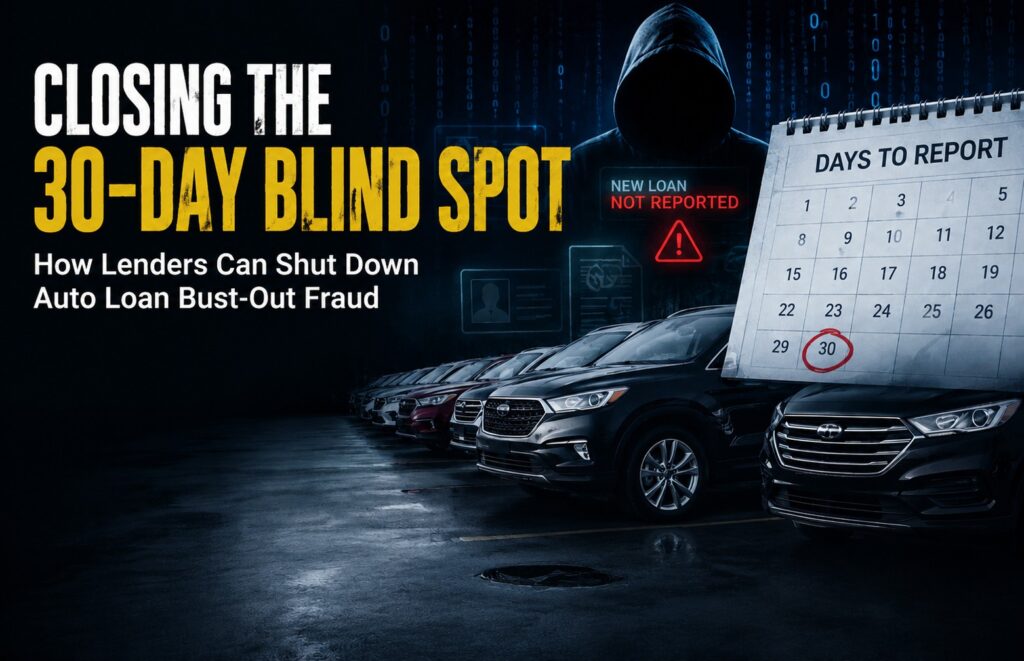
Closing the 30-Day Blind Spot: How Lenders Can Shut Down Auto Loan Bust-Out Fraud
There was a time when bust-out fraud meant a borrower intentionally maxing out every available line of credit before disappearing. Today’s version is far more organized, far more sophisticated, and costing lenders millions of dollars in vehicle losses.
The modern auto loan bust-out scheme doesn’t rely on one fraudulent loan. It relies on several.
Using stolen identities, synthetic identities, AI-generated employment documents, altered driver’s licenses, and increasingly convincing biometric deception, organized fraud rings obtain financing for multiple vehicles from multiple lenders before any of those new loans appear on a credit bureau. By the time the first lender realizes additional financing exists, the vehicles have often disappeared, been exported, dismantled, or otherwise become nearly impossible to recover.
The criminals certainly deserve the blame. But they aren’t exploiting some secret vulnerability hidden deep inside the financial system. They’re exploiting a weakness the industry has known about for years.

–
The 30-Day Blind Spot
Most lenders depend heavily on traditional credit bureau data when evaluating an application. The problem is timing.
Newly originated auto loans are not reported instantly. Depending on reporting cycles, there may be several weeks before a financed vehicle appears on a consumer’s credit file.
That delay creates a dangerous window.
During that period, the same identity may successfully obtain financing through multiple dealerships and multiple lenders, each relying on a bureau report that appears perfectly clean because none of the previous loans have yet been reported.
From the lender’s perspective, each transaction looks independent.
From the fraud ring’s perspective, it’s simply another stop on the day’s itinerary.
–
Technology Has Changed. So Has Fraud.
Artificial intelligence has dramatically lowered the barrier for organized financial crime.
Fraudsters can now generate convincing pay stubs, W-2s, bank statements, employment verification letters, utility bills, and identification documents in minutes. Deepfake technology and sophisticated identity theft techniques have made remote verification increasingly difficult, especially for lenders that continue relying on static document reviews.
What once required an experienced document forger can now be produced with readily available software.
The result is an industrialized fraud process capable of targeting dozens of lenders simultaneously.
–
The Real Weakness Isn’t the Fraudsters
The uncomfortable truth is that organized fraud succeeds because underwriting practices have not evolved as quickly as the criminals.
Most lenders still make credit decisions assuming the bureau file represents the applicant’s complete financial picture.
Increasingly, it doesn’t.
The absence of newly originated debt is no longer evidence that the debt doesn’t exist. It may simply mean the reporting cycle hasn’t caught up.
That distinction matters.
–
Six Steps Lenders Can Take Today
While no fraud prevention strategy is perfect, lenders can significantly reduce their exposure by focusing on the gaps organized fraud rings routinely exploit.
1. Look Beyond Traditional Bureau Data
Credit reports should no longer be viewed as a complete picture of a borrower’s current obligations.
Multiple recent automotive credit inquiries within a short period deserve additional scrutiny, even when the bureau itself shows little outstanding debt. A clean report accompanied by numerous recent inquiries may indicate a borrower shopping for financing, or it may signal an organized bust-out operation.
–
2. Slow Down High-Risk Applications
Bust-out fraud depends on speed.
Fraud rings attempt to finance as many vehicles as possible before new loans become visible to other lenders. Introducing manual reviews for applications displaying elevated fraud indicators, even if only for 24 to 48 hours, can disrupt the timeline that these schemes rely upon.
Legitimate borrowers rarely object to a brief verification process.
Professional fraudsters usually do.
–
3. Hold Dealers Accountable
Dealership performance should be measured by more than sales volume.
Lenders already monitor early payment defaults and portfolio performance. Adding fraud-related metrics such as identity theft frequency, first-payment fraud, document inconsistencies, and repeated involvement in confirmed fraud investigations can reveal patterns long before losses become significant.
A dealership generating unusually high fraud losses deserves the same attention as one producing excessive charge-offs.
–
4. Modernize Identity Verification
A driver’s license and a selfie are no longer enough.
Modern verification should combine document authentication, biometric matching, device intelligence, behavioral analytics, IP analysis, and fraud consortium databases to build a more complete picture of applicant legitimacy.
No single technology is foolproof.
Layered verification remains the strongest defense.
–
5. Share Fraud Intelligence Faster
Fraud rings collaborate.
Financial institutions often don’t.
Lenders should actively participate in fraud consortiums and intelligence-sharing initiatives that allow confirmed fraudulent identities, devices, employers, addresses, and behavioral patterns to be identified before they spread throughout the industry.
Every lender operating in isolation increases risk for everyone else.
–
6. Analyze Portfolios for Patterns
Bust-out fraud is often difficult to recognize one loan at a time.
Viewed across an entire portfolio, however, patterns emerge.
Multiple loans tied to the same employer, phone number, mailing address, dealership group, transportation company, shipping destination, or geographic region may reveal organized activity that individual underwriters could never identify during the origination process.
Portfolio analytics have become as important as front-end underwriting.
–
Prevention Costs Less Than Recovery
Once multiple vehicles have been financed, titled, and removed from the market, recovery options become limited.
Some vehicles are exported.
Others are dismantled.
Many simply disappear into organized trafficking networks.
At that point, collections and repossession professionals are left attempting to recover collateral that may no longer exist.
The best repossession is the one that never becomes necessary.
–
The Bottom Line
Organized bust-out fraud isn’t succeeding because criminals have discovered some previously unknown loophole.
It’s succeeding because underwriting assumptions haven’t kept pace with how quickly fraud has evolved.
The industry’s greatest vulnerability isn’t the reporting delay itself.
It’s continuing to treat a 30-day-old snapshot of a borrower’s financial obligations as though it represents today’s reality.
As artificial intelligence, synthetic identities, and organized fraud networks continue advancing, lenders will need to shift from simply verifying documents to validating entire financial narratives.
Those that do will significantly reduce fraud losses.
Those that don’t may continue discovering the problem only after the vehicles, and the borrowers, are long gone.
Closing the 30-Day Blind Spot: How Lenders Can Shut Down Auto Loan Bust-Out Fraud – Closing the 30-Day Blind Spot: How Lenders Can Shut Down Auto Loan Bust-Out Fraud – Closing the 30-Day Blind Spot: How Lenders Can Shut Down Auto Loan Bust-Out Fraud
Closing the 30-Day Blind Spot: How Lenders Can Shut Down Auto Loan Bust-Out Fraud – Credit Union Collections – Credit Union Collectors – Lending – Fraud – Fraud – Auto Loan –







More Stories
Credit Union Employee Accused of Stealing from the Dead
Credit Union Promoted Employee Despite Fraud Warnings — Then Collapsed Under $3.5 Million in Losses
The New Normal? Auto Loan Delinquencies May Have Found Their Floor
When the Auto Loan Outlives the Car
Nearly One in Five American Families Fell Behind on Debt Payments
The Weak Links: One Loan, Many Points of Attack