



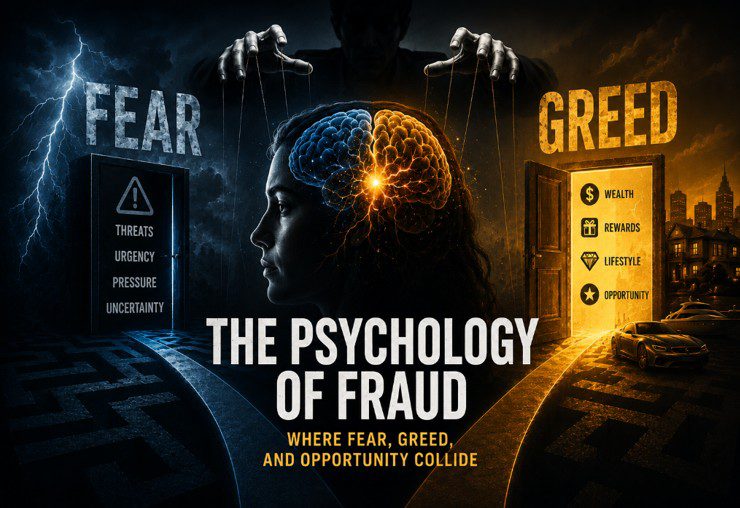
Understanding how fear, greed, stress, and cognitive shortcuts create the perfect conditions for fraud—and why anyone can become a victim.
=
EDITORIAL
Every fraud scheme, whether it involves a stolen identity, a romance scam, a fake investment opportunity, or a fraudulent loan application, ultimately relies on the same two human emotions: fear and greed. Fraudsters understand something that many financial institutions overlook; they are not attacking computers, accounts, or security systems. They are attacking the human brain.
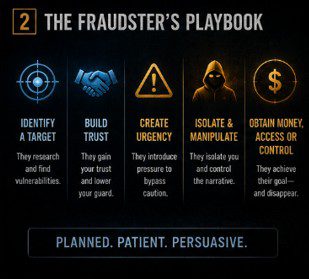
The most successful criminals are often amateur psychologists. They understand how people make decisions under stress, how urgency overrides logic, and how emotion can temporarily silence reason.

In many cases, the victim and the perpetrator are engaged in a psychological dance where both parties are driven by powerful emotional rewards.
The Triggers
When most people think about fraud, they picture stolen passwords, forged checks, hacked accounts, or elaborate cybercrime schemes.
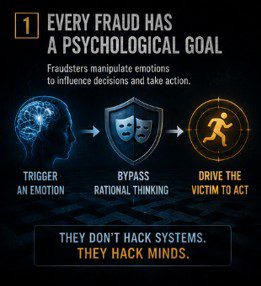
In reality, the most important tool in a fraudster’s arsenal is neither technology nor deception. It is psychology.
Every successful fraud depends upon influencing human behavior. Whether the target is a retired credit union member, a young borrower, a business owner, or a financial institution employee, the fraudster’s goal is always the same: trigger an emotional response powerful enough to bypass rational thinking.
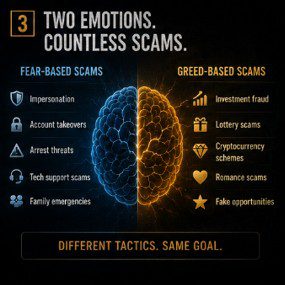
At its core, almost every fraud scheme is built upon one of two emotional foundations: fear or greed.
The Fear Response
Fear-based fraud is perhaps the most effective form of manipulation because it targets one of humanity’s oldest survival mechanisms.
When a person perceives danger, the brain’s amygdala immediately activates the fight-or-flight response. Adrenaline increases. Heart rate rises. Attention narrows. The body prepares for action.
From an evolutionary perspective, this response helped humans survive predators and physical threats.
Unfortunately, it also makes people vulnerable to modern fraud.
The victim receives a phone call claiming their account has been compromised. A text message warns that their identity has been stolen. An email threatens legal action, arrest, foreclosure, or account closure.
The fraudster creates urgency because urgency suppresses critical thinking.
Under stress, the brain shifts away from deliberate analysis and toward immediate action. The victim is no longer asking, “Does this make sense?” They are asking, “How do I make this problem go away?”
This phenomenon has recently been commonly referred to as an “amygdala hijack.” Rational thought is not eliminated, but it becomes temporarily subordinate to emotion.
The victim is not behaving irrationally because they are unintelligent.
They are behaving exactly as the human brain was designed to behave under perceived threat.
The Greed Response
While fear pushes people away from danger, greed pulls them toward opportunity.
Greed-based fraud exploits the human desire for gain, advantage, status, or financial security.

Lottery scams, cryptocurrency schemes, investment frauds, fake inheritances, romance scams, and fraudulent business opportunities all rely on the same principle: convincing the victim that a unique opportunity exists and that immediate action is required.
Interestingly, greed-based scams do not always target wealthy individuals.
Many victims are motivated not by greed in the traditional sense, but by hope.
The promise of paying off debt.
The opportunity to retire comfortably.
The chance to help family members.
The possibility of financial relief.
Fraudsters understand that hope and greed often occupy the same psychological territory.
The victim sees a solution to a problem they desperately want solved.
Just as fear narrows attention, so does opportunity.
The victim begins focusing on potential rewards while ignoring warning signs.
The Fraudster’s Psychology
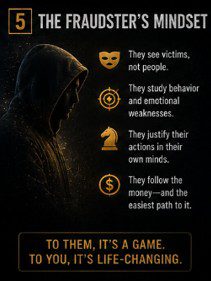
Contrary to popular belief, many fraudsters are not criminal masterminds. What they often possess is an intuitive understanding of human behavior.
Successful fraudsters become experts at identifying emotional vulnerabilities.
They study trust.
They study authority.
They study social pressure.
They study human needs.
Many display traits associated with manipulation, narcissism, or psychopathy. Others view fraud as a business transaction and emotionally distance themselves from the harm they cause.
Some justify their actions by believing large institutions can absorb the losses.
Others convince themselves that victims are responsible for their own mistakes.
The common thread is the ability to separate their actions from the emotional consequences experienced by the victim.
The Meeting Point
The most dangerous moment in any fraud occurs when the emotional needs of the victim intersect with the emotional objectives of the fraudster.
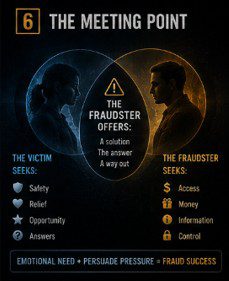
The fraudster wants compliance. >The victim wants relief.
The fraudster wants money. > The victim wants safety.
The fraudster wants access. > The victim wants certainty.
At that intersection, both parties are pursuing what they perceive to be a solution.
The fraudster offers a way out of fear or a path toward reward.
The victim embraces that solution because it appears to satisfy an urgent emotional need.
This is where fraud succeeds.
Not because the victim lacks intelligence. Not because the victim failed to read a warning brochure.
But because the fraudster successfully manipulated the very cognitive shortcuts that every human being relies upon daily.
Why Intelligent People Become Victims
One of the greatest misconceptions about fraud is that victims are careless, gullible, or uninformed.
Research consistently shows otherwise.
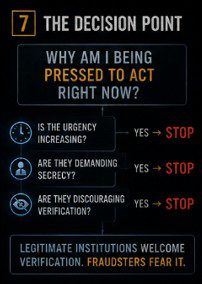
Doctors, attorneys, executives, accountants, bankers, law enforcement officers, and technology professionals have all fallen victim to sophisticated scams.
Knowledge alone is not immunity.
In fact, confidence can sometimes create vulnerability. People often assume they would recognize a scam, which reduces their vigilance when faced with a novel approach.
The reality is uncomfortable but important: Anyone can become a victim under the right circumstances.
A recent death in the family.
Financial stress.
Fear of legal consequences.
Loneliness.
A sudden opportunity.
Emotional vulnerability is universal.
The Future of Fraud
Artificial intelligence is making fraud more convincing than ever. Voice cloning can imitate family members. Deepfake videos can mimic trusted authorities.
Automated systems can personalize scams at a scale never before possible.
Yet despite these technological advances, the underlying formula remains unchanged.
Fraud still relies on fear.
Fraud still relies on greed.
Fraud still relies on manipulating human emotions faster than rational thought can respond.
Technology may evolve, but human psychology remains remarkably consistent.
That is why the future of fraud prevention will depend as much on understanding the human mind as it does on developing new security tools.
Because in the end, fraud is not primarily a technology problem, it is a human problem.
–
Kevin Armstrong
Publisher
The Psychology of Fraud: Where Fear, Greed, and Opportunity Collide – The Psychology of Fraud: Where Fear, Greed, and Opportunity Collide – The Psychology of Fraud: Where Fear, Greed, and Opportunity Collide
The Psychology of Fraud: Where Fear, Greed, and Opportunity Collide – Fraud – Fraud – Auto Loan – Lending – Credit Union Collections – Credit Union Collectors







More Stories
The Weak Links: One Loan, Many Points of Attack
Join Us at UCC 2027 – Credit Union Attendees Receive $200 Off
STUPID STUFF FRAUDSTERS BUY: The Gold-Plated Cybertruck
CEO Pleads Guilty to Embezzling Millions from Credit Union
Two Men. Two Stolen Identities. One Greenwich Dealership.
The Seasonal Loan Delinquency Reprieve May Be Ending