



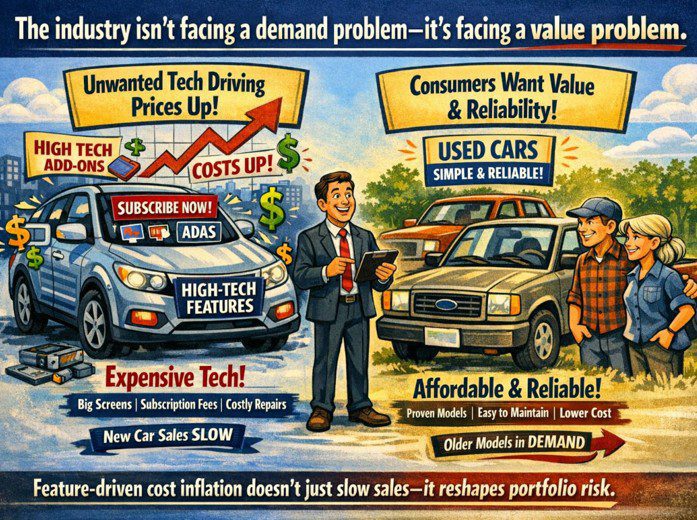
We built vehicles consumers can’t afford –> and then wondered why demand shifted.
–
Some of the biggest drivers of vehicle price inflation aren’t Powertrains or Materials…
they’re Technologies consumers never asked for. Oversized screens. Subscription-ready software. Layered driver assist packages. FEATURE CREEP in every trim.
All of it adds cost. Little of it improves affordability.
Meanwhile, the Tech consumers DO care about: Comfort, Reliability, Operating Cost, & in the EV world: Range and Charging Consistency… is still uneven in a market already reacting to affordability pressure.
Recent ICE (Internal Combustion Engine) Side Facts That Prove the Point:
- Average ICE transaction prices continue rising even as incentives increase… meaning MSRP inflation is becoming structural, not purely demand-driven.
- Toyota, Honda, & Ford all cited higher production costs tied partly to electronics, sensors, & infotainment systems now standard on lower trims.
- JD Power reported rising consumer frustration tied to touchscreen-only controls replacing physical buttons.
- Multiple OEMs have reduced or eliminated lower-cost trims, forcing buyers into tech-heavy mid & upper packages.
- Used vehicle demand for 5–10yr old ICE models has surged, specifically because they offer simpler tech, lower repair costs, & more predictable ownership.
- Insurance premiums have climbed for vehicles w/ advanced driver assist systems because repairs are more expensive.
This is the opposite of the old ICE playbook, where OEMs built trims around Comfort, Reliability & Affordability. Think of the old Ford Texas/Oklahoma packages… value-oriented trims built off basic truck configurations. Buyers could get towing capability, durability, practical upgrades, & comfort w/out being pushed into luxury packages or unnecessary tech.
They sold because they aligned with market priorities.
Recent OEM Financial Signals (EV + ICE)
- Ford’s Model e division posted multi-billion-dollar losses, prompting slower EV investment.
- GM delayed several EV launches & scaled back production citing cost pressure & slower adoption.
- Stellantis reported margin pressure on both ICE and EV models tied to rising tech & compliance costs.
- Tesla cut prices multiple times, compressing margins & signaling affordability strain even in the EV-first segment.
- Multiple OEMs reported higher-than-expected Warranty & Repair costs tied to electronics & sensor-based systems.
These aren’t isolated events… they’re symptoms of the same structural issue:
Feature-driven cost inflation is outpacing consumer value.
When product mixes become too expensive, volume softens, incentives rise, & residual risk increases. That pressure eventually hits credit performance & portfolios.
We built vehicles consumers can’t afford –> and then wondered why demand shifted.

Consumers responded rationally: shifting demand into Used inventory.
When New car pricing is driven more by features than fundamentals, affordability breaks… and the cycle bends.
–

–
Servicing Solutions – VP, Loss Mitigation | Auto, Lease & Powersport Finance | Risk & Recovery Strategy | LGD, Remarketing & Portfolio Performance
–
Related:
Why Powersports Is the Early Warning Signal for Auto (Right Now) – Ahead of the Curve — Part 4
Servicing Is Eating Originations – Ahead of the Curve Part 3
Ahead of the Curve — Part 2 – Residual Risk Is the New Credit Risk
Ahead of the Curve: Part 1 – Payment Elasticity is the Real Constraint
The Auto Industry Isn’t Facing a Demand Problem, It’s Facing a Value Problem – The Auto Industry Isn’t Facing a Demand Problem, It’s Facing a Value Problem – The Auto Industry Isn’t Facing a Demand Problem, It’s Facing a Value Problem
The Auto Industry Isn’t Facing a Demand Problem, It’s Facing a Value Problem – Delinquency – Bankruptcy – Lending – Auto Loan – Credit Union Collections – Credit Union Collectors – Repossession – Repossess – Repossession – Remarketing






More Stories
The New Normal? Auto Loan Delinquencies May Have Found Their Floor
When the Auto Loan Outlives the Car
Nearly One in Five American Families Fell Behind on Debt Payments
STUPID STUFF FRAUDSTERS BUY: Gotta Fraud ’Em All!
Two Men. Two Stolen Identities. One Greenwich Dealership.
The Risk Didn’t Leave Auto Finance, It Changed Hands